Colour is the first thing anyone notices about an awning, and it changes the light underneath. For premises in Kirkwall we choose fabric with the interior and the stock in mind.
It helps if you can be there when we visit Kirkwall, since five minutes walking the frontage together answers more than a long email.
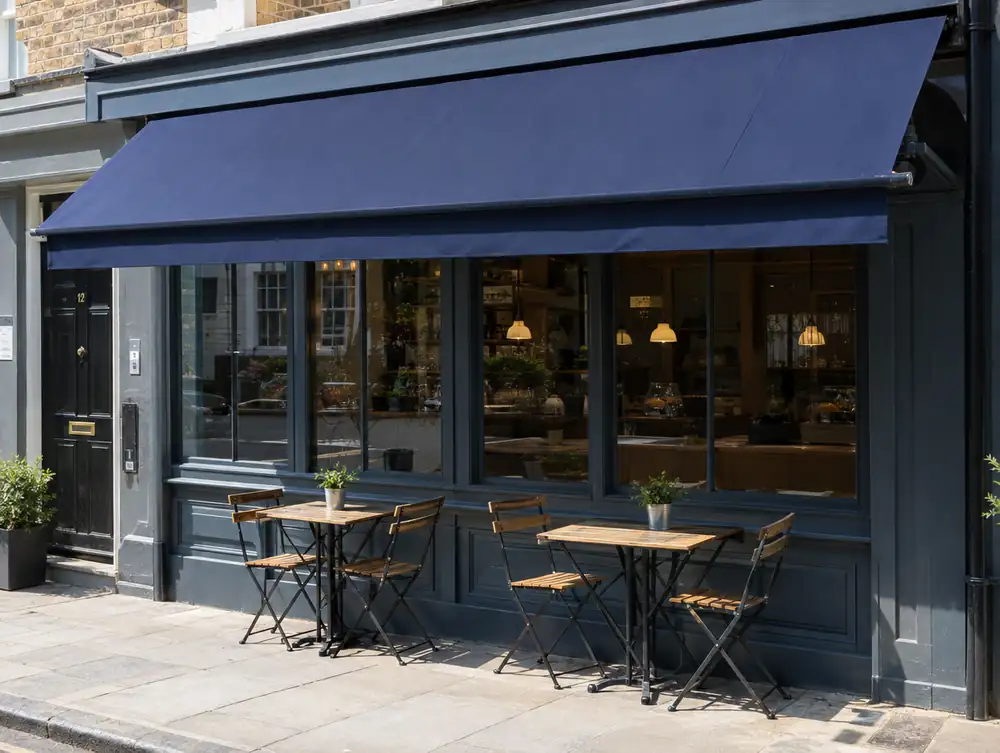
How do you design around the building when planning canopies and awnings in Kirkwall?
Should your frontage still have an old blind box, we open it up at survey. A sound box can take a new roller and cover, and it keeps a detail worth having.
Where the pavement is narrow, a long arm will reach too far, so we would look at a shorter projection or a drop-arm blind. Headroom and the kerb line are measured before we suggest a size.
If there are storeys above the shop, the frontage should feel like the base of the building and not a sign stuck on it. Lining up mullions with the windows overhead is a small move that settles the whole elevation at Kirkwall premises.
What might canopies and awnings cost in Kirkwall?
Allow £1,495 to £9,995 plus VAT per canopy or awning. Size and specification set most of that figure for canopies and awnings, and the rest depends on what the survey finds on site.
What permissions should you check for canopies and awnings in Kirkwall?
Class 9A, Scotland's shop permitted development right, gives no route for a shopfront change. It covers Class 1A premises, but not work that alters or extends beyond the existing front, and it doesn't apply in conservation areas, National Parks or World Heritage Sites. For canopies and awnings at premises in the Kirkwall area, that generally means a planning application unless the external appearance isn't materially affected.
Signs in Scotland come under the 1984 Advertisement Regulations, which have their own class numbers. At premises in the Kirkwall area, an unlit fascia sign generally needs no application under Class IV(1) of Schedule 4 if it sits on a wall containing a shop window, tops out at 4.6m or first-floor level, and keeps letters to 0.75m high. Anything beyond that needs advertisement consent, and displaying a sign without consent is a criminal offence.
Expect planning and advert applications here to go to Orkney Islands Council in the normal way. We check what that means for your building when we survey it in Kirkwall.
Do you cover Kirkwall?
We can take on work in Kirkwall, with the survey arranged directly with you once we understand the job. Travel and access appear as their own lines on the quotation, apart from the cost of the frontage.
| Town | Kirkwall |
|---|---|
| Area | Scottish Islands |
| Postcode districts | KW15 |
| Planning authority | Orkney Islands Council |
| Building approval | Building warrant (Technical Handbook) |
| Survey | By arrangement |
Questions about canopies and awnings in Kirkwall
Can an awning in Kirkwall be motorised?
Yes, most can. A tubular motor sits inside the roller, with a remote or wall switch, and a wind sensor can be added. You will need a power supply near the box, which we check at survey.
Which awning suits a cafe in Kirkwall?
A folding arm awning with a motor usually suits a cafe, because it covers a wide area with no posts. If tables sit close to the kerb or the site is windy, a shorter projection or fixed canopy may suit better.
Will an awning hide the sign on my Kirkwall premises?
It should not, if it is designed properly. We place the box and valance so the name reads with the cover out, or we add lettering to the valance.
Do I need listed building consent for a shopfront in the Kirkwall area?
Almost certainly, if the building is listed and windows or doors are changing, according to Historic Environment Scotland. The planning authority decides, and Historic Environment Scotland is consulted on some applications. Scottish Ministers are notified if it objects.
Do I need a building warrant for a shopfront in the Kirkwall area?
Usually yes in Scotland, if the work alters a wall or structure. Schedule 3 of the Building (Scotland) Regulations 2004 lists some work that needs no warrant, such as replacing a door or window with its frame, but the standards still apply. Shopfronts aren't named there, so ask the council before relying on it.