From measured survey to handover, awnings and canopies across Larne and County Antrim sit under one contract, alongside any sign or shopfront work on the same frontage. Your named contact treats the fabric, the frame and the fixing as one job.
Measuring the opening is the easy part of a survey in Larne. We also look at the beam above, the pavement fall and any meters or drains nearby.
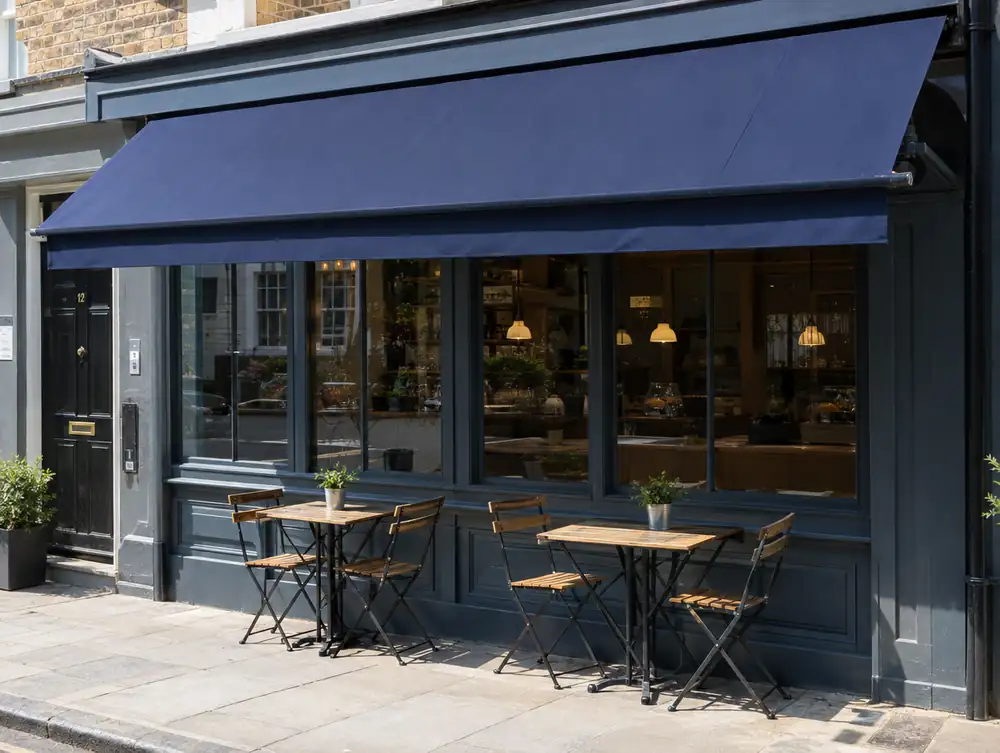
Where should you begin with canopies and awnings in Larne?
If the wall is rendered or cavity-built, we check what lies behind it before designing brackets. Long anchors or a spreader plate can take the load where a standard fixing would pull out.
Should your frontage still have an old blind box, we open it up at survey. A sound box can take a new roller and cover, and it keeps a detail worth having.
If your premises were once two shops, decide early whether the front should read as one or as two. One continuous fascia with a repeated bay width usually settles the elevation better than two mismatched halves, which is worth testing on any Larne unit of that kind.
What sign-off might you need for canopies and awnings in Larne?
Shutters in Northern Ireland are treated like the rest of the frontage: as no permitted development route appears to exist, they usually fall to the appearance test. Building work that materially affects the external appearance needs planning permission, for canopies and awnings at premises in the Larne area as for anything else on the frontage, while a true like-for-like usually doesn't. Ask the council where a particular job stands.
Class 4(2) is the class for lit signs in Northern Ireland, because Class 5 can't be lit. For premises in the Larne area, it generally means halo or character-only lighting, static, with the lowest part at least 2.5m up. Brightness limits of 1,000, 800, 600 and 400 candela apply by area, and the council can confirm whether the Regulations have changed since they were made in 2015.
At survey we check how things stand for your building, although applications for planning permission or advertisement consent here normally go to Mid and East Antrim Borough Council.
What price should you expect for canopies and awnings in Larne?
The guide for canopies and awnings is £1,495 to £9,995 plus VAT per canopy or awning. Expect the lower end for simple work with clear access, and the upper end where detail, finish or awkward conditions add hours.
| Town | Larne |
|---|---|
| Area | County Antrim |
| Postcode districts | BT40 |
| Planning authority | Mid and East Antrim Borough Council |
| Building approval | Building Control (Technical Booklets) |
| Survey | Free for new work |
Questions about canopies and awnings in Larne
Can the awning match other premises I run in County Antrim?
Yes. Send a photograph and any fabric reference, and we match the cloth, valance and lettering as closely as current ranges allow. Fabric lines change over time, so we show you a sample first.
Which awning suits a cafe in Larne?
A folding arm awning with a motor usually suits a cafe, because it covers a wide area with no posts. If tables sit close to the kerb or the site is windy, a shorter projection or fixed canopy may suit better.
Can an awning in Larne be motorised?
Yes, most can. A tubular motor sits inside the roller, with a remote or wall switch, and a wind sensor can be added. You will need a power supply near the box, which we check at survey.
Do I need planning permission to change a shopfront in the Larne area?
Usually yes, when the work materially affects the external appearance. Northern Ireland's 2015 Order appears to offer no permitted development route for a shopfront. The council confirms the position, and a true like-for-like replacement usually needs no application.
What building approval does a shopfront in the Larne area need?
Usually a full plans application to Building Control in Northern Ireland, because building notices are for single dwellings. The Technical Booklets set the detail, with Booklet V for glass and Booklet R for access. Only dwelling windows and doors are exempt, so ask Building Control before assuming a like-for-like job falls outside the rules.