A well-chosen awning gives Milton Keynes premises shade, shelter and a stronger presence, then folds away when the weather turns. Projection, headroom and fixings are settled before anyone chooses a fabric.
Surveys for Milton Keynes are booked with you directly. Tell us your quieter days and we'll work around them.
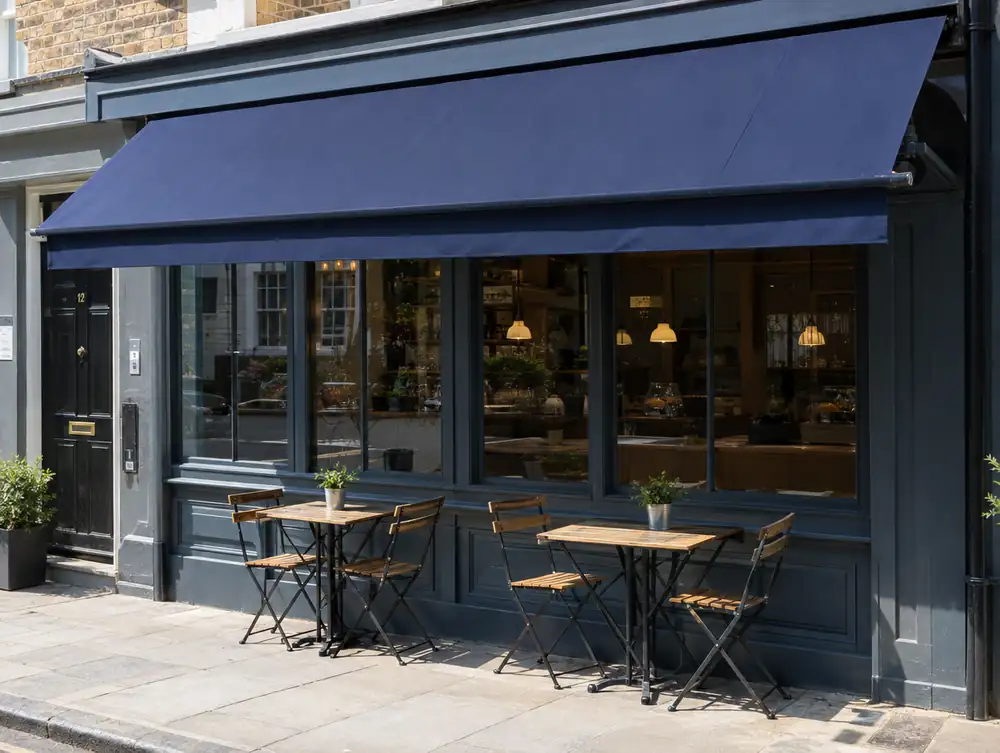
How do you design around the building when planning canopies and awnings in Milton Keynes?
Where the pavement is narrow, a long arm will reach too far, so we would look at a shorter projection or a drop-arm blind. Headroom and the kerb line are measured before we suggest a size.
If your Milton Keynes frontage faces south or west, we size the projection for the afternoon sun. A north-facing unit rarely needs shade, so a fixed canopy for shelter may be a wiser use of the budget.
If your premises were once two shops, decide early whether the front should read as one or as two. One continuous fascia with a repeated bay width usually settles the elevation better than two mismatched halves, which is worth testing on any Milton Keynes unit of that kind.
What permissions should you check for canopies and awnings in Milton Keynes?
England has no permitted development route for changing a shopfront. Part 7 Class A of the General Permitted Development Order 2015 excludes creating, altering or replacing one, and it allows no alterations at all on article 2(3) land. That leaves two outcomes for canopies and awnings at premises in the Milton Keynes area: a planning application, or work that doesn't materially affect the external appearance.
Class 4B, England's class for lit signs, isn't available in conservation areas, Areas of Outstanding Natural Beauty, National Parks or the Broads, so a lit sign there normally needs advertisement consent. In an area of special control it is unavailable too, and Class 5 drops to a 3.6m top height, 0.3m letters and one-tenth of the building face up to 3.6m. Ask the council which designations cover premises in the Milton Keynes area.
Milton Keynes applications for planning permission or advertisement consent are normally handled by Milton Keynes Council. Our survey includes a check of the position for your address.
What might canopies and awnings cost in Milton Keynes?
Until the survey is done, plan on £1,495 to £9,995 plus VAT per canopy or awning. Unusual sizes, fine detail and phased working push the figure up, while a simple brief and clear access keep it toward the lower end.
| Town | Milton Keynes |
|---|---|
| Area | Buckinghamshire |
| Postcode districts | MK13, MK14, MK6, MK9 |
| Planning authority | Milton Keynes Council |
| Building approval | Building Regulations (Approved Documents) |
| Distance from Great Barr | About 60 miles |
| Survey | Free for new work |
Questions about canopies and awnings in Milton Keynes
How long will an awning last on Milton Keynes premises?
A good frame typically lasts 15 years or more, and acrylic canvas typically lasts 7 to 10 years. Regular cleaning and retracting in high wind make the biggest difference.
Which awning suits a cafe in Milton Keynes?
A folding arm awning with a motor usually suits a cafe, because it covers a wide area with no posts. If tables sit close to the kerb or the site is windy, a shorter projection or fixed canopy may suit better.
Will an awning hide the sign on my Milton Keynes premises?
It should not, if it is designed properly. We place the box and valance so the name reads with the cover out, or we add lettering to the valance.
Do I need listed building consent for a shopfront in the Milton Keynes area?
Usually yes, if the building is listed. In England the local planning authority decides, and Historic England is notified of Grade I and II* works and specified Grade II works. Like-for-like repair may not need consent, so ask the council before work starts.
Do I need planning permission to change a shopfront in the Milton Keynes area?
Usually yes, if the work materially affects the building's external appearance. England's shop permitted development rights exclude creating, altering or replacing a shopfront, so there is no shortcut. A true like-for-like replacement usually needs no application, and the council confirms the position.