People choose where to sit partly by what is overhead. Tables under a good awning in Newton Mearns can gain useful trading hours in spring and autumn.
A survey in Newton Mearns usually starts outside, looking at the whole elevation before any tape comes out, because the frontage has to answer the building above it.
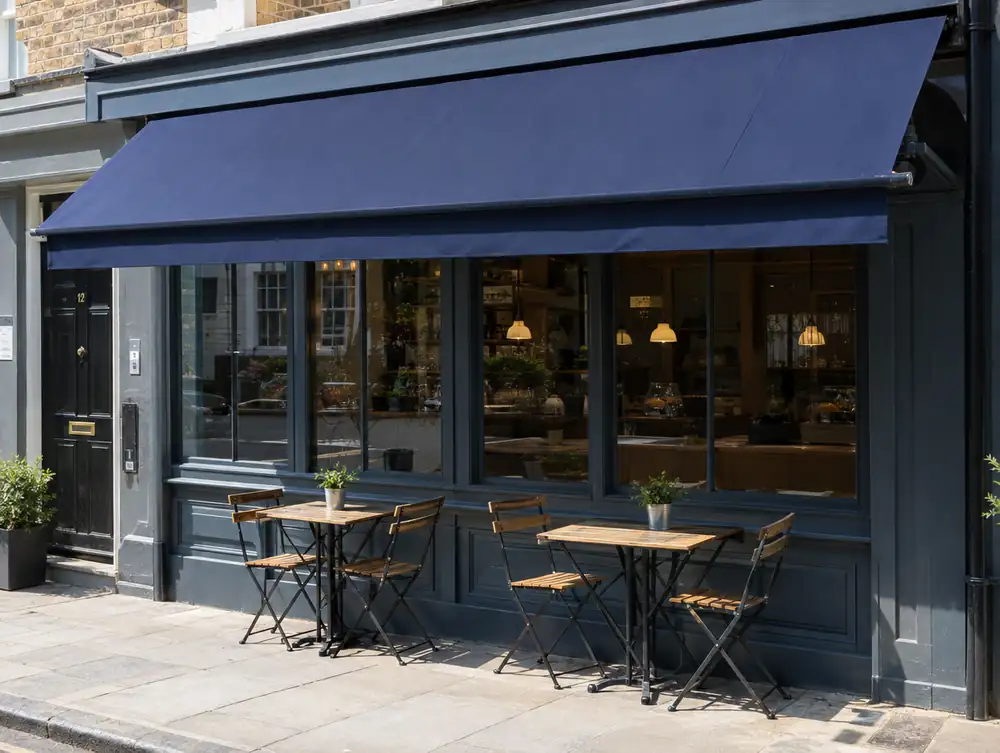
What goes into getting canopies and awnings right in Newton Mearns?
If you only need cover at the door, a small fixed canopy or Dutch canopy over the entrance may do the job at a fraction of the cost of a full-width awning. We would draw both, so you can compare them on your elevation.
If your Newton Mearns frontage faces south or west, we size the projection for the afternoon sun. A north-facing unit rarely needs shade, so a fixed canopy for shelter may be a wiser use of the budget.
Where units share one long run of fascia, breaking the height makes you stand out for the wrong reason. If that describes your Newton Mearns parade, keep the line and win attention with lettering, lighting and what's in the window.
How much could canopies and awnings in Newton Mearns cost you?
We would budget £1,495 to £9,995 plus VAT per canopy or awning. Scope sets most of the figure, so a clear brief at the start does more for the budget than any later change of detail.
Which applications might canopies and awnings in Newton Mearns involve?
Section 26 of the Town and Country Planning (Scotland) Act 1997 sets the test: work that doesn't materially affect the external appearance isn't development. For canopies and awnings at premises in the Newton Mearns area, anything that does needs planning permission, and a true like-for-like replacement usually doesn't. The council confirms how that applies to each site.
Signs in Scotland come under the 1984 Advertisement Regulations, which have their own class numbers. At premises in the Newton Mearns area, an unlit fascia sign generally needs no application under Class IV(1) of Schedule 4 if it sits on a wall containing a shop window, tops out at 4.6m or first-floor level, and keeps letters to 0.75m high. Anything beyond that needs advertisement consent, and displaying a sign without consent is a criminal offence.
For Newton Mearns, the usual route for planning and advert applications is through East Renfrewshire Council, and we confirm that when we visit.
| Town | Newton Mearns |
|---|---|
| Area | Glasgow and Clyde |
| Postcode districts | G77 |
| Planning authority | East Renfrewshire Council |
| Building approval | Building warrant (Technical Handbook) |
| Distance from Great Barr | About 243 miles |
| Survey | Free for new work |
Questions about canopies and awnings in Newton Mearns
How long will an awning last on Newton Mearns premises?
A good frame typically lasts 15 years or more, and acrylic canvas typically lasts 7 to 10 years. Regular cleaning and retracting in high wind make the biggest difference.
Can the awning match other premises I run in Glasgow and Clyde?
Yes. Send a photograph and any fabric reference, and we match the cloth, valance and lettering as closely as current ranges allow. Fabric lines change over time, so we show you a sample first.
Can an awning in Newton Mearns be motorised?
Yes, most can. A tubular motor sits inside the roller, with a remote or wall switch, and a wind sensor can be added. You will need a power supply near the box, which we check at survey.
Do I need listed building consent for a shopfront in the Newton Mearns area?
Almost certainly, if the building is listed and windows or doors are changing, according to Historic Environment Scotland. The planning authority decides, and Historic Environment Scotland is consulted on some applications. Scottish Ministers are notified if it objects.
Which way must a fire exit door open on a shop in the Newton Mearns area?
In the direction of escape. Regulation 13(2) of the Fire Safety (Scotland) Regulations 2006 also rules out sliding and revolving doors on a dedicated fire exit and says fire exit doors can't be locked against immediate use. Duties sit with dutyholders under Part 3 of the Fire (Scotland) Act 2005, meaning the employer and any person with control of the premises.