Colour is the first thing anyone notices about an awning, and it changes the light underneath. For premises in Peterborough we choose fabric with the interior and the stock in mind.
Surveys for Peterborough are booked with you directly. Tell us your quieter days and we'll work around them.
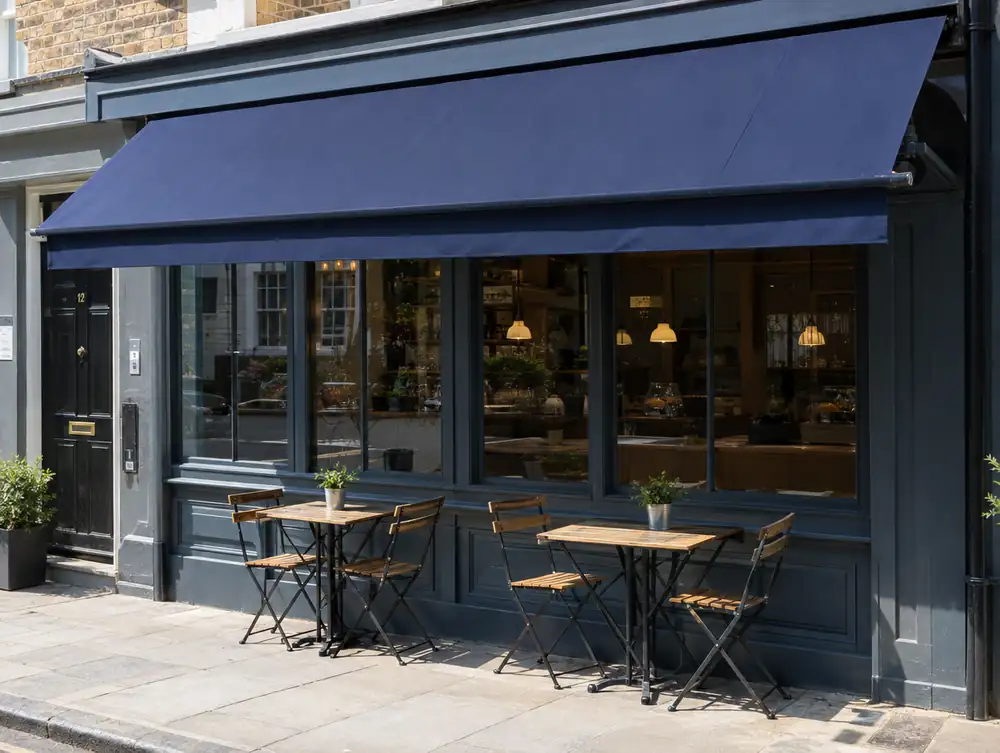
What makes canopies and awnings work well on Peterborough premises?
If you only need cover at the door, a small fixed canopy or Dutch canopy over the entrance may do the job at a fraction of the cost of a full-width awning. We would draw both, so you can compare them on your elevation.
If the wall is rendered or cavity-built, we check what lies behind it before designing brackets. Long anchors or a spreader plate can take the load where a standard fixing would pull out.
Where the footway outside your Peterborough premises is narrow, a recessed entrance earns its keep. It gives people a dry place to pause out of the walkway, and it adds a longer run of display glass either side of the door.
Could canopies and awnings in Peterborough need planning permission?
England has no permitted development route for changing a shopfront. Part 7 Class A of the General Permitted Development Order 2015 excludes creating, altering or replacing one, and it allows no alterations at all on article 2(3) land. That leaves two outcomes for canopies and awnings at premises in the Peterborough area: a planning application, or work that doesn't materially affect the external appearance.
Class 4B, England's class for lit signs, isn't available in conservation areas, Areas of Outstanding Natural Beauty, National Parks or the Broads, so a lit sign there normally needs advertisement consent. In an area of special control it is unavailable too, and Class 5 drops to a 3.6m top height, 0.3m letters and one-tenth of the building face up to 3.6m. Ask the council which designations cover premises in the Peterborough area.
At survey we check how things stand for your building, although applications for planning permission or advertisement consent here normally go to Peterborough City Council.
How much should you set aside for canopies and awnings in Peterborough?
Our guide band is £1,495 to £9,995 plus VAT per canopy or awning. Scope is the biggest lever, so a tighter brief for canopies and awnings brings the figure down faster than any change of detail.
| Town | Peterborough |
|---|---|
| Area | Cambridgeshire |
| Postcode districts | PE1, PE2, PE3, PE4 |
| Planning authority | Peterborough City Council |
| Building approval | Building Regulations (Approved Documents) |
| Distance from Great Barr | About 70 miles |
| Survey | Free for new work |
Questions about canopies and awnings in Peterborough
Can the awning match other premises I run in Cambridgeshire?
Yes. Send a photograph and any fabric reference, and we match the cloth, valance and lettering as closely as current ranges allow. Fabric lines change over time, so we show you a sample first.
Will an awning or canopy be measured before I get a price in Peterborough?
Yes. Every price comes from a measure-up, because wall construction and pavement width affect the design. You then receive an itemised quotation, valid for 90 days.
Do you replace awning fabric in Peterborough?
Yes, provided the frame is sound. We measure the frame, check the arms and roller, then make a new cover in your chosen canvas and colour.
What rules apply to a fire exit door through a shopfront in the Peterborough area?
It must open in the direction of escape and can't be locked against immediate use, and a dedicated fire exit can't be a sliding or revolving door. In England that comes from article 14(2) of the Regulatory Reform (Fire Safety) Order 2005, and the duty sits with the responsible person, normally the employer or whoever controls the premises for a business, otherwise the owner. An outward door can clash with section 153 of the Highways Act 1980 where it opens onto the footway, so raise it early.
Does the Equality Act apply to a shop entrance in the Peterborough area?
Yes. The Equality Act 2010 applies in England, as across Great Britain, and it requires reasonable steps to remove, alter or avoid physical features that disadvantage disabled people. The duty is anticipatory, so it looks at disabled people generally, and a new Services Code replaced the 2011 Code on 5 August 2026.