From a single-bay stair tower to a full frontage, we design and fit curtain walling for premises in Castlereagh and the surrounding parts of County Antrim. One contract covers the frame, the glass and the junction with the shopfront below.
We measure your Castlereagh opening in person, at a time agreed with you first, so the visit fits around your trading.
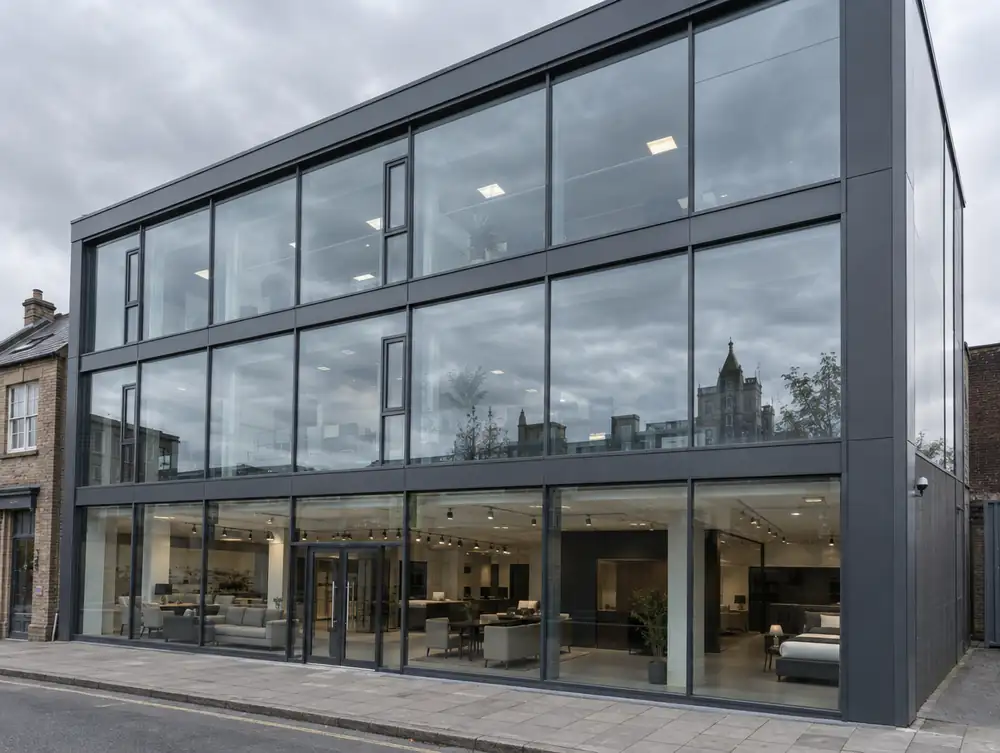
Where should you begin with curtain walling in Castlereagh?
Should the floors above stay occupied, the work can be phased bay by bay, with temporary weathering at the end of each shift. Tenants keep their rooms dry and the old elevation comes out in an order that suits the building.
Where the elevation faces south or west, solar control glass can do more for comfort than any blind. If it looks north, we would usually keep the glass clear and neutral, so the building does not turn dull on a grey day.
If the pavement falls across your frontage, let the stallriser take up the slope and keep the glass line dead level. The eye reads the long horizontal, so Castlereagh premises on a slope look settled once that line is true.
What sign-off might you need for curtain walling in Castlereagh?
Northern Ireland appears to have no permitted development route for a shopfront, as its 2015 Order mentions shops only in the Part 4 changes of use. For curtain walling at premises in the Castlereagh area, expect a planning application unless the external appearance isn't materially affected. Ask the council to confirm the position.
Expect planning and advert applications here to go to Belfast City Council in the normal way. We check what that means for your building when we survey it in Castlereagh.
What price should you expect for curtain walling in Castlereagh?
Allow £550 to £1,250 plus VAT per m². Size and specification set most of that figure for curtain walling, and the rest depends on what the survey finds on site.
| Town | Castlereagh |
|---|---|
| Area | County Antrim |
| Postcode districts | BT4, BT5, BT6, BT7 |
| Planning authority | Belfast City Council |
| Building approval | Building Control (Technical Booklets) |
| Survey | Free for new work |
Does Belfast City Council publish shopfront guidance?
Yes, Supplementary Planning Guidance: Advertising and Signage (2023). It deals with advertising and signage, not with shopfronts generally. A few of the things it asks for:
- Where an original fascia exists it should be used, with no advertising below fascia level or on pilasters or columns.
- Halo lighting of letters is preferred, and internally lit lightboxes should be avoided.
- Projecting signs should extend about 1m at most including fixings and sit at least 2.25m above ground.
Questions about curtain walling in Castlereagh
Is curtain walling right for a single-storey unit in Castlereagh?
Usually not. A well-designed aluminium shopfront will span most single-storey openings with slimmer sections and lower cost. Curtain walling starts to make sense once the glass runs past a floor edge or the opening is unusually tall.
Can you match the frames already on my Castlereagh building?
Usually, yes. Colour can be matched to a RAL reference or a sample, and cap profiles can be chosen to sit close to what is there. An exact match on an old system may not be possible, in which case we would suggest a deliberate change at a natural break.
What should I send before a survey of my Castlereagh premises?
The address, a few photographs and any existing drawings are enough to start. Tell us how the building is used and which floors stay occupied, because that shapes the access plan.
Do roller shutters need planning permission in the Castlereagh area?
Usually yes, when they materially affect the external appearance. No permitted development route for shutters appears in Northern Ireland's 2015 Order, so treat them as falling to the appearance test. Check with the council before ordering.
Does the Disability Discrimination Act apply to a shop entrance in the Castlereagh area?
Yes. The Disability Discrimination Act 1995 applies in Northern Ireland, and section 21 deals with physical features that make a service hard for disabled people to use. Regulations made in 2007 (SR 2007/473) add detail on features, third-party consent and design standards.