For a facade in Knaresborough, the grid matters more than any single pane. Mullions, transoms and spandrels are drawn together so the elevation reads as one composition from across the road.
We measure your Knaresborough opening in person, at a time agreed with you first, so the visit fits around your trading.
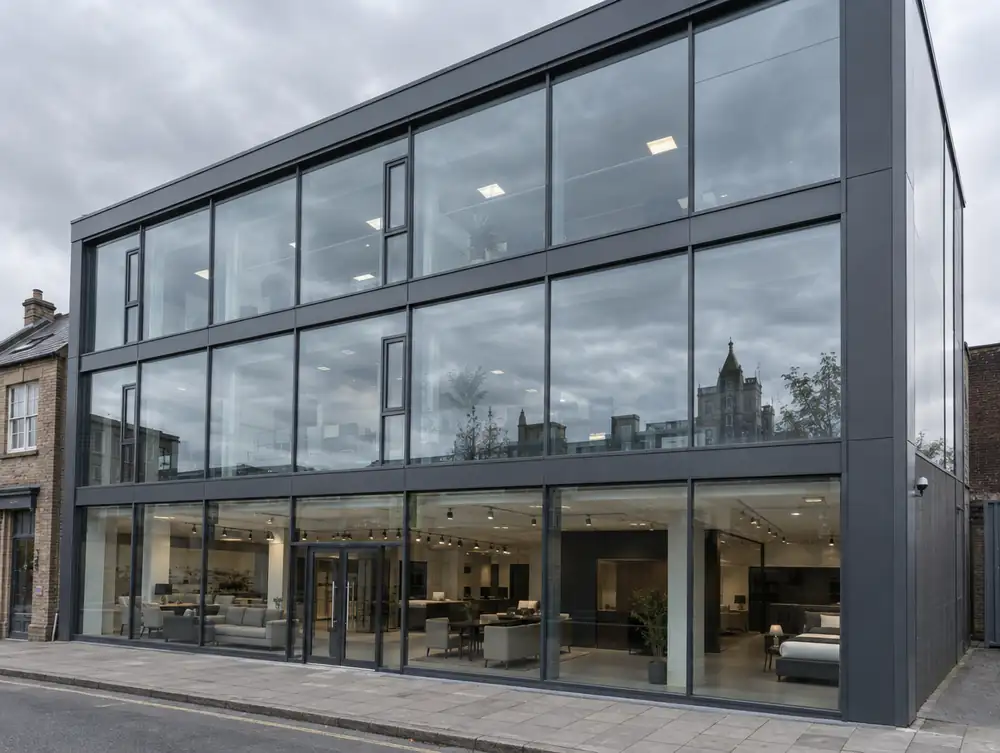
What makes curtain walling work well on Knaresborough premises?
If the ground floor of your Knaresborough premises is a shop, we carry the curtain wall grid down into the shopfront below. Door heads, fascia line and transoms then line up by design.
Where the elevation faces south or west, solar control glass can do more for comfort than any blind. If it looks north, we would usually keep the glass clear and neutral, so the building does not turn dull on a grey day.
A corner unit has two fronts to think about, and the return elevation often does as much selling as the main one. If that is your layout in Knaresborough, carry the fascia and glass line round the corner and treat both faces as one composition.
Could curtain walling in Knaresborough need planning permission?
Security grilles and shutters are named in England's rules: installing or replacing one on a shopfront sits outside the shop permitted development rights. The frontage itself is treated the same way, so for curtain walling at premises in the Knaresborough area, building work that materially affects the appearance needs planning permission. Confirm the position with the council before anything is ordered.
For Knaresborough, the usual route for planning and advert applications is through North Yorkshire Council, and we confirm that when we visit.
How much should you set aside for curtain walling in Knaresborough?
Allow £550 to £1,250 plus VAT per m². Size and specification set most of that figure for curtain walling, and the rest depends on what the survey finds on site.
| Town | Knaresborough |
|---|---|
| Area | North Yorkshire |
| Postcode districts | HG5 |
| Planning authority | North Yorkshire Council |
| Building approval | Building Regulations (Approved Documents) |
| Distance from Great Barr | About 103 miles |
| Survey | Free for new work |
Does Harrogate publish shopfront guidance?
Yes, Shopfronts Design Guide (2019). It covers the former Harrogate Borough Council area only, so it doesn't apply across the whole council area. A few of the things it asks for:
- The stallriser should not exceed 20% of the overall shopfront height, and timber ones should use frame and panel construction.
- The fascia should not exceed 10% of shopfront height, and the combined cornice, fascia and architrave should not exceed 20%.
- Lettering should be one-third to one-half of the fascia height, and no more than 375mm on modern over-deep fascias.
Questions about curtain walling in Knaresborough
Can you match the frames already on my Knaresborough building?
Usually, yes. Colour can be matched to a RAL reference or a sample, and cap profiles can be chosen to sit close to what is there. An exact match on an old system may not be possible, in which case we would suggest a deliberate change at a natural break.
Can you replace failing curtain walling on premises in Knaresborough?
Yes. We survey the frame, brackets and seals first, because some elevations only need new glass and gaskets. If the frame itself has failed, we draw a replacement that can be phased around the building's use.
Who do I deal with during a curtain walling job in Knaresborough?
You have one named contact from survey to handover. The contract is with S&K Glazing Limited, and vetted teams working under S&K Glazing carry out the work.
Does a shop sign in the Knaresborough area need advertisement consent?
Not always. In England, an unlit sign within Class 5 of the 2007 Advertisement Regulations generally needs no application, and neither does a lit sign within Class 4B. Anything outside those classes needs consent, and Class 4B isn't available in conservation areas, so check before ordering.
Does the Equality Act apply to a shop entrance in the Knaresborough area?
Yes. The Equality Act 2010 applies in England, as across Great Britain, and it requires reasonable steps to remove, alter or avoid physical features that disadvantage disabled people. The duty is anticipatory, so it looks at disabled people generally, and a new Services Code replaced the 2011 Code on 5 August 2026.