Built-up letters, flat-cut metal or hand-painted timber can each work on fascias in Bonnyrigg, depending on the frontage and the brand. A scale drawing of the sign on your elevation makes the choice easy to judge.
Nothing gets ordered off the back of a survey in Bonnyrigg, because its job is to give us the numbers to draw and price from.
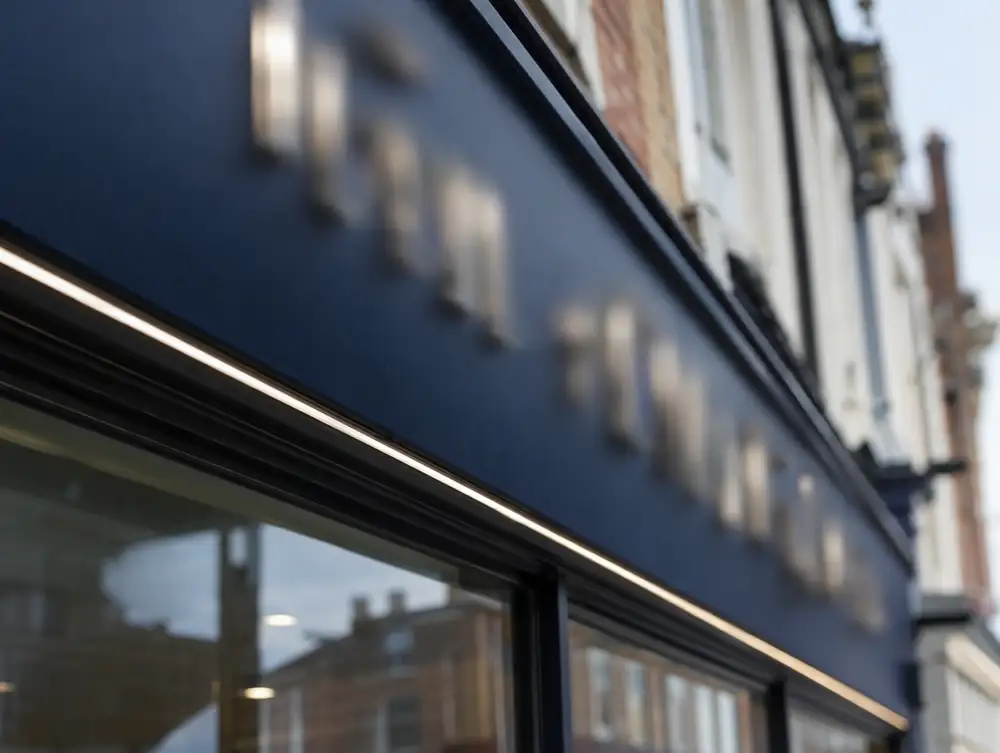
How would we approach fascia signage for your Bonnyrigg premises?
If the frontage faces south or west, we steer dark vinyl and printed panels away from direct sun, as they fade and move more. Painted or powder-coated metal will hold its colour for longer.
On a corner plot, the sign has to turn the corner cleanly. We set letter size and panel joints so the name reads from both streets, with the return falling at a natural break.
If your Bonnyrigg unit is narrow, a central door can split a small window into two weak ones. Moving the door to one side gives you a single confident pane, provided the layout inside still works.
What should you budget for fascia signage in Bonnyrigg?
Guide price: £395 to £1,995 plus VAT per sign. Materials, finish and the amount of drawing and coordination involved all move it, and your itemised quotation shows where the money goes on fascia signage.
What consents could affect fascia signage in Bonnyrigg?
Scottish guidance says like-for-like windows need no permission, and a true like-for-like frontage replacement usually follows the same logic. Class 7A covers altering or replacing an existing window, but it doesn't mention shopfronts, so ask before relying on it for a display window. For fascia signage at premises in the Bonnyrigg area, a material effect on the external appearance means planning permission, and the council confirms the position.
Class VI is the class for lit signs in Scotland, and it is tightly drawn: each character lit from within, the sign at least 2.5m up, no more than 0.25m of projection, and static lighting. One Scottish council says illuminated signs always need express consent, which doesn't match Class VI, so ask the council for the Bonnyrigg area before ordering.
Bonnyrigg applications for planning permission or advertisement consent are normally handled by Midlothian Council. Our survey includes a check of the position for your address.
| Town | Bonnyrigg |
|---|---|
| Area | Edinburgh and the Lothians |
| Postcode districts | EH18, EH19, EH22, EH24 |
| Planning authority | Midlothian Council |
| Building approval | Building warrant (Technical Handbook) |
| Distance from Great Barr | About 235 miles |
| Survey | Free for new work |
Questions about fascia signage in Bonnyrigg
Can a new fascia sign in Bonnyrigg be fitted on a closed day?
Yes, we can arrange that, or fit out of hours if that suits you better. Most fascia signs take about a day, so the work can often go into your quietest trading hours.
What if the fascia behind my old sign in Bonnyrigg is rotten?
We show you photographs and price the repair before going further. A short section of timber can often be spliced in, while a badly decayed fascia is better replaced with a new subframe.
Can a sign match my other sites in Edinburgh and the Lothians?
Yes. Send a photograph and the drawings or brand file from an existing site, and we match the letter style, finish and colour reference. Fascia depth may differ, so the size is adjusted to keep the proportions right.
Does the Equality Act cover a shop entrance in the Bonnyrigg area?
Yes. The Equality Act 2010 applies in Scotland as part of Great Britain, and its anticipatory duty expects reasonable steps to remove, alter or avoid physical features that disadvantage disabled people generally. BS 8300-2:2018 is the current British Standard for accessible buildings.
Which way must a fire exit door open on a shop in the Bonnyrigg area?
In the direction of escape. Regulation 13(2) of the Fire Safety (Scotland) Regulations 2006 also rules out sliding and revolving doors on a dedicated fire exit and says fire exit doors can't be locked against immediate use. Duties sit with dutyholders under Part 3 of the Fire (Scotland) Act 2005, meaning the employer and any person with control of the premises.