Built-up letters, flat-cut metal or hand-painted timber can each work on fascias in Monmouth, depending on the frontage and the brand. A scale drawing of the sign on your elevation makes the choice easy to judge.
It helps if you can be there when we visit Monmouth, since five minutes walking the frontage together answers more than a long email.
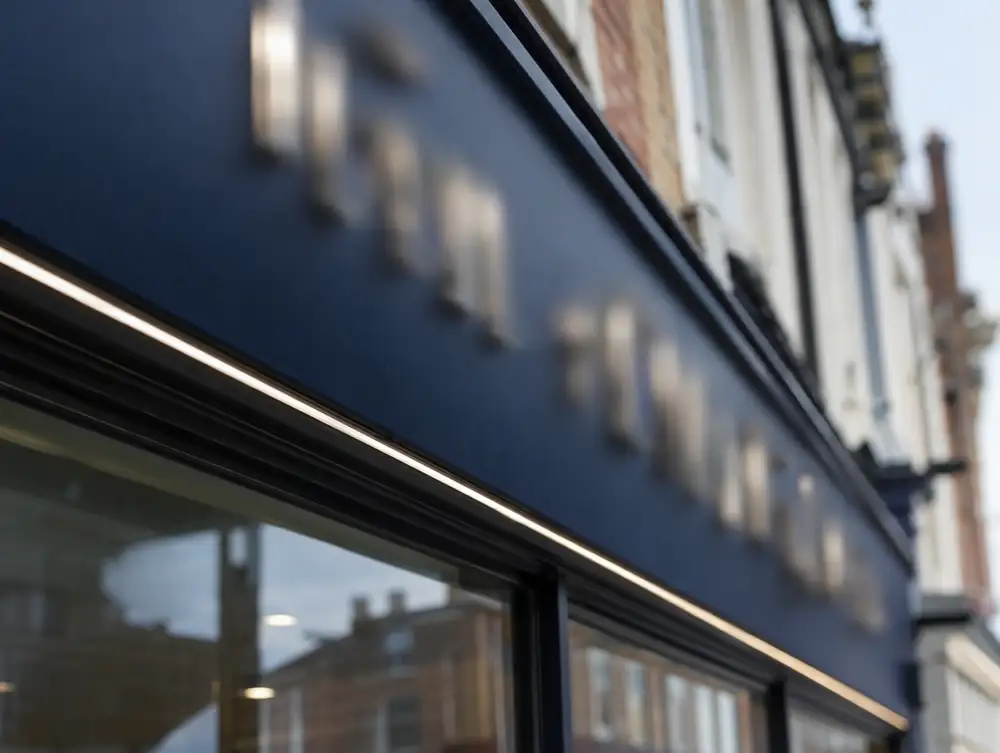
What should you think about before commissioning fascia signage in Monmouth?
On a corner plot, the sign has to turn the corner cleanly. We set letter size and panel joints so the name reads from both streets, with the return falling at a natural break.
If the frontage faces south or west, we steer dark vinyl and printed panels away from direct sun, as they fade and move more. Painted or powder-coated metal will hold its colour for longer.
On a north-facing frontage the glass stays free of glare, but the interior can look dim from the street, so lighting needs to sit closer to the window. If your Monmouth premises face south, the problem flips to reflections by day and fading stock.
Who approves fascia signage in Monmouth?
Going by Part 42 of the 1995 Order as inserted in 2014, Wales has no permitted development route for changing a shopfront. The right covers A1 and A2 premises, but it excludes creating, altering or replacing a shopfront, or fitting or replacing a security grill or shutter on one, and it doesn't apply on Article 1(5) land. For fascia signage at premises in the Monmouth area, that leaves a planning application, or work that leaves the appearance materially unchanged.
Signs in Wales still come under the 1992 Advertisement Regulations, with the classes set out in Schedule 3. At premises in the Monmouth area, an unlit fascia sign generally needs no application under Class 5 if it sits on a wall containing a shop window and tops out at 4.6m or the first-floor sill if that is lower. Ask the council about letter sizes, and bear in mind that displaying a sign without consent is a criminal offence.
Expect planning and advert applications here to go to Monmouthshire County Council in the normal way. We check what that means for your building when we survey it in Monmouth.
What is a realistic budget for fascia signage in Monmouth?
We would budget £395 to £1,995 plus VAT per sign. Scope sets most of the figure, so a clear brief at the start does more for the budget than any later change of detail.
| Town | Monmouth |
|---|---|
| Area | Gwent |
| Postcode districts | NP25 |
| Planning authority | Monmouthshire County Council |
| Building approval | Building Regulations (Approved Documents for Wales) |
| Distance from Great Barr | About 61 miles |
| Survey | Free for new work |
Questions about fascia signage in Monmouth
Can a sign match my other sites in Gwent?
Yes. Send a photograph and the drawings or brand file from an existing site, and we match the letter style, finish and colour reference. Fascia depth may differ, so the size is adjusted to keep the proportions right.
What artwork do you need for a sign in Monmouth?
Vector files such as AI, EPS or PDF are ideal, along with any brand guidelines. If you only have a low-resolution logo, it can be redrawn, and that time is shown on the quotation.
Can a new fascia sign in Monmouth be fitted on a closed day?
Yes, we can arrange that, or fit out of hours if that suits you better. Most fascia signs take about a day, so the work can often go into your quietest trading hours.
Does a replacement shopfront in the Monmouth area need Building Regulations approval?
Assume yes until building control says otherwise, because Wales has no like-for-like exemption. Glazing is judged against Approved Document N, as Wales keeps Part N. A registered installer can self-certify replacement windows and doors in non-dwellings, but not structural glass, curtain walling or revolving doors.
Can a roller shutter go on a shop in the Monmouth area without planning permission?
Usually not in Wales. Part 42 of the 1995 Order, as inserted in 2014, excludes installing or replacing a security grill or shutter on a shopfront, so the rights for shops don't help. The only way to avoid an application is work that doesn't materially affect the appearance, and the council confirms that.