Premises in Port Glasgow can have anything from a shallow sign band to a deep boxed-out panel. We work with what the building gives you and, where it helps, take an oversized fascia back to a better depth.
We measure your Port Glasgow opening in person, at a time agreed with you first, so the visit fits around your trading.
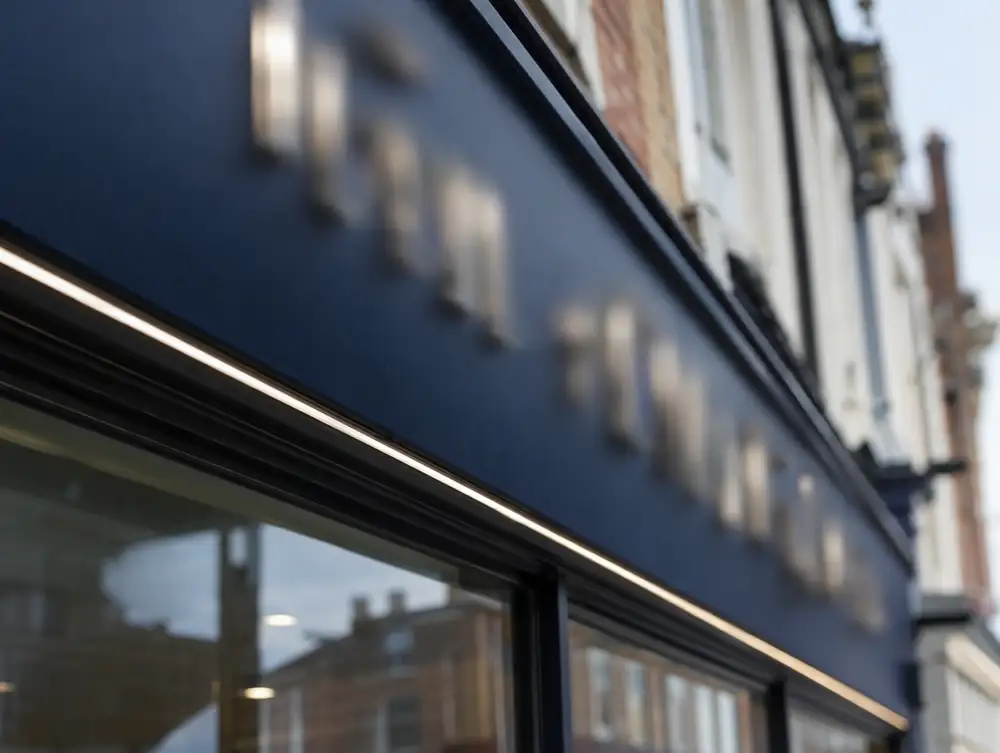
Where should you begin with fascia signage in Port Glasgow?
If your Port Glasgow unit sits in a parade of similar shops, we would look at the fascia line on either side before setting your sign height. Holding that line usually looks more confident than trying to outgrow it.
A deep fascia above a low shopfront can often be reduced on the drawing board. If your Port Glasgow premises have one, we would show you a slimmer panel option, with the ceiling line behind it adjusted to suit.
If there are storeys above the shop, the frontage should feel like the base of the building and not a sign stuck on it. Lining up mullions with the windows overhead is a small move that settles the whole elevation at Port Glasgow premises.
What sign-off might you need for fascia signage in Port Glasgow?
Shutters aren't named in Class 9A, so in Scotland they usually fall to the appearance test. The same goes for fascia signage at premises in the Port Glasgow area: building work that materially affects the external appearance needs planning permission, and a true like-for-like usually doesn't. Ask the council to confirm the position for your site.
Signs in Scotland come under the 1984 Advertisement Regulations, which have their own class numbers. At premises in the Port Glasgow area, an unlit fascia sign generally needs no application under Class IV(1) of Schedule 4 if it sits on a wall containing a shop window, tops out at 4.6m or first-floor level, and keeps letters to 0.75m high. Anything beyond that needs advertisement consent, and displaying a sign without consent is a criminal offence.
For Port Glasgow, the usual route for planning and advert applications is through Inverclyde Council, and we confirm that when we visit.
What price should you expect for fascia signage in Port Glasgow?
Allow £395 to £1,995 plus VAT per sign. Size and specification set most of that figure for fascia signage, and the rest depends on what the survey finds on site.
| Town | Port Glasgow |
|---|---|
| Area | Glasgow and Clyde |
| Postcode districts | PA13, PA14, PA15 |
| Planning authority | Inverclyde Council |
| Building approval | Building warrant (Technical Handbook) |
| Distance from Great Barr | About 259 miles |
| Survey | Free for new work |
Questions about fascia signage in Port Glasgow
Can a fascia sign in Port Glasgow be lit later on?
Yes, if the sign is planned for it. Built-up letters can take halo lighting when the panel and cable route are prepared at the start, which costs far less than adapting them afterwards.
Will you remove the old sign from my Port Glasgow premises?
Yes. Taking down the old sign, clearing old fixings and making good are included in the itemised quotation. We tell you what we find behind it before going further.
Can a new fascia sign in Port Glasgow be fitted on a closed day?
Yes, we can arrange that, or fit out of hours if that suits you better. Most fascia signs take about a day, so the work can often go into your quietest trading hours.
Do I need listed building consent for a shopfront in the Port Glasgow area?
Almost certainly, if the building is listed and windows or doors are changing, according to Historic Environment Scotland. The planning authority decides, and Historic Environment Scotland is consulted on some applications. Scottish Ministers are notified if it objects.
Which way must a fire exit door open on a shop in the Port Glasgow area?
In the direction of escape. Regulation 13(2) of the Fire Safety (Scotland) Regulations 2006 also rules out sliding and revolving doors on a dedicated fire exit and says fire exit doors can't be locked against immediate use. Duties sit with dutyholders under Part 3 of the Fire (Scotland) Act 2005, meaning the employer and any person with control of the premises.