We design, make and fit fascia signage in Rawmarsh and across South Yorkshire, as one job under one contract. Removal of the old sign, repairs behind it and the new sign all sit on one itemised quotation.
Your survey is where the price gets real, because widths, heights, levels and access are all taken on site in Rawmarsh.
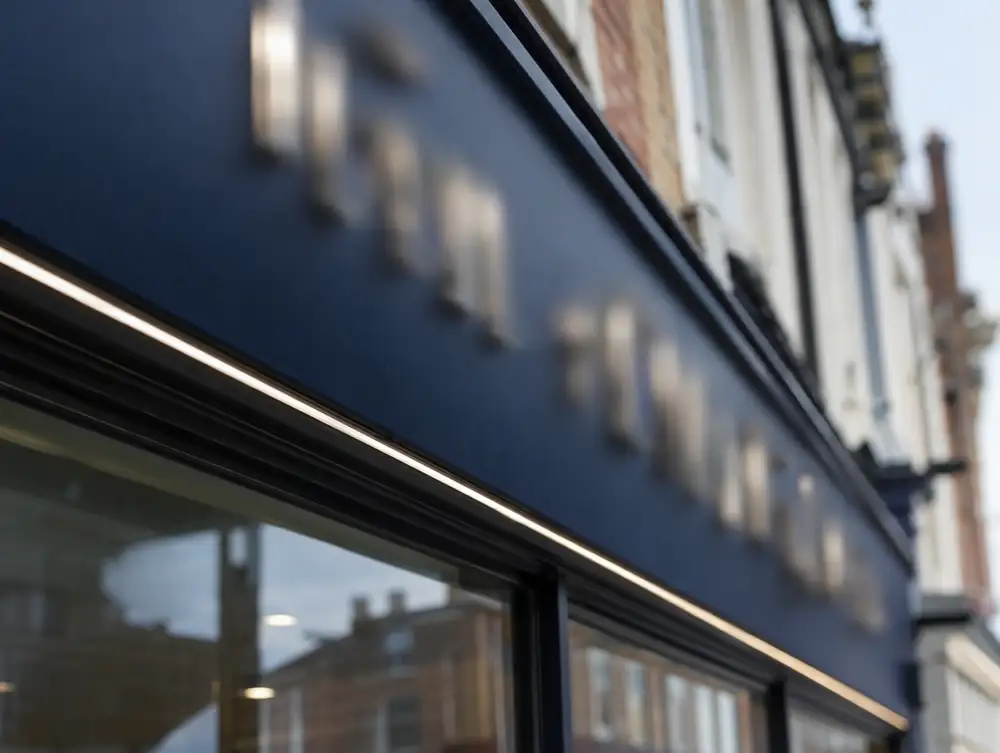
What makes fascia signage work well on Rawmarsh premises?
If your Rawmarsh unit sits in a parade of similar shops, we would look at the fascia line on either side before setting your sign height. Holding that line usually looks more confident than trying to outgrow it.
If the frontage faces south or west, we steer dark vinyl and printed panels away from direct sun, as they fade and move more. Painted or powder-coated metal will hold its colour for longer.
On a north-facing frontage the glass stays free of glare, but the interior can look dim from the street, so lighting needs to sit closer to the window. If your Rawmarsh premises face south, the problem flips to reflections by day and fading stock.
How much should you set aside for fascia signage in Rawmarsh?
The guide for fascia signage is £395 to £1,995 plus VAT per sign. Expect the lower end for simple work with clear access, and the upper end where detail, finish or awkward conditions add hours.
Could fascia signage in Rawmarsh need planning permission?
Security grilles and shutters are named in England's rules: installing or replacing one on a shopfront sits outside the shop permitted development rights. The frontage itself is treated the same way, so for fascia signage at premises in the Rawmarsh area, building work that materially affects the appearance needs planning permission. Confirm the position with the council before anything is ordered.
Lighting moves a sign out of Class 5 in England, because that class allows illumination only for medical-type notices. Class 4B then applies at premises in the Rawmarsh area: halo or character-only lighting, static, with the lowest part at least 2.5m up. Brightness is capped at 600 cd/m² on signs up to 10m² and 300 cd/m² above that, and anything outside these limits needs advertisement consent.
At survey we check how things stand for your building, although applications for planning permission or advertisement consent here normally go to Rotherham Metropolitan Borough Council.
| Town | Rawmarsh |
|---|---|
| Area | South Yorkshire |
| Postcode districts | S62 |
| Planning authority | Rotherham Metropolitan Borough Council |
| Building approval | Building Regulations (Approved Documents) |
| Distance from Great Barr | About 67 miles |
| Survey | Free for new work |
Questions about fascia signage in Rawmarsh
Will a new sign suit the rest of my Rawmarsh frontage?
That is what the scale drawing is for. We draw the sign on your actual elevation with door, windows and stallriser in place, so you can judge colour and proportion together.
Will you remove the old sign from my Rawmarsh premises?
Yes. Taking down the old sign, clearing old fixings and making good are included in the itemised quotation. We tell you what we find behind it before going further.
What if the fascia behind my old sign in Rawmarsh is rotten?
We show you photographs and price the repair before going further. A short section of timber can often be spliced in, while a badly decayed fascia is better replaced with a new subframe.
What rules apply to a fire exit door through a shopfront in the Rawmarsh area?
It must open in the direction of escape and can't be locked against immediate use, and a dedicated fire exit can't be a sliding or revolving door. In England that comes from article 14(2) of the Regulatory Reform (Fire Safety) Order 2005, and the duty sits with the responsible person, normally the employer or whoever controls the premises for a business, otherwise the owner. An outward door can clash with section 153 of the Highways Act 1980 where it opens onto the footway, so raise it early.
Does a new shopfront in the Rawmarsh area need Building Regulations approval?
Assume yes until building control says otherwise. England has no like-for-like exemption, though registered installers can self-certify replacement windows and doors in non-dwellings. That route doesn't cover structural glass, curtain walling or revolving doors.