Built-up letters, flat-cut metal or hand-painted timber can each work on fascias in Ryde, depending on the frontage and the brand. A scale drawing of the sign on your elevation makes the choice easy to judge.
Your survey is where the price gets real, because widths, heights, levels and access are all taken on site in Ryde.
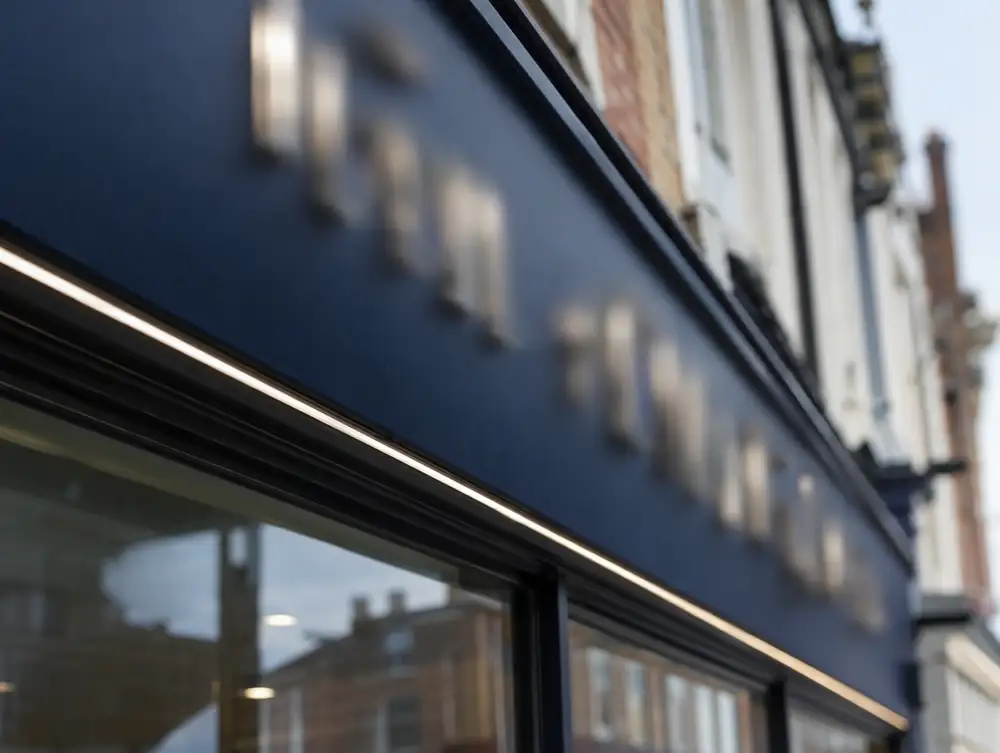
What goes into getting fascia signage right in Ryde?
If the frontage faces south or west, we steer dark vinyl and printed panels away from direct sun, as they fade and move more. Painted or powder-coated metal will hold its colour for longer.
Where a shutter box sits above the window, the sign has to be designed around it. We either house the box behind the fascia or adjust the panel, so nothing sits awkwardly proud of the frontage.
Where the building has good brick or stone around the opening, set the frame back in the reveal so the masonry can be seen. On Ryde premises with a flat elevation, that deep reveal throws a shadow line that adds real depth in low sun.
Which applications might fascia signage in Ryde involve?
A true like-for-like replacement usually needs no planning permission in England, because the external appearance isn't materially affected. New materials, a different glass line or altered proportions usually do count as material, so for fascia signage at premises in the Ryde area, an application is then likely. The council confirms which side of that line a job falls on.
Lighting moves a sign out of Class 5 in England, because that class allows illumination only for medical-type notices. Class 4B then applies at premises in the Ryde area: halo or character-only lighting, static, with the lowest part at least 2.5m up. Brightness is capped at 600 cd/m² on signs up to 10m² and 300 cd/m² above that, and anything outside these limits needs advertisement consent.
Ryde applications for planning permission or advertisement consent are normally handled by Isle of Wight Council. Our survey includes a check of the position for your address.
How much could fascia signage in Ryde cost you?
The guide for fascia signage is £395 to £1,995 plus VAT per sign. Expect the lower end for simple work with clear access, and the upper end where detail, finish or awkward conditions add hours.
Do you cover Ryde?
We can take on work in Ryde, with the survey arranged directly with you once we understand the job. Travel and access appear as their own lines on the quotation, apart from the cost of the frontage.
| Town | Ryde |
|---|---|
| Area | Isle of Wight |
| Postcode districts | PO33, PO34 |
| Planning authority | Isle of Wight Council |
| Building approval | Building Regulations (Approved Documents) |
| Survey | By arrangement |
Questions about fascia signage in Ryde
Will a new sign suit the rest of my Ryde frontage?
That is what the scale drawing is for. We draw the sign on your actual elevation with door, windows and stallriser in place, so you can judge colour and proportion together.
Can a new fascia sign in Ryde be fitted on a closed day?
Yes, we can arrange that, or fit out of hours if that suits you better. Most fascia signs take about a day, so the work can often go into your quietest trading hours.
Can a fascia sign in Ryde be lit later on?
Yes, if the sign is planned for it. Built-up letters can take halo lighting when the panel and cable route are prepared at the start, which costs far less than adapting them afterwards.
Do I need listed building consent for a shopfront in the Ryde area?
Usually yes, if the building is listed. In England the local planning authority decides, and Historic England is notified of Grade I and II* works and specified Grade II works. Like-for-like repair may not need consent, so ask the council before work starts.
Do I need planning permission to change a shopfront in the Ryde area?
Usually yes, if the work materially affects the building's external appearance. England's shop permitted development rights exclude creating, altering or replacing a shopfront, so there is no shortcut. A true like-for-like replacement usually needs no application, and the council confirms the position.