Opening premises in Syston usually means a new fascia with a date attached. Manufacture typically takes 2 to 4 weeks from approved artwork, and fitting can be arranged around your opening plans.
Bring whatever you have to the survey in Syston: brand guidelines, lease plans, old drawings or a photo of a frontage you admire.
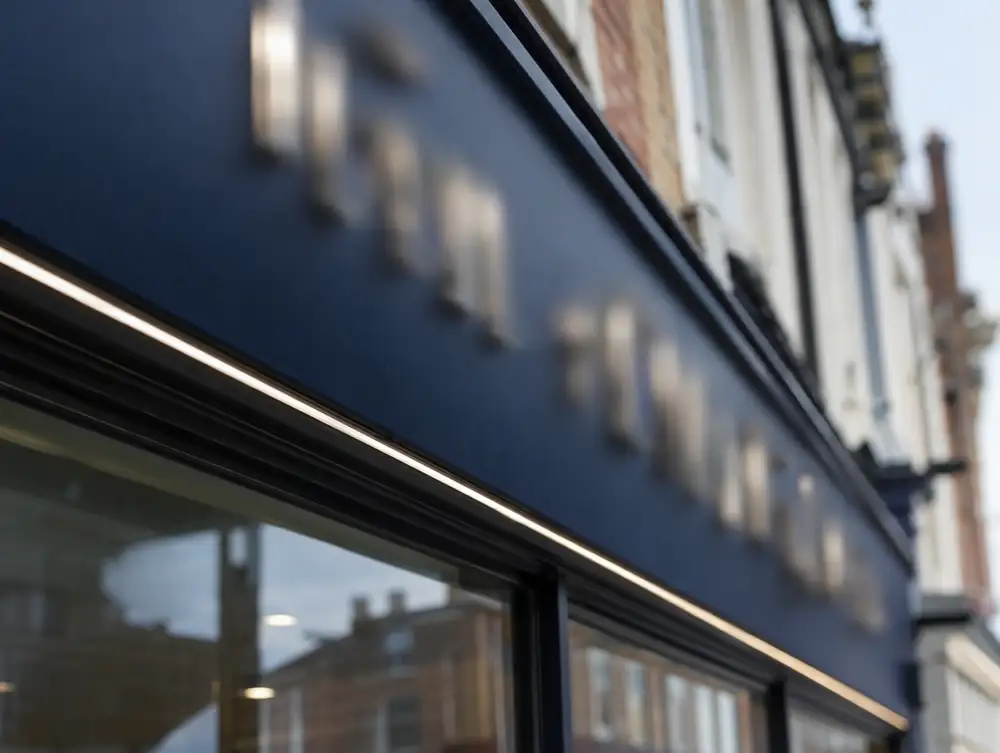
What goes into getting fascia signage right in Syston?
Where the fascia on your Syston premises has been overclad, we lift a sample at survey to see what is underneath. Original timber, cornice mouldings or tile may be worth keeping, and they change what the new sign should be.
If the frontage faces south or west, we steer dark vinyl and printed panels away from direct sun, as they fade and move more. Painted or powder-coated metal will hold its colour for longer.
If your Syston unit sits in a Victorian parade, the old pilasters usually set the rhythm, so a new front should land on them and not run past them. Keep that line and even a modern frame looks as though it belongs.
How much could fascia signage in Syston cost you?
Until the survey is done, plan on £395 to £1,995 plus VAT per sign. Unusual sizes, fine detail and phased working push the figure up, while a simple brief and clear access keep it toward the lower end.
Which applications might fascia signage in Syston involve?
A true like-for-like replacement usually needs no planning permission in England, because the external appearance isn't materially affected. New materials, a different glass line or altered proportions usually do count as material, so for fascia signage at premises in the Syston area, an application is then likely. The council confirms which side of that line a job falls on.
Class 4B, England's class for lit signs, isn't available in conservation areas, Areas of Outstanding Natural Beauty, National Parks or the Broads, so a lit sign there normally needs advertisement consent. In an area of special control it is unavailable too, and Class 5 drops to a 3.6m top height, 0.3m letters and one-tenth of the building face up to 3.6m. Ask the council which designations cover premises in the Syston area.
We confirm the position at survey, because a boundary or a special designation can change who handles the file, but applications from Syston premises normally go to Charnwood Borough Council.
| Town | Syston |
|---|---|
| Area | Leicestershire |
| Postcode districts | LE4, LE5, LE7 |
| Planning authority | Charnwood Borough Council |
| Building approval | Building Regulations (Approved Documents) |
| Distance from Great Barr | About 37 miles |
| Survey | Free for new work |
Questions about fascia signage in Syston
Can a fascia sign in Syston be lit later on?
Yes, if the sign is planned for it. Built-up letters can take halo lighting when the panel and cable route are prepared at the start, which costs far less than adapting them afterwards.
What artwork do you need for a sign in Syston?
Vector files such as AI, EPS or PDF are ideal, along with any brand guidelines. If you only have a low-resolution logo, it can be redrawn, and that time is shown on the quotation.
How quickly can I see a drawing for my Syston sign?
Drawings typically follow within one to two weeks of the survey, depending on the artwork and how many options you want to see. Your named contact will give you a date once the survey is booked.
What rules apply to a fire exit door through a shopfront in the Syston area?
It must open in the direction of escape and can't be locked against immediate use, and a dedicated fire exit can't be a sliding or revolving door. In England that comes from article 14(2) of the Regulatory Reform (Fire Safety) Order 2005, and the duty sits with the responsible person, normally the employer or whoever controls the premises for a business, otherwise the owner. An outward door can clash with section 153 of the Highways Act 1980 where it opens onto the footway, so raise it early.
Does a new shopfront in the Syston area need Building Regulations approval?
Assume yes until building control says otherwise. England has no like-for-like exemption, though registered installers can self-certify replacement windows and doors in non-dwellings. That route doesn't cover structural glass, curtain walling or revolving doors.