Restoring an old front in Caterham means keeping the character and solving the modern problems. Door gear, lighting, security and cleaning all have to work without showing from the street.
It helps if you can be there when we visit Caterham, since five minutes walking the frontage together answers more than a long email.
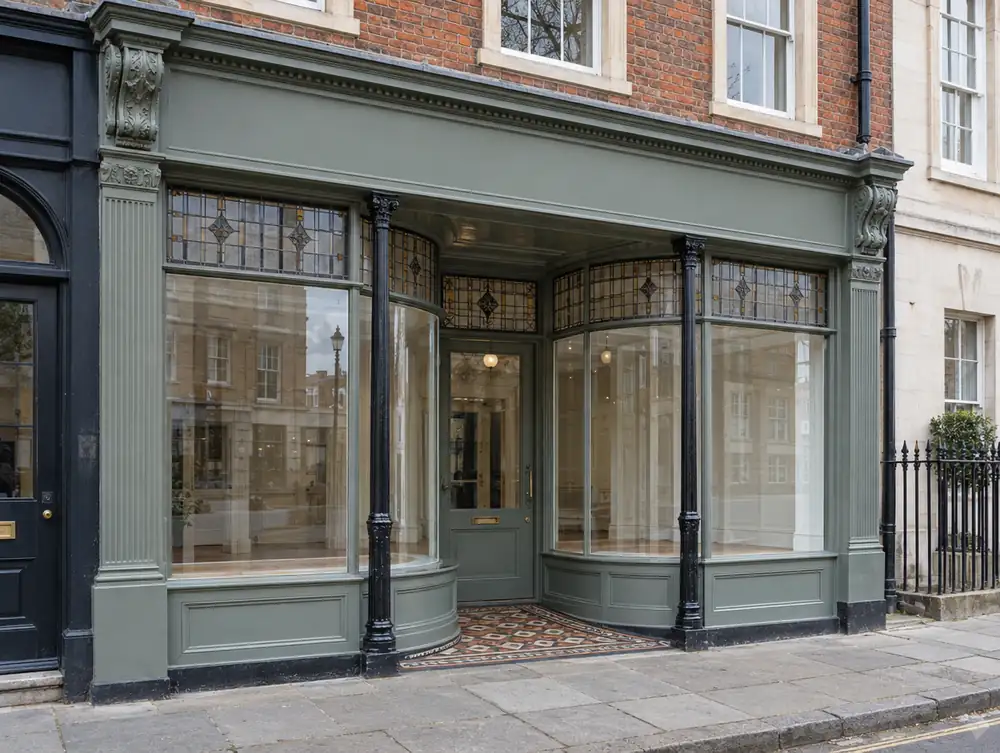
What goes into getting heritage shopfronts right in Caterham?
Period corner shops often had a canted entrance or a curved pane. If yours did, the floor and ceiling at your Caterham premises may still show its line, and we'd look for those marks before redesigning the corner.
A landlord may own the building while you hold the lease, and each can see old fabric differently. For Caterham premises we'd prepare a plain record of what's there and what we propose, so both sides can agree before work starts.
Where the building has good brick or stone around the opening, set the frame back in the reveal so the masonry can be seen. On Caterham premises with a flat elevation, that deep reveal throws a shadow line that adds real depth in low sun.
How much could heritage shopfronts in Caterham cost you?
Allow £8,495 to £24,995 plus VAT for a typical frontage. Size and specification set most of that figure for heritage shopfronts, and the rest depends on what the survey finds on site.
Which applications might heritage shopfronts in Caterham involve?
For heritage shopfronts at premises in the Caterham area, the deciding question in England is whether the building work materially affects the external appearance. If it does, planning permission is needed, while a true like-for-like replacement usually needs none. The council confirms the position for each site.
Planning and advert applications for Caterham premises normally go to Tandridge District Council. We check the position for your address at survey.
| Town | Caterham |
|---|---|
| Area | Surrey |
| Postcode districts | CR3, CR5, CR6, RH9 |
| Planning authority | Tandridge District Council |
| Building approval | Building Regulations (Approved Documents) |
| Distance from Great Barr | About 117 miles |
| Survey | Free for new work |
Questions about heritage shopfronts in Caterham
How long will restoration take at my Caterham premises?
New joinery typically takes 8 to 14 weeks to make, then 1 to 3 weeks on site. The survey gives you a realistic programme, because repair-only jobs can take far less.
Can a new sign go on my old Caterham shopfront?
Yes, and traditional sign writing often looks right on a painted fascia. We'd draw the lettering to suit the fascia, then fix anything raised so it does no harm to the original timber.
Which old features would you always try to save in Surrey?
Tiled stallrisers, mosaic thresholds, console brackets, ironwork and leaded top lights, wherever they survive. These are the details that are hardest to recreate convincingly.
Does a new shopfront in the Caterham area need Building Regulations approval?
Assume yes until building control says otherwise. England has no like-for-like exemption, though registered installers can self-certify replacement windows and doors in non-dwellings. That route doesn't cover structural glass, curtain walling or revolving doors.
Do roller shutters need planning permission in the Caterham area?
Usually yes. Installing or replacing a security grill or shutter on a shopfront is expressly outside England's shop permitted development rights, so the only way to avoid an application is work that doesn't materially affect the appearance. Ask the council before ordering.