We travel from Great Barr to survey and restore period shopfronts for Didcot premises, with drawings detailed enough for a specialist to read. One named contact stays with the job throughout.
Expect us to measure the opening, photograph the existing front and check how materials will reach it on the day, at a time you have agreed.
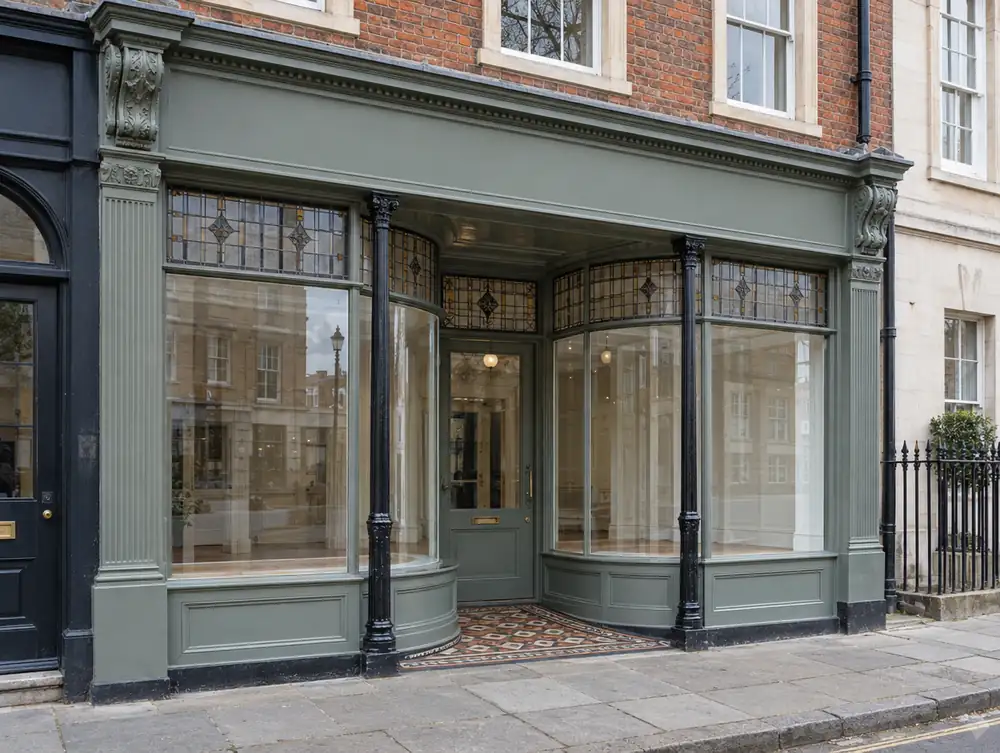
How do you design around the building when planning heritage shopfronts in Didcot?
Sun is hard on old paintwork and putty. For a south-facing period front in Didcot, we'd look at a traditional retractable blind, which shades the glass, protects the stock and brings back a useful feature.
A landlord may own the building while you hold the lease, and each can see old fabric differently. For Didcot premises we'd prepare a plain record of what's there and what we propose, so both sides can agree before work starts.
If you trade after dark in Didcot, the view in matters more than the sign. A warm, evenly lit interior with light on the back wall will usually do more than a brighter fascia, because it gives the eye somewhere to go.
What permissions should you check for heritage shopfronts in Didcot?
England has no permitted development route for changing a shopfront. Part 7 Class A of the General Permitted Development Order 2015 excludes creating, altering or replacing one, and it allows no alterations at all on article 2(3) land. That leaves two outcomes for heritage shopfronts at premises in the Didcot area: a planning application, or work that doesn't materially affect the external appearance.
Planning and advert applications for Didcot premises normally go to South Oxfordshire District Council. We check the position for your address at survey.
What might heritage shopfronts cost in Didcot?
Allow £8,495 to £24,995 plus VAT for a typical frontage. Size and specification set most of that figure for heritage shopfronts, and the rest depends on what the survey finds on site.
| Town | Didcot |
|---|---|
| Area | Oxfordshire |
| Postcode districts | OX11 |
| Planning authority | South Oxfordshire District Council |
| Building approval | Building Regulations (Approved Documents) |
| Distance from Great Barr | About 71 miles |
| Survey | Free for new work |
Questions about heritage shopfronts in Didcot
How long will restoration take at my Didcot premises?
New joinery typically takes 8 to 14 weeks to make, then 1 to 3 weeks on site. The survey gives you a realistic programme, because repair-only jobs can take far less.
What does a period survey of my Didcot shop involve?
We measure the front, photograph every detail and check the condition of timber, paint and glass. With your agreement, we may lift a small piece of later boarding to see what survives behind it.
Which old features would you always try to save in Oxfordshire?
Tiled stallrisers, mosaic thresholds, console brackets, ironwork and leaded top lights, wherever they survive. These are the details that are hardest to recreate convincingly.
Does the Equality Act apply to a shop entrance in the Didcot area?
Yes. The Equality Act 2010 applies in England, as across Great Britain, and it requires reasonable steps to remove, alter or avoid physical features that disadvantage disabled people. The duty is anticipatory, so it looks at disabled people generally, and a new Services Code replaced the 2011 Code on 5 August 2026.
Does a new shopfront in the Didcot area need Building Regulations approval?
Assume yes until building control says otherwise. England has no like-for-like exemption, though registered installers can self-certify replacement windows and doors in non-dwellings. That route doesn't cover structural glass, curtain walling or revolving doors.