Underneath a later fascia on your Hull premises, there may be more of the old front than you think. Our survey looks for the brackets, cornices and ghost lines that show how it once looked.
It helps if you can be there when we visit Hull, since five minutes walking the frontage together answers more than a long email.
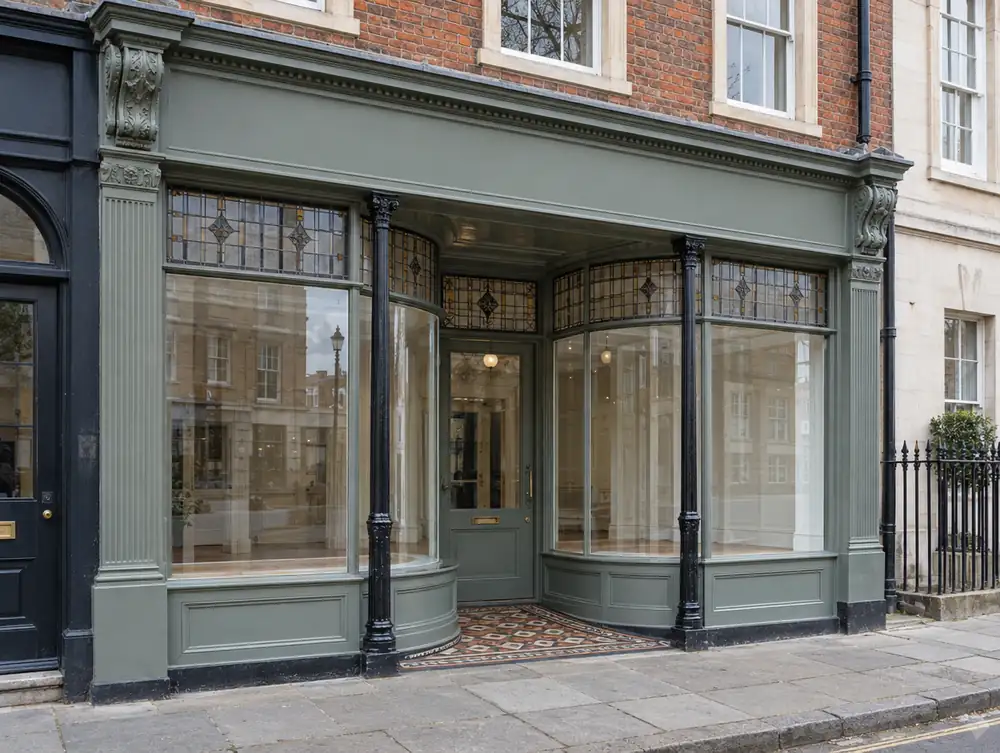
How do you design around the building when planning heritage shopfronts in Hull?
In a parade of matching period fronts in Hull, your neighbours are the pattern book. If their pilasters or cornices survive, we'd copy those sizes so your unit rejoins the row.
A landlord may own the building while you hold the lease, and each can see old fabric differently. For Hull premises we'd prepare a plain record of what's there and what we propose, so both sides can agree before work starts.
A corner unit has two fronts to think about, and the return elevation often does as much selling as the main one. If that is your layout in Hull, carry the fascia and glass line round the corner and treat both faces as one composition.
What might heritage shopfronts cost in Hull?
As a working budget, use £8,495 to £24,995 plus VAT for a typical frontage. Your place inside that range for heritage shopfronts depends mostly on how much of the existing frontage can stay and how much has to be put right first.
What permissions should you check for heritage shopfronts in Hull?
England has no permitted development route for changing a shopfront. Part 7 Class A of the General Permitted Development Order 2015 excludes creating, altering or replacing one, and it allows no alterations at all on article 2(3) land. That leaves two outcomes for heritage shopfronts at premises in the Hull area: a planning application, or work that doesn't materially affect the external appearance.
For Hull, the usual route for planning and advert applications is through Hull City Council, and we confirm that when we visit.
| Town | Hull |
|---|---|
| Area | East Riding of Yorkshire |
| Postcode districts | HU1, HU2, HU3, HU5 |
| Planning authority | Hull City Council |
| Building approval | Building Regulations (Approved Documents) |
| Distance from Great Barr | About 105 miles |
| Survey | Free for new work |
Does Hull City Council publish shopfront guidance?
Yes, Supplementary Planning Document 16: Whitefriargate/Silver Street Shop Front Design Guide (2020). It covers Whitefriargate and Silver Street only, so it doesn't apply across the whole council area. A few of the things it asks for:
- The fascia should be about one-fifth of the overall shop front height and sit between the pilasters.
- External grilles or shutters are avoided except in wholly exceptional circumstances, and solid external shutters are not suitable in Whitefriargate.
- Uncoloured shutters are unlikely to be acceptable, with black or very dark colours suggested.
Questions about heritage shopfronts in Hull
How long will restoration take at my Hull premises?
New joinery typically takes 8 to 14 weeks to make, then 1 to 3 weeks on site. The survey gives you a realistic programme, because repair-only jobs can take far less.
Who makes the joinery for Hull premises?
Specialist joiners vetted by us and working under S&K Glazing make and fit it. You deal with one named contact, and the contract is with S&K Glazing Limited.
Can I still have good security on a period front in Hull?
Yes. An internal shutter, laminated glass where the frame can carry it and discreet alarm contacts protect the shop without changing how it looks from the street.
Do I need planning permission to change a shopfront in the Hull area?
Usually yes, if the work materially affects the building's external appearance. England's shop permitted development rights exclude creating, altering or replacing a shopfront, so there is no shortcut. A true like-for-like replacement usually needs no application, and the council confirms the position.
Does a new shopfront in the Hull area need Building Regulations approval?
Assume yes until building control says otherwise. England has no like-for-like exemption, though registered installers can self-certify replacement windows and doors in non-dwellings. That route doesn't cover structural glass, curtain walling or revolving doors.