Old tiles, carved brackets and slim glazing bars give a frontage in Kilmarnock a quality new work struggles to match. Where they've survived we keep them, and where they've gone we draw their replacements at full size.
Nothing gets ordered off the back of a survey in Kilmarnock, because its job is to give us the numbers to draw and price from.
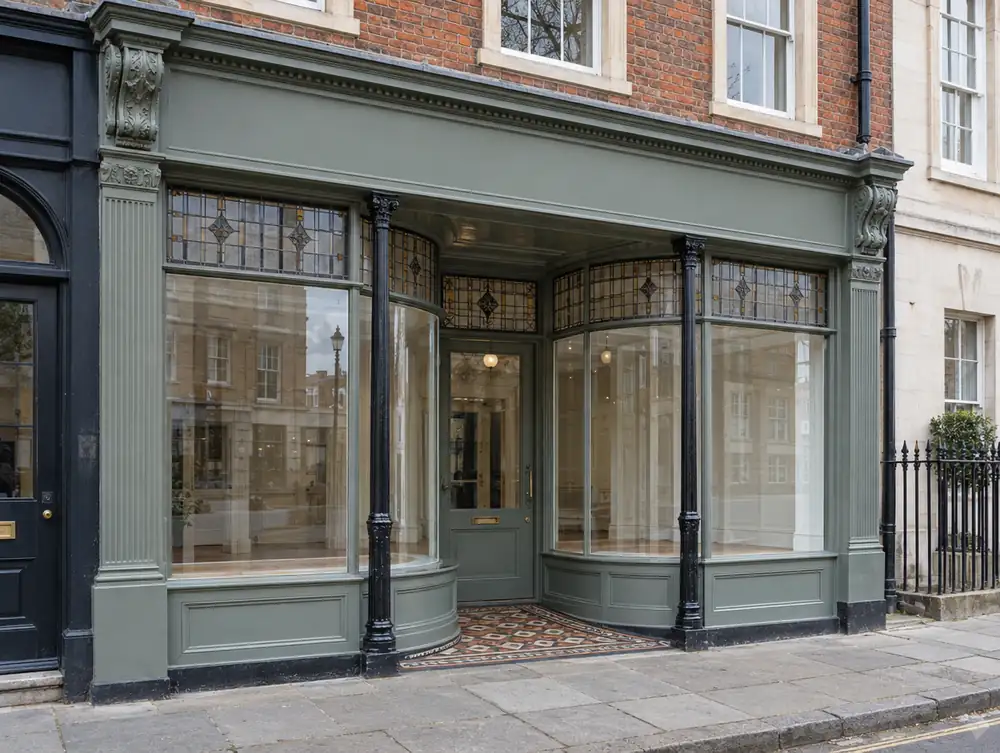
What makes heritage shopfronts work well on Kilmarnock premises?
Period corner shops often had a canted entrance or a curved pane. If yours did, the floor and ceiling at your Kilmarnock premises may still show its line, and we'd look for those marks before redesigning the corner.
Deep recessed lobbies are among the first things to go in a refit. If your Kilmarnock premises still have one, especially with a tiled floor, we'd protect it, repair the floor and reuse the returns as display.
If you trade after dark in Kilmarnock, the view in matters more than the sign. A warm, evenly lit interior with light on the back wall will usually do more than a brighter fascia, because it gives the eye somewhere to go.
How much should you set aside for heritage shopfronts in Kilmarnock?
Until the survey is done, plan on £8,495 to £24,995 plus VAT for a typical frontage. Unusual sizes, fine detail and phased working push the figure up, while a simple brief and clear access keep it toward the lower end.
Could heritage shopfronts in Kilmarnock need planning permission?
Shutters aren't named in Class 9A, so in Scotland they usually fall to the appearance test. The same goes for heritage shopfronts at premises in the Kilmarnock area: building work that materially affects the external appearance needs planning permission, and a true like-for-like usually doesn't. Ask the council to confirm the position for your site.
Kilmarnock applications for planning permission or advertisement consent are normally handled by East Ayrshire Council. Our survey includes a check of the position for your address.
| Town | Kilmarnock |
|---|---|
| Area | Ayrshire |
| Postcode districts | KA1 |
| Planning authority | East Ayrshire Council |
| Building approval | Building warrant (Technical Handbook) |
| Distance from Great Barr | About 236 miles |
| Survey | Free for new work |
Questions about heritage shopfronts in Kilmarnock
Which old features would you always try to save in Ayrshire?
Tiled stallrisers, mosaic thresholds, console brackets, ironwork and leaded top lights, wherever they survive. These are the details that are hardest to recreate convincingly.
How much of my Kilmarnock shopfront can be kept?
Usually more than it first appears. Decay tends to stay low on posts and doors, while the upper joinery is often sound and can stay.
Can you find the colour my Kilmarnock shopfront used to be?
Often. Scraping back through the paint layers shows earlier colours, and a specialist can analyse them if the detail matters.
Which way must a fire exit door open on a shop in the Kilmarnock area?
In the direction of escape. Regulation 13(2) of the Fire Safety (Scotland) Regulations 2006 also rules out sliding and revolving doors on a dedicated fire exit and says fire exit doors can't be locked against immediate use. Duties sit with dutyholders under Part 3 of the Fire (Scotland) Act 2005, meaning the employer and any person with control of the premises.
Does the Equality Act cover a shop entrance in the Kilmarnock area?
Yes. The Equality Act 2010 applies in Scotland as part of Great Britain, and its anticipatory duty expects reasonable steps to remove, alter or avoid physical features that disadvantage disabled people generally. BS 8300-2:2018 is the current British Standard for accessible buildings.