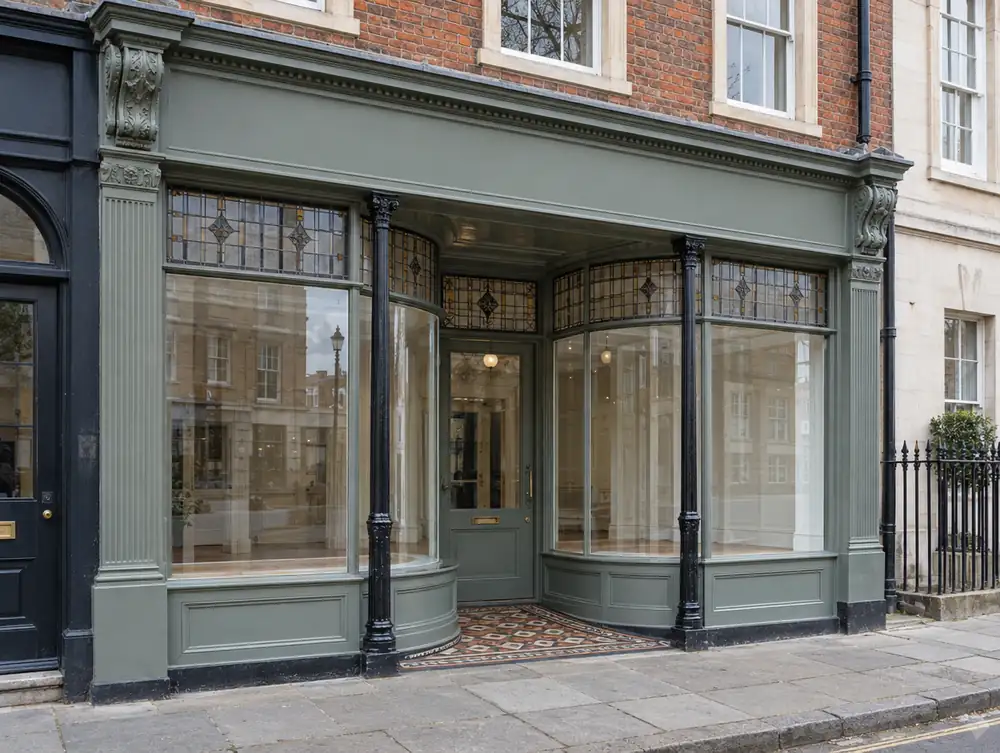
If your Lancaster building deserves better than the front it has, a recreated period shopfront could be the answer. We work from surviving fabric, old photographs and the proportions of the elevation above.
Nothing gets ordered off the back of a survey in Lancaster, because its job is to give us the numbers to draw and price from.
Where should you begin with heritage shopfronts in Lancaster?
In a parade of matching period fronts in Lancaster, your neighbours are the pattern book. If their pilasters or cornices survive, we'd copy those sizes so your unit rejoins the row.
Old joinery doesn't suit rushed night work, though parts of the job do. At Lancaster premises that can't close, we'd carry out noisy removal and glazing out of hours, and leave careful repairs and painting for the day behind a dust screen.
Where units share one long run of fascia, breaking the height makes you stand out for the wrong reason. If that describes your Lancaster parade, keep the line and win attention with lettering, lighting and what's in the window.
What price should you expect for heritage shopfronts in Lancaster?
Guide price: £8,495 to £24,995 plus VAT for a typical frontage. Materials, finish and the amount of drawing and coordination involved all move it, and your itemised quotation shows where the money goes on heritage shopfronts.
What sign-off might you need for heritage shopfronts in Lancaster?
Security grilles and shutters are named in England's rules: installing or replacing one on a shopfront sits outside the shop permitted development rights. The frontage itself is treated the same way, so for heritage shopfronts at premises in the Lancaster area, building work that materially affects the appearance needs planning permission. Confirm the position with the council before anything is ordered.
Lancaster applications for planning permission or advertisement consent are normally handled by Lancaster City Council. Our survey includes a check of the position for your address.
| Town | Lancaster |
|---|---|
| Area | Lancashire |
| Postcode districts | LA1, LA3, LA4 |
| Planning authority | Lancaster City Council |
| Building approval | Building Regulations (Approved Documents) |
| Distance from Great Barr | About 110 miles |
| Survey | Free for new work |
Questions about heritage shopfronts in Lancaster
How much of my Lancaster shopfront can be kept?
Usually more than it first appears. Decay tends to stay low on posts and doors, while the upper joinery is often sound and can stay.
Can you find the colour my Lancaster shopfront used to be?
Often. Scraping back through the paint layers shows earlier colours, and a specialist can analyse them if the detail matters.
Which old features would you always try to save in Lancashire?
Tiled stallrisers, mosaic thresholds, console brackets, ironwork and leaded top lights, wherever they survive. These are the details that are hardest to recreate convincingly.
Do I need listed building consent for a shopfront in the Lancaster area?
Usually yes, if the building is listed. In England the local planning authority decides, and Historic England is notified of Grade I and II* works and specified Grade II works. Like-for-like repair may not need consent, so ask the council before work starts.
What rules apply to a fire exit door through a shopfront in the Lancaster area?
It must open in the direction of escape and can't be locked against immediate use, and a dedicated fire exit can't be a sliding or revolving door. In England that comes from article 14(2) of the Regulatory Reform (Fire Safety) Order 2005, and the duty sits with the responsible person, normally the employer or whoever controls the premises for a business, otherwise the owner. An outward door can clash with section 153 of the Highways Act 1980 where it opens onto the footway, so raise it early.