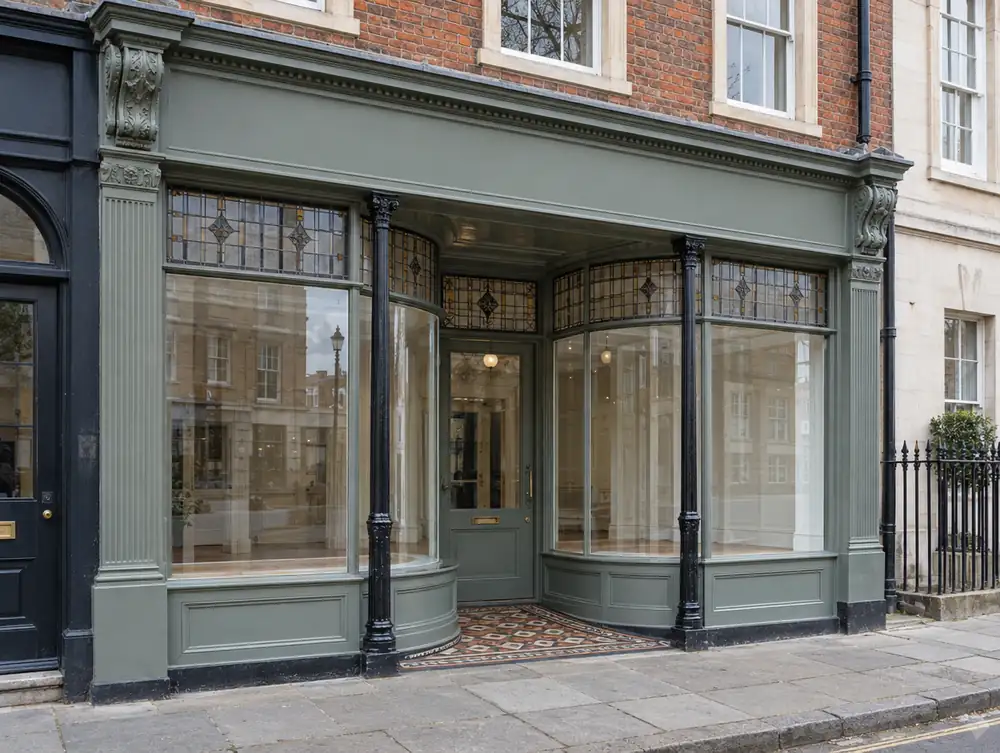
Old tiles, carved brackets and slim glazing bars give a frontage in Poulton-le-Fylde a quality new work struggles to match. Where they've survived we keep them, and where they've gone we draw their replacements at full size.
Your survey is where the price gets real, because widths, heights, levels and access are all taken on site in Poulton-le-Fylde.
How do you design around the building when planning heritage shopfronts in Poulton-le-Fylde?
Period corner shops often had a canted entrance or a curved pane. If yours did, the floor and ceiling at your Poulton-le-Fylde premises may still show its line, and we'd look for those marks before redesigning the corner.
Sun is hard on old paintwork and putty. For a south-facing period front in Poulton-le-Fylde, we'd look at a traditional retractable blind, which shades the glass, protects the stock and brings back a useful feature.
If your premises were once two shops, decide early whether the front should read as one or as two. One continuous fascia with a repeated bay width usually settles the elevation better than two mismatched halves, which is worth testing on any Poulton-le-Fylde unit of that kind.
What permissions should you check for heritage shopfronts in Poulton-le-Fylde?
Security grilles and shutters are named in England's rules: installing or replacing one on a shopfront sits outside the shop permitted development rights. The frontage itself is treated the same way, so for heritage shopfronts at premises in the Poulton-le-Fylde area, building work that materially affects the appearance needs planning permission. Confirm the position with the council before anything is ordered.
We confirm the position at survey, because a boundary or a special designation can change who handles the file, but applications from Poulton-le-Fylde premises normally go to Wyre Borough Council.
What might heritage shopfronts cost in Poulton-le-Fylde?
Guide price: £8,495 to £24,995 plus VAT for a typical frontage. Materials, finish and the amount of drawing and coordination involved all move it, and your itemised quotation shows where the money goes on heritage shopfronts.
| Town | Poulton-le-Fylde |
|---|---|
| Area | Lancashire |
| Postcode districts | FY1, FY2, FY3, FY6 |
| Planning authority | Wyre Borough Council |
| Building approval | Building Regulations (Approved Documents) |
| Distance from Great Barr | About 99 miles |
| Survey | Free for new work |
Questions about heritage shopfronts in Poulton-le-Fylde
Can a new sign go on my old Poulton-le-Fylde shopfront?
Yes, and traditional sign writing often looks right on a painted fascia. We'd draw the lettering to suit the fascia, then fix anything raised so it does no harm to the original timber.
How long will restoration take at my Poulton-le-Fylde premises?
New joinery typically takes 8 to 14 weeks to make, then 1 to 3 weeks on site. The survey gives you a realistic programme, because repair-only jobs can take far less.
Which old features would you always try to save in Lancashire?
Tiled stallrisers, mosaic thresholds, console brackets, ironwork and leaded top lights, wherever they survive. These are the details that are hardest to recreate convincingly.
What rules apply to a fire exit door through a shopfront in the Poulton-le-Fylde area?
It must open in the direction of escape and can't be locked against immediate use, and a dedicated fire exit can't be a sliding or revolving door. In England that comes from article 14(2) of the Regulatory Reform (Fire Safety) Order 2005, and the duty sits with the responsible person, normally the employer or whoever controls the premises for a business, otherwise the owner. An outward door can clash with section 153 of the Highways Act 1980 where it opens onto the footway, so raise it early.
Do I need planning permission to change a shopfront in the Poulton-le-Fylde area?
Usually yes, if the work materially affects the building's external appearance. England's shop permitted development rights exclude creating, altering or replacing a shopfront, so there is no shortcut. A true like-for-like replacement usually needs no application, and the council confirms the position.