A closed shop should still look alive. For Aberdeen frontages, a perforated curtain and a lit display keep the window working long after you lock up.
Bring whatever you have to the survey in Aberdeen: brand guidelines, lease plans, old drawings or a photo of a frontage you admire.
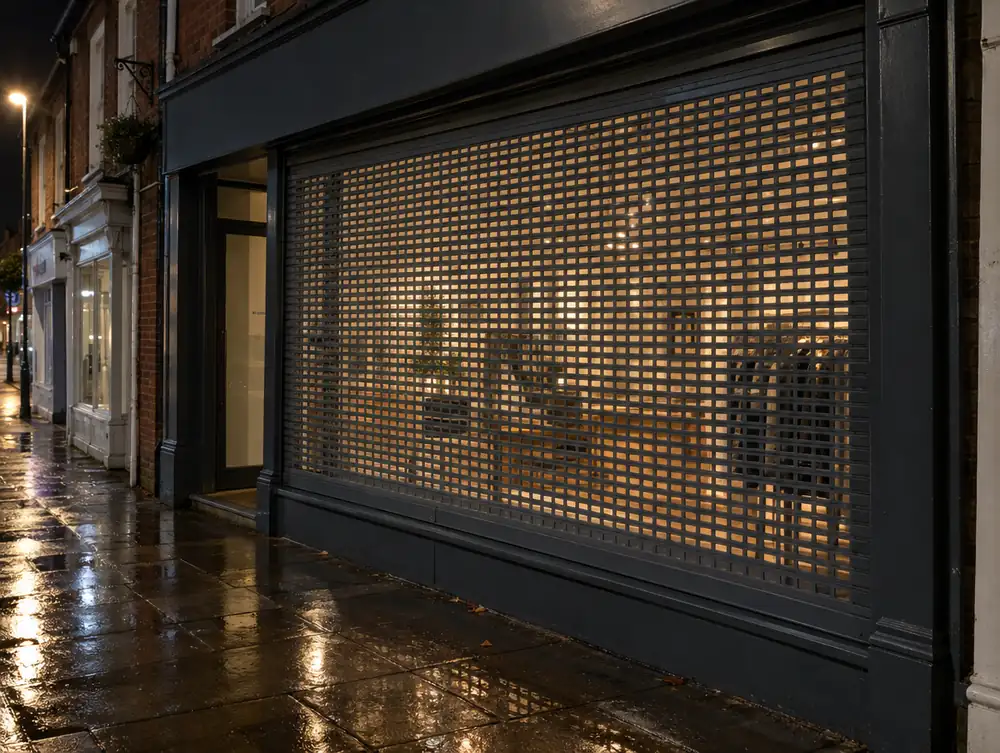
How do you design around the building when planning perforated roller shutters in Aberdeen?
For premises that open early or trade late, shutter noise can matter to neighbours. A motor with a soft start and well-set guides runs noticeably more quietly.
On premises with a recessed entrance, the shutter line needs careful thought. We usually bring it forward to the building line, or close the recess separately, so the doorway does not become a hiding place.
If you trade after dark in Aberdeen, the view in matters more than the sign. A warm, evenly lit interior with light on the back wall will usually do more than a brighter fascia, because it gives the eye somewhere to go.
What permissions should you check for perforated roller shutters in Aberdeen?
Class 9A, Scotland's shop permitted development right, gives no route for a shopfront change. It covers Class 1A premises, but not work that alters or extends beyond the existing front, and it doesn't apply in conservation areas, National Parks or World Heritage Sites. For perforated roller shutters at premises in the Aberdeen area, that generally means a planning application unless the external appearance isn't materially affected.
We confirm the position at survey, because a boundary or a special designation can change who handles the file, but applications from Aberdeen premises normally go to Aberdeen City Council.
What might perforated roller shutters cost in Aberdeen?
Until the survey is done, plan on £1,695 to £4,495 plus VAT per shutter. Unusual sizes, fine detail and phased working push the figure up, while a simple brief and clear access keep it toward the lower end.
| Town | Aberdeen |
|---|---|
| Area | Aberdeen and Aberdeenshire |
| Postcode districts | AB10, AB11, AB24, AB25 |
| Planning authority | Aberdeen City Council |
| Building approval | Building warrant (Technical Handbook) |
| Distance from Great Barr | About 318 miles |
| Survey | Free for new work |
Does Aberdeen City Council publish shopfront guidance?
Yes, Aberdeen Planning Guidance 2023: Shops and Signs (2023). It tells applicants what the council expects from new and altered shopfronts. A few of the things it asks for:
- Stallrisers typically form no more than 20% of the shopfront height, and original timber ones must be retained and restored.
- Fascia depth should be no greater than 20% of the shop frontage height, with lettering no more than two-thirds of the fascia depth.
- Sub-fascias are not permitted, and existing ones are expected to be removed.
Questions about perforated roller shutters in Aberdeen
Can one person open the shutter at my Aberdeen shop?
Yes. Powered shutters run at the turn of a key or a button press, and a manual override is available if the power fails. We show your staff both at handover.
Can you fit an internal shutter on my Aberdeen premises?
Usually, yes. We check for ceiling space, a clear path behind the window and a solid fixing for the guides. Where space is tight, a slim box or a smaller display can make it work.
What controls can a shutter have?
A key switch, a wall button or a remote are the usual choices, each with a manual override. Many shops use a key switch at the door, so closing up needs someone present.
Do I need a building warrant for a shopfront in the Aberdeen area?
Usually yes in Scotland, if the work alters a wall or structure. Schedule 3 of the Building (Scotland) Regulations 2004 lists some work that needs no warrant, such as replacing a door or window with its frame, but the standards still apply. Shopfronts aren't named there, so ask the council before relying on it.
Do roller shutters need planning permission in the Aberdeen area?
Usually yes, if they materially affect the external appearance. Class 9A doesn't name shutters, so in Scotland treat them as falling to the appearance test rather than assuming a permitted development route. Ask the council before ordering, as this is a reading of the rules and not an official statement.