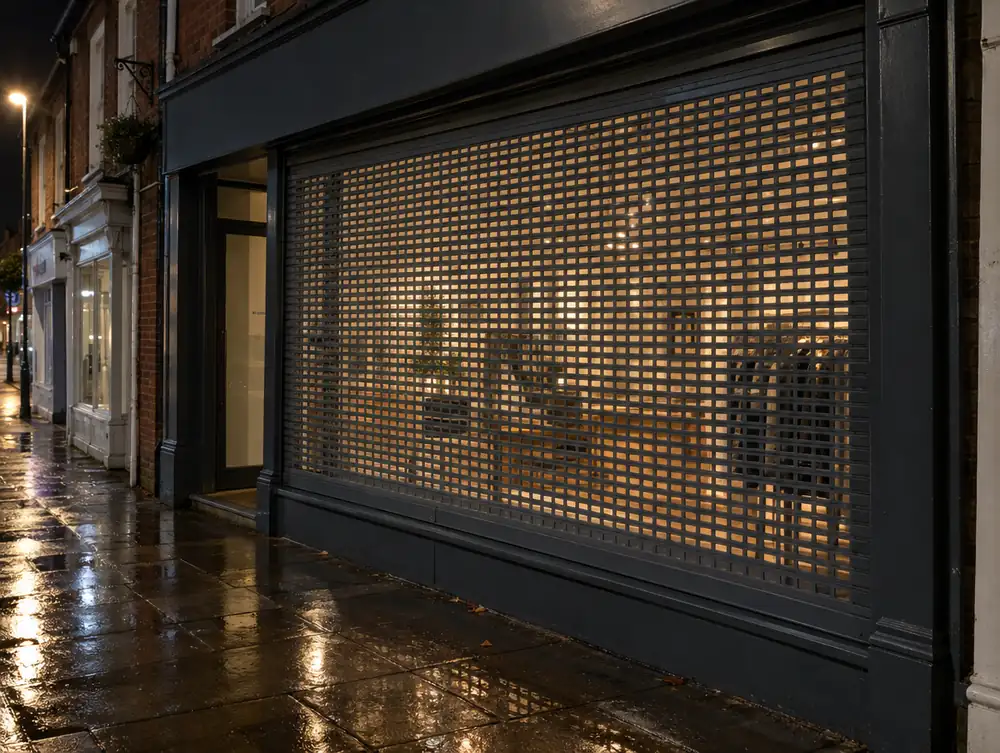
Perforated roller shutters give Bath premises out-of-hours protection while light and the display still show through. We look first at whether the shutter should sit inside the glass, since that often gives a better frontage.
It helps if you can be there when we visit Bath, since five minutes walking the frontage together answers more than a long email.
What should you think about before commissioning perforated roller shutters in Bath?
If your Bath shopfront has a suspended ceiling behind it, an internal box can often hide above the tiles. Where the ceiling is solid or very low, we would look at a slim box in a painted bulkhead.
Where stock is high in value, a perforated shutter alone may not be enough. We would look at laminated glass in front, a rated curtain, and what your insurer expects, then specify the three together.
Where the footway outside your Bath premises is narrow, a recessed entrance earns its keep. It gives people a dry place to pause out of the walkway, and it adds a longer run of display glass either side of the door.
Who approves perforated roller shutters in Bath?
For perforated roller shutters at premises in the Bath area, the deciding question in England is whether the building work materially affects the external appearance. If it does, planning permission is needed, while a true like-for-like replacement usually needs none. The council confirms the position for each site.
Planning and advert applications for Bath premises normally go to Bath and North East Somerset Council. We check the position for your address at survey.
What is a realistic budget for perforated roller shutters in Bath?
We would budget £1,695 to £4,495 plus VAT per shutter. Scope sets most of the figure, so a clear brief at the start does more for the budget than any later change of detail.
| Town | Bath |
|---|---|
| Area | Somerset |
| Postcode districts | BA1, BA2 |
| Planning authority | Bath and North East Somerset Council |
| Building approval | Building Regulations (Approved Documents) |
| Distance from Great Barr | About 83 miles |
| Survey | Free for new work |
Does Bath and North East Somerset Council publish shopfront guidance?
Yes, Bath Conservation Area: Commercial signage and tables and chairs on the highway (2016). It covers commercial signage and tables and chairs in the Bath Conservation Area only, so it doesn't apply across the whole council area. A few of the things it asks for:
- Fascia signs must stay within the original architectural fascia and show only the business name or nature, with the street number discreetly included.
- Internally lit signs are not allowed except in extremely special circumstances such as late-night pharmacies.
- Projecting signs are limited to one per principal frontage, at least 2.6m above the pavement and 1m from the kerb, up to 750mm x 750mm.
Read our summary of the Bath and North East Somerset guidance
Questions about perforated roller shutters in Bath
How noisy is a shutter in Bath premises?
A modern tubular motor is fairly quiet, and a well-set curtain only makes a low rumble. Heavier steel shutters and worn guides make more noise, which matters if there are flats above.
Can a perforated shutter match my other sites in Somerset?
Yes. Send us the colour reference and curtain type from an existing site, and we match them on the new one. The box and guides may differ, because each frontage has its own structure.
Can I keep my window display lit behind a shutter in Bath?
Yes, and we recommend it. A low-level light on a timer costs very little and lets the display read through the perforations overnight.
Do roller shutters need planning permission in the Bath area?
Usually yes. Installing or replacing a security grill or shutter on a shopfront is expressly outside England's shop permitted development rights, so the only way to avoid an application is work that doesn't materially affect the appearance. Ask the council before ordering.
What rules apply to a fire exit door through a shopfront in the Bath area?
It must open in the direction of escape and can't be locked against immediate use, and a dedicated fire exit can't be a sliding or revolving door. In England that comes from article 14(2) of the Regulatory Reform (Fire Safety) Order 2005, and the duty sits with the responsible person, normally the employer or whoever controls the premises for a business, otherwise the owner. An outward door can clash with section 153 of the Highways Act 1980 where it opens onto the footway, so raise it early.