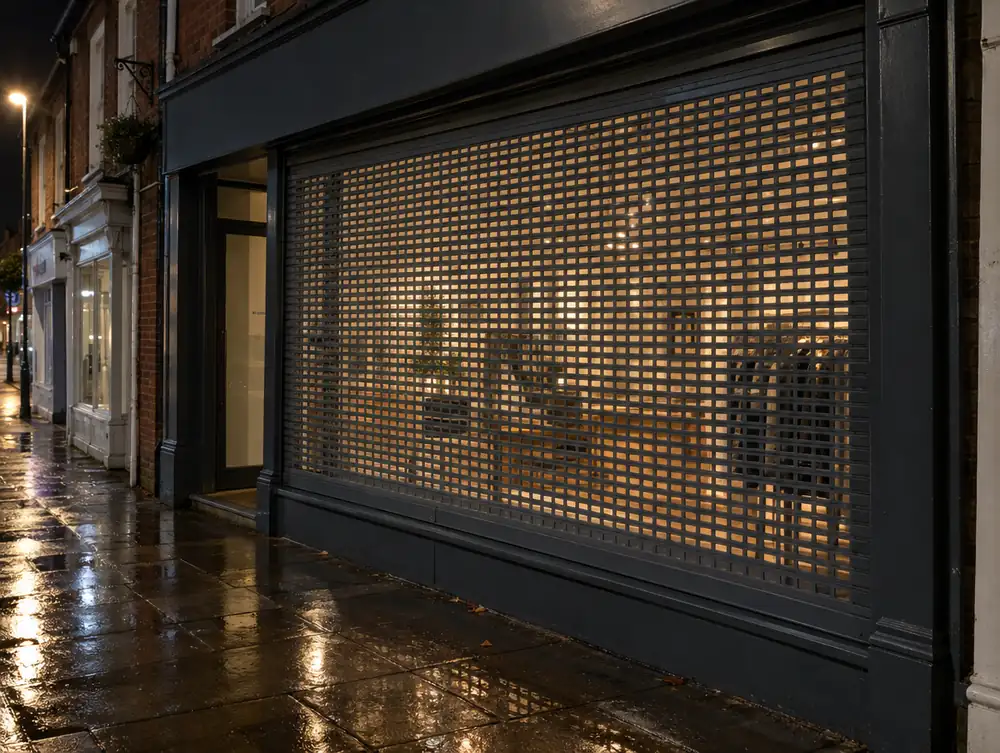
Solid shutters leave a blank wall behind them, and perforated ones do not. Across Whitchurch we fit curtains with enough open area for the display to read through them.
Please have keys to any meter cupboards and shutter housings to hand when we survey in Whitchurch, because what sits behind them can change the drawing.
How would we approach perforated roller shutters for your Whitchurch premises?
If the display goes dark overnight, the shutter will read as plain metal from the street. A low-level timer on the window lighting costs very little and keeps your Whitchurch frontage looking open.
For premises that open early or trade late, shutter noise can matter to neighbours. A motor with a soft start and well-set guides runs noticeably more quietly.
If there are storeys above the shop, the frontage should feel like the base of the building and not a sign stuck on it. Lining up mullions with the windows overhead is a small move that settles the whole elevation at Whitchurch premises.
What consents could affect perforated roller shutters in Whitchurch?
The existing rules still apply in Wales, because most of the Planning (Wales) Act 2026 is waiting for a commencement order. For perforated roller shutters at premises in the Whitchurch area, building work that materially affects the external appearance needs planning permission, while a true like-for-like replacement usually doesn't. The council confirms the current position.
For Whitchurch, the usual route for planning and advert applications is through City of Cardiff Council, and we confirm that when we visit.
What should you budget for perforated roller shutters in Whitchurch?
A sensible starting budget is £1,695 to £4,495 plus VAT per shutter. What shifts the figure is whatever can't be seen yet, such as the condition behind the old frontage or the services running through it.
| Town | Whitchurch |
|---|---|
| Area | South Glamorgan |
| Postcode districts | CF11, CF14, CF15, CF5 |
| Planning authority | City of Cardiff Council |
| Building approval | Building Regulations (Approved Documents for Wales) |
| Distance from Great Barr | About 91 miles |
| Survey | Free for new work |
Does Cardiff Council publish shopfront guidance?
Yes, Shopfront Design and Signage SPG (2019). It tells applicants what the council expects from new and altered shopfronts. A few of the things it asks for:
- A fascia should typically be no deeper than one-fifth of the shopfront's height.
- Solid or perforated roller shutters are not supported, and external shutters are unacceptable in the city centre, Cardiff Bay, conservation areas and on listed buildings.
- Where external shutters are allowed in exceptional cases in district or local centres, considerations include at least 50% transparency and a colour coating matching the shopfront.
Questions about perforated roller shutters in Whitchurch
Do you remove old shutters in Whitchurch?
Yes. Taking out the old curtain, box and guides, then making good the frontage, is shown as its own line in the itemised quotation.
What happens if the shutter jams at closing time in Whitchurch?
Do not force it, because that can damage the curtain and motor. Use the manual override if it is safe, then call us. Repairs are charged call-outs, and the fixed price is shown on our site.
Can you fit an internal shutter on my Whitchurch premises?
Usually, yes. We check for ceiling space, a clear path behind the window and a solid fixing for the guides. Where space is tight, a slim box or a smaller display can make it work.
Who decides listed building consent for a shopfront in the Whitchurch area?
Planning authorities and Welsh Ministers share control of listed building consent in Wales, under the Historic Environment (Wales) Act 2023. Cadw is the national body, and the 1990 Act no longer applies. Ask the council where an application should start.
What access duty applies to a shop in the Whitchurch area?
The Equality Act 2010 applies, in Wales as across Great Britain, and it requires reasonable steps to remove, alter or avoid physical features that disadvantage disabled people. The duty is anticipatory, so it covers disabled people generally. A feature that meets a design standard is generally protected for 10 years.