Looking for a front with more character on your Dunbar premises? A painted timber frontage, built up in layers and proportioned to the building, has a warmth that reads from across the street.
Expect us to measure the opening, photograph the existing front and check how materials will reach it on the day, at a time you have agreed.
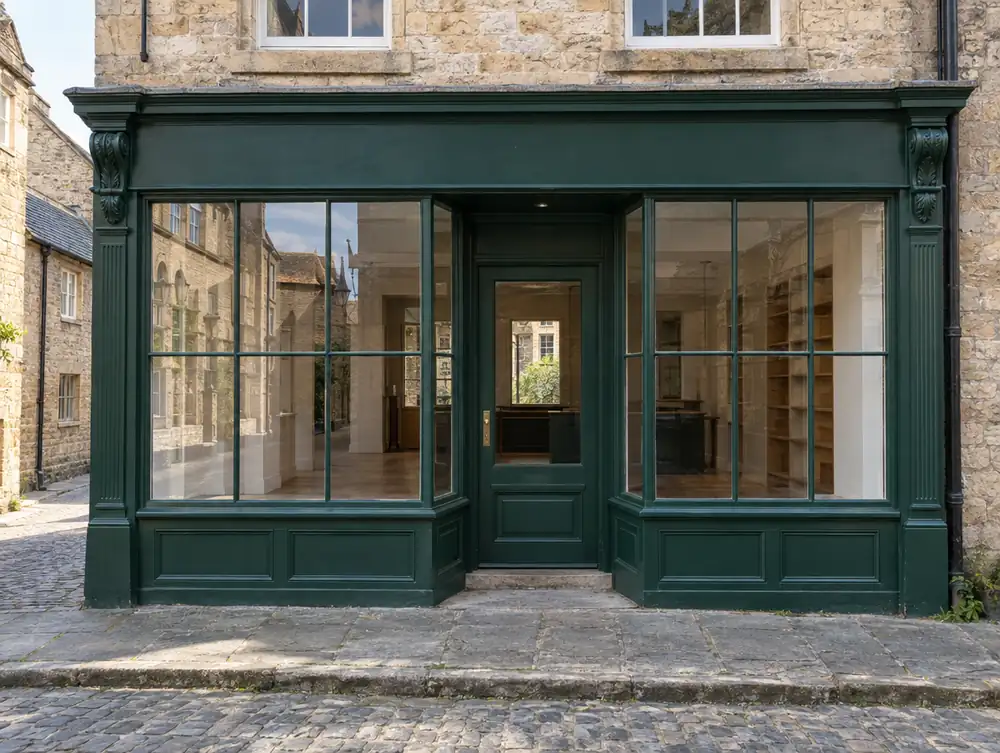
What makes timber shopfronts work well on Dunbar premises?
Timber fits a night programme better than you'd think, since most of the joinery is made elsewhere. For a unit in Dunbar that can't close by day, we'd fit the frame in stages at night and leave painting until the end, once the dust has gone.
If your Dunbar premises have a deep recessed entrance, timber can make it feel like a welcome. We'd panel the returns, add a lit soffit and lay a hard-wearing threshold, keeping the end grain of every post clear of the wet.
Where the building has good brick or stone around the opening, set the frame back in the reveal so the masonry can be seen. On Dunbar premises with a flat elevation, that deep reveal throws a shadow line that adds real depth in low sun.
How much should you set aside for timber shopfronts in Dunbar?
Allow £3,995 to £13,995 plus VAT for a typical frontage. Size and specification set most of that figure for timber shopfronts, and the rest depends on what the survey finds on site.
Could timber shopfronts in Dunbar need planning permission?
Class 9A, Scotland's shop permitted development right, gives no route for a shopfront change. It covers Class 1A premises, but not work that alters or extends beyond the existing front, and it doesn't apply in conservation areas, National Parks or World Heritage Sites. For timber shopfronts at premises in the Dunbar area, that generally means a planning application unless the external appearance isn't materially affected.
For Dunbar, the usual route for planning and advert applications is through East Lothian Council, and we confirm that when we visit.
| Town | Dunbar |
|---|---|
| Area | Edinburgh and the Lothians |
| Postcode districts | EH42 |
| Planning authority | East Lothian Council |
| Building approval | Building warrant (Technical Handbook) |
| Distance from Great Barr | About 240 miles |
| Survey | Free for new work |
Questions about timber shopfronts in Dunbar
Is timber a sensible choice for my Dunbar frontage?
Usually, if you're happy with a repaint every 5 to 7 years. A survey shows how exposed the front is and whether the structure behind it is sound, and we'll tell you if aluminium would serve you better.
Do you make the joinery for Dunbar shops to order?
Yes. Every length is made to the signed-off drawings for your opening, then brought to Dunbar from Great Barr by vetted teams working under S&K Glazing.
Can you fit a timber front around existing tiles in Dunbar?
Often, yes, and it's usually worth trying. If your stallriser or entrance has good original tile, we'd measure it carefully and scribe the new joinery to it.
Do I need listed building consent for a shopfront in the Dunbar area?
Almost certainly, if the building is listed and windows or doors are changing, according to Historic Environment Scotland. The planning authority decides, and Historic Environment Scotland is consulted on some applications. Scottish Ministers are notified if it objects.
Do I need a building warrant for a shopfront in the Dunbar area?
Usually yes in Scotland, if the work alters a wall or structure. Schedule 3 of the Building (Scotland) Regulations 2004 lists some work that needs no warrant, such as replacing a door or window with its frame, but the standards still apply. Shopfronts aren't named there, so ask the council before relying on it.