Want a front in Harrogate that feels made rather than assembled? Timber does that well, provided the mouldings are in scale and the joinery is detailed to shed water.
We measure your Harrogate opening in person, at a time agreed with you first, so the visit fits around your trading.
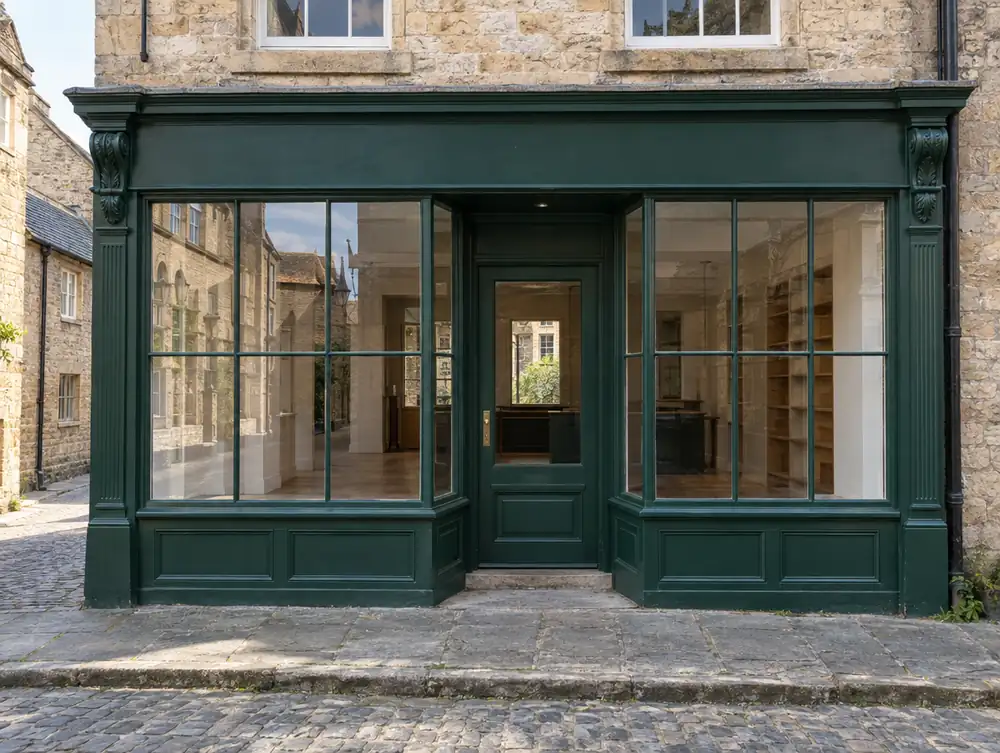
Where should you begin with timber shopfronts in Harrogate?
If your Harrogate premises have a deep recessed entrance, timber can make it feel like a welcome. We'd panel the returns, add a lit soffit and lay a hard-wearing threshold, keeping the end grain of every post clear of the wet.
Timber fits a night programme better than you'd think, since most of the joinery is made elsewhere. For a unit in Harrogate that can't close by day, we'd fit the frame in stages at night and leave painting until the end, once the dust has gone.
Where the building has good brick or stone around the opening, set the frame back in the reveal so the masonry can be seen. On Harrogate premises with a flat elevation, that deep reveal throws a shadow line that adds real depth in low sun.
What price should you expect for timber shopfronts in Harrogate?
We would budget £3,995 to £13,995 plus VAT for a typical frontage. Scope sets most of the figure, so a clear brief at the start does more for the budget than any later change of detail.
What sign-off might you need for timber shopfronts in Harrogate?
Security grilles and shutters are named in England's rules: installing or replacing one on a shopfront sits outside the shop permitted development rights. The frontage itself is treated the same way, so for timber shopfronts at premises in the Harrogate area, building work that materially affects the appearance needs planning permission. Confirm the position with the council before anything is ordered.
Expect planning and advert applications here to go to North Yorkshire Council in the normal way. We check what that means for your building when we survey it in Harrogate.
| Town | Harrogate |
|---|---|
| Area | North Yorkshire |
| Postcode districts | HG1, HG2 |
| Planning authority | North Yorkshire Council |
| Building approval | Building Regulations (Approved Documents) |
| Distance from Great Barr | About 101 miles |
| Survey | Free for new work |
Does Harrogate publish shopfront guidance?
Yes, Shopfronts Design Guide (2019). It covers the former Harrogate Borough Council area only, so it doesn't apply across the whole council area. A few of the things it asks for:
- The stallriser should not exceed 20% of the overall shopfront height, and timber ones should use frame and panel construction.
- The fascia should not exceed 10% of shopfront height, and the combined cornice, fascia and architrave should not exceed 20%.
- Lettering should be one-third to one-half of the fascia height, and no more than 375mm on modern over-deep fascias.
Questions about timber shopfronts in Harrogate
Can you copy a timber shopfront I've seen in North Yorkshire?
We can work from your photo and borrow what makes it succeed, including proportions, moulding sizes and colour. The front is then drawn to your own Harrogate opening.
Will timber suffer on my Harrogate frontage if it gets a lot of rain?
Not if the details are right. Sloped cills, sealed end grain and plinth blocks keep water moving, and the paint system then only has to deal with the weather, not trapped damp.
What should I budget for looking after a timber front in Harrogate?
A repaint every 5 to 7 years, plus a yearly wash and touch-up of the cills. Door gear needs checking too, since seasonal movement can throw a door out of line.
Do roller shutters need planning permission in the Harrogate area?
Usually yes. Installing or replacing a security grill or shutter on a shopfront is expressly outside England's shop permitted development rights, so the only way to avoid an application is work that doesn't materially affect the appearance. Ask the council before ordering.
Does a new shopfront in the Harrogate area need Building Regulations approval?
Assume yes until building control says otherwise. England has no like-for-like exemption, though registered installers can self-certify replacement windows and doors in non-dwellings. That route doesn't cover structural glass, curtain walling or revolving doors.