An optician's frontage has to beat reflection, because frames are small and usually seen from an angle. It also has to keep sunlight off stock and work for people whose sight is the reason they've come.
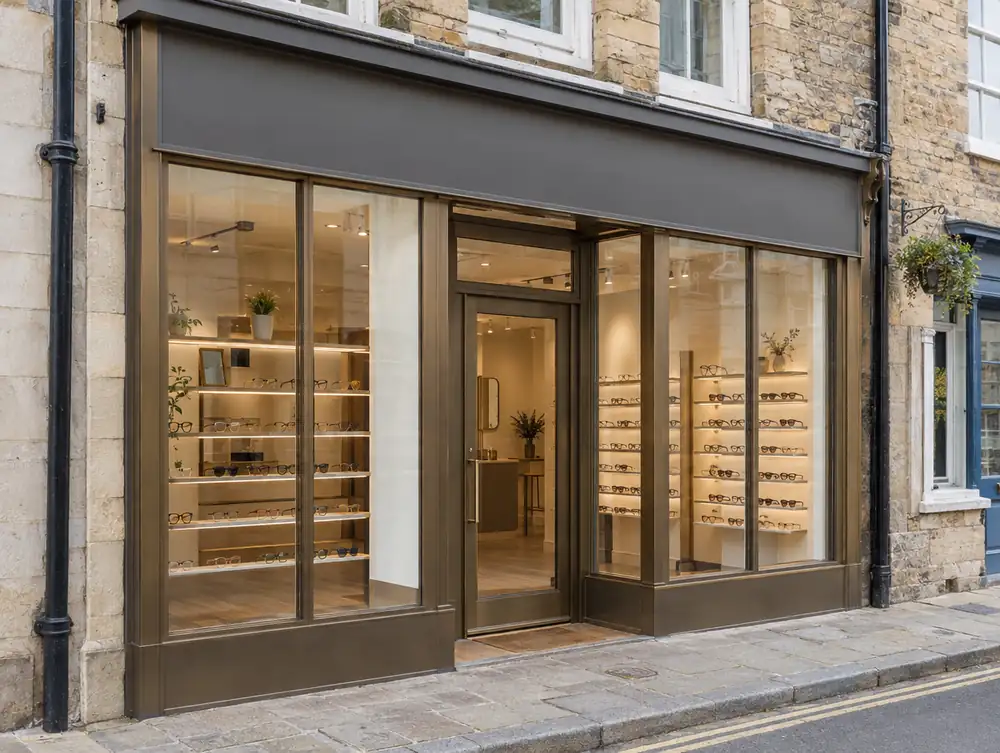
How do you reduce glare on an optician's window?
Anti-reflective coated glass is the direct fix, and it earns its cost on a bright elevation facing a pale building or open sky.
Glass mirrors whatever is brighter than the room behind it, so attack the problem from both sides. Shade the outside of the pane with a canopy, raise the light level in the display and put a dark backing behind the frames. Low-iron glass keeps colours honest too, since a green tint dulls pale acetate and clear frames. At survey we stand on the far pavement, because that is where the reflection you're fighting begins.
How high should frames sit in an optician's window?
Roughly 1200 to 1600mm above the pavement, where a passer-by's eye lands on something that small. That usually means a raised stallriser or tiered glass shelves.
There is a catch on glazed doors and screens. Markings sit at 850 to 1000mm and 1400 to 1600mm in all four UK nations, right across that display zone, so draw them in early. A fine etched pattern reads as part of the brand, where a sticker strip would cross your frames.
Light the shelves from the front edge. Backlit panels are tempting, but they turn thin metal frames into silhouettes.
How do you stop frames fading in the window?
Keep direct sun off them, because coloured acetate can fade and yellow over a summer.
Laminated glass filters much of the ultraviolet and an awning handles the rest. Rotating stock prevents pale ghost marks on display shelves, which show up the moment a frame is sold.
Pale and crystal acetates show yellowing first, so place them deeper in the window and give the sunniest positions to metal.
What do people with poor sight need from an entrance?
Contrast and predictability: a door they can find, and no surprise at the threshold. A glass door in a glass screen is the hardest thing to locate, so a framed door often serves better than a frameless one.
- Strong contrast between door, frame and surrounding wall
- Glass markings that stand out against both daylight and the interior
- A level threshold, or 15mm at most under guidance in all four nations
- Plain, generous lettering on the fascia
- Shade over the exit, as eye drops can leave people sensitive to bright light
Can a testing room sit at the front of the shop?
It can, but it has to go properly dark, so a back-painted or solid panel is more reliable than a blind.
Most practices keep testing at the rear and give the frontage to frame selection, since people judge a frame on their own face most accurately in daylight. Pre-test equipment looks clinical from outside, so keep it off the main sightline.
Common questions
Is anti-reflective glass worth the extra?
On a bright elevation, usually yes. View a sample pane on site, since the gain depends on what sits opposite.
Can reflections be removed completely?
No. Coatings and shading cut them sharply, but some reflection will remain on a sunny day.
Does an optician need a canopy?
It helps most on a south or west front, shading both glass and stock. Inclusive Mobility guidance from 2021 gives 2300mm of clearance generally, so draw it to at least that.
Should an optician's door be automatic?
Not always, but it helps people who are unsure of the step or the glass. A well-set manual door with strong contrast can also work.