Aluminium shopfronts for Carrickfergus premises start with a measured survey of your opening, because the neat lines of the metal will expose any lean in the building. We draw the frame to scale and you sign off every dimension before anything is made.
Surveys for Carrickfergus are booked with you directly. Tell us your quieter days and we'll work around them.
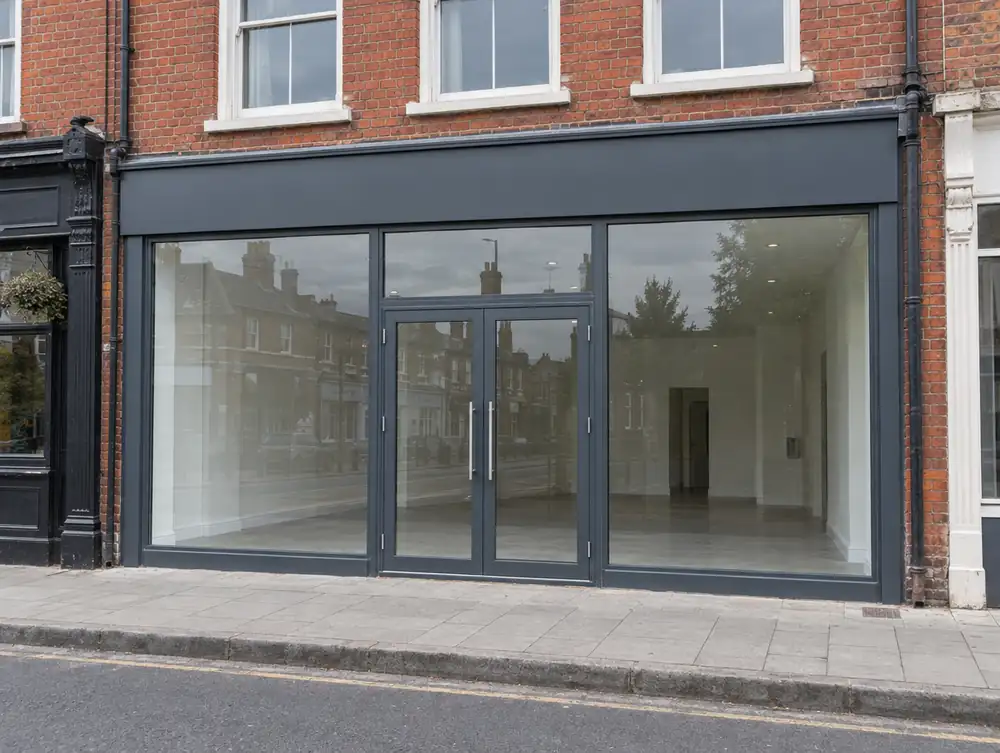
What should you think about before commissioning aluminium shopfronts in Carrickfergus?
If your Carrickfergus frontage faces south or west, the colour choice has a physical effect. Dark frames run hot in full sun and long runs of aluminium move, so we'd leave room for expansion at the fascia and look at solar control glass to protect stock.
On a corner plot, the side elevation does as much selling as the front. We'd run the stallriser and fascia round at one height and use a slim corner post in the frame colour, so anyone approaching your Carrickfergus premises from either direction sees one continuous shopfront.
Where a fascia has crept down over the years, lifting it back to its original line can add real height to the glass. Check what sits behind it first at Carrickfergus premises, since a shutter box or old beam may set the limit.
Who approves aluminium shopfronts in Carrickfergus?
Section 23 of the Planning Act (Northern Ireland) 2011 sets the test: work that doesn't materially affect the external appearance isn't development. That makes appearance the deciding point for aluminium shopfronts at premises in the Carrickfergus area, so planning permission is needed if it is materially affected and usually not for a true like-for-like replacement. The council confirms the position for the particular premises.
We confirm the position at survey, because a boundary or a special designation can change who handles the file, but applications from Carrickfergus premises normally go to Mid and East Antrim Borough Council.
What is a realistic budget for aluminium shopfronts in Carrickfergus?
The guide for aluminium shopfronts is £2,495 to £11,995 plus VAT for a typical 3 to 7 m frontage. Expect the lower end for simple work with clear access, and the upper end where detail, finish or awkward conditions add hours.
| Town | Carrickfergus |
|---|---|
| Area | County Antrim |
| Postcode districts | BT38 |
| Planning authority | Mid and East Antrim Borough Council |
| Building approval | Building Control (Technical Booklets) |
| Survey | Free for new work |
Questions about aluminium shopfronts in Carrickfergus
Can I keep trading while my Carrickfergus shopfront is replaced?
Often, yes. The front can usually be replaced a section at a time, with temporary screens keeping the shop secure, and a closed-day or out-of-hours fit can be arranged if that suits you better.
Will an aluminium front make my Carrickfergus shop warmer?
It can, though the glass matters more than the frame. A thermally broken section with double-glazed units loses less heat than single glazing, and a well-sealed door is often the change you notice most on a cold day.
Who carries out the work in Carrickfergus?
Vetted teams working under S&K Glazing carry it out, with one named contact from survey to handover. The contract is with S&K Glazing Limited, and we travel to Carrickfergus from Great Barr.
What rules apply to a fire exit door through a shopfront in the Carrickfergus area?
It must open in the direction of escape, it can't be locked against immediate use, and a dedicated fire exit can't be sliding or revolving. In Northern Ireland that comes from regulation 13(2) of the Fire Safety Regulations (Northern Ireland) 2010, and duties sit with dutyholders, meaning the employer and any person with control of the premises, whom the Fire and Rescue Service calls the appropriate person. An outward door may also need Department consent under Article 56 of the Roads (Northern Ireland) Order 1993.
Does the Disability Discrimination Act apply to a shop entrance in the Carrickfergus area?
Yes. The Disability Discrimination Act 1995 applies in Northern Ireland, and section 21 deals with physical features that make a service hard for disabled people to use. Regulations made in 2007 (SR 2007/473) add detail on features, third-party consent and design standards.