Slim frames and low upkeep make aluminium a sound choice for retailers, restaurants and landlords in Mossend. Each front is designed, made and fitted to the measured opening, with one contract covering glass, frame, sign and shutter.
Please have keys to any meter cupboards and shutter housings to hand when we survey in Mossend, because what sits behind them can change the drawing.
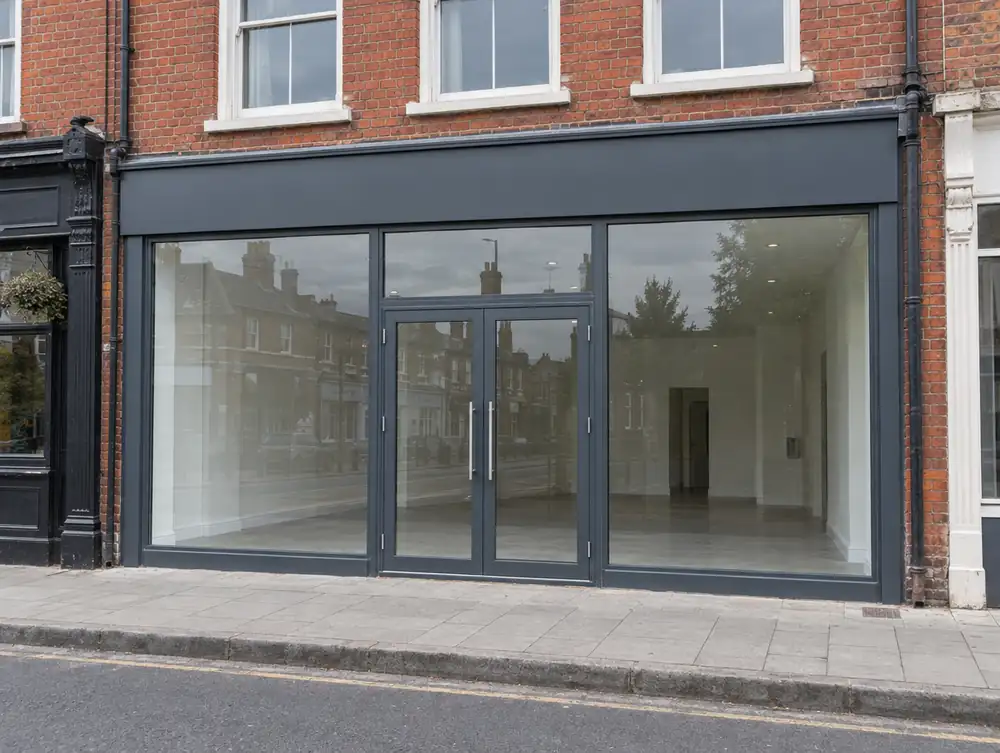
Where should you begin with aluminium shopfronts in Mossend?
Some Mossend landlords issue a shopfront specification, and we'd draw to it from the start. Where your brand needs something different, we mark each departure on the drawing so the landlord can approve the front without a round of guesswork.
On a corner plot, the side elevation does as much selling as the front. We'd run the stallriser and fascia round at one height and use a slim corner post in the frame colour, so anyone approaching your Mossend premises from either direction sees one continuous shopfront.
If your Mossend unit sits in a Victorian parade, the old pilasters usually set the rhythm, so a new front should land on them and not run past them. Keep that line and even a modern frame looks as though it belongs.
What sign-off might you need for aluminium shopfronts in Mossend?
Shutters aren't named in Class 9A, so in Scotland they usually fall to the appearance test. The same goes for aluminium shopfronts at premises in the Mossend area: building work that materially affects the external appearance needs planning permission, and a true like-for-like usually doesn't. Ask the council to confirm the position for your site.
Expect planning and advert applications here to go to North Lanarkshire Council in the normal way. We check what that means for your building when we survey it in Mossend.
What price should you expect for aluminium shopfronts in Mossend?
Allow £2,495 to £11,995 plus VAT for a typical 3 to 7 m frontage. Size and specification set most of that figure for aluminium shopfronts, and the rest depends on what the survey finds on site.
| Town | Mossend |
|---|---|
| Area | Lanarkshire |
| Postcode districts | G71, ML1, ML4, ML5 |
| Planning authority | North Lanarkshire Council |
| Building approval | Building warrant (Technical Handbook) |
| Distance from Great Barr | About 241 miles |
| Survey | Free for new work |
Does North Lanarkshire Council publish shopfront guidance?
Yes, Shopfronts & Security (2011). It tells applicants what the council expects from new and altered shopfronts. A few of the things it asks for:
- Original stallrisers should be retained or reinstated, and new ones should be 450mm to 700mm high.
- Fascias should be horizontally proportioned and roughly 300mm to 450mm high.
- Demountable grilles are preferred, and externally stored roller shutters carry a high risk of refusal.
Questions about aluminium shopfronts in Mossend
What happens to my old shopfront in Mossend?
We strip it out and take it away, and that work appears as its own line on the quotation. If part of the old front is worth keeping, such as a stallriser or decorative ironwork, say so at survey and we'll draw around it.
Can I keep trading while my Mossend shopfront is replaced?
Often, yes. The front can usually be replaced a section at a time, with temporary screens keeping the shop secure, and a closed-day or out-of-hours fit can be arranged if that suits you better.
Can you match a shopfront I like elsewhere in Lanarkshire?
Usually, yes. Send the photo and address, and we'll work out the section, colour and proportions behind it, then adapt them to your Mossend opening.
Does a shop sign in the Mossend area need advertisement consent?
Not always. Scotland's 1984 Regulations let an unlit sign within Class IV(1) go up without an application, and Class VI does the same for a lit sign with each character lit from within. Class VI isn't available in conservation areas, and one council says lit signs always need express consent, so ask first.
Does the Equality Act cover a shop entrance in the Mossend area?
Yes. The Equality Act 2010 applies in Scotland as part of Great Britain, and its anticipatory duty expects reasonable steps to remove, alter or avoid physical features that disadvantage disabled people generally. BS 8300-2:2018 is the current British Standard for accessible buildings.