Does your Bo’ness shop need a hands-free entrance? A well-set sliding door gives customers, pushchairs and wheelchairs a clear way in, without anything swinging into the street.
A survey in Bo’ness usually starts outside, looking at the whole elevation before any tape comes out, because the frontage has to answer the building above it.
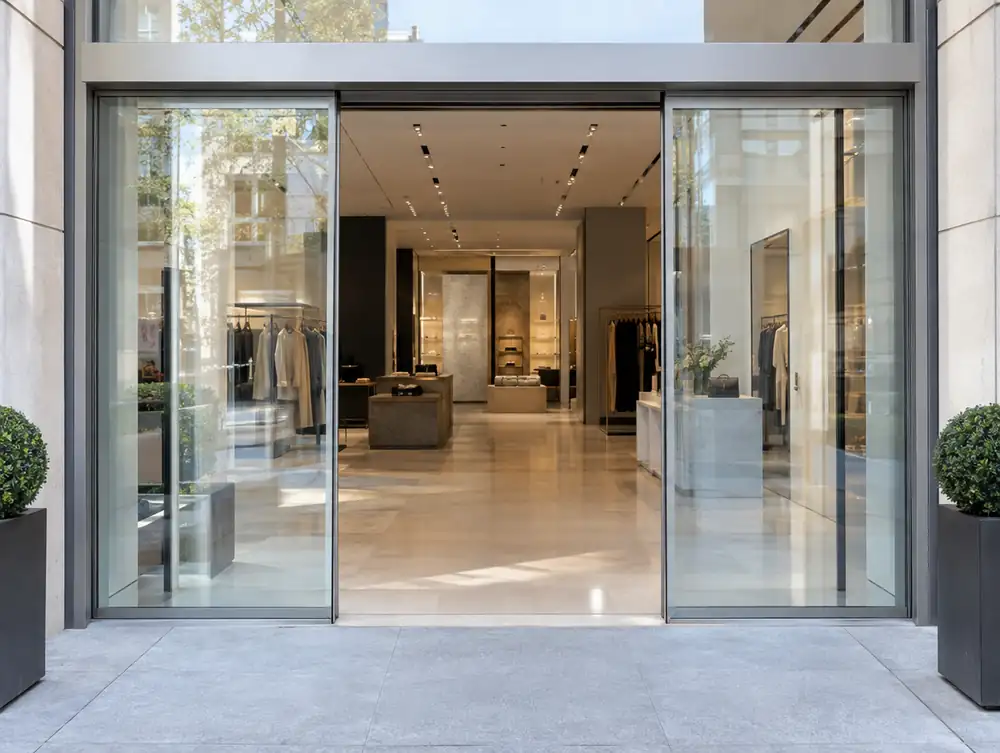
What makes automatic sliding doors work well on Bo’ness premises?
A deep recess is a gift for an automatic door. At Bo’ness premises with one, we'd set the door back from the street so the sensors see less of the pavement and the leaves get some shelter from the wind.
If your Bo’ness entrance catches low sun, infrared sensors can misread the light on the floor. We'd favour radar with a presence sensor set for those conditions, and consider solar control glass in the leaves.
If your Bo’ness unit is narrow, a central door can split a small window into two weak ones. Moving the door to one side gives you a single confident pane, provided the layout inside still works.
Could automatic sliding doors in Bo’ness need planning permission?
Class 9A, Scotland's shop permitted development right, gives no route for a shopfront change. It covers Class 1A premises, but not work that alters or extends beyond the existing front, and it doesn't apply in conservation areas, National Parks or World Heritage Sites. For automatic sliding doors at premises in the Bo’ness area, that generally means a planning application unless the external appearance isn't materially affected.
For Bo’ness, the usual route for planning and advert applications is through Falkirk Council, and we confirm that when we visit.
How much should you set aside for automatic sliding doors in Bo’ness?
Allow £3,895 to £11,995 plus VAT per entrance. Size and specification set most of that figure for automatic sliding doors, and the rest depends on what the survey finds on site.
| Town | Bo’ness |
|---|---|
| Area | Stirling and Falkirk |
| Postcode districts | EH49, EH51, FK3 |
| Planning authority | Falkirk Council |
| Building approval | Building warrant (Technical Handbook) |
| Distance from Great Barr | About 249 miles |
| Survey | Free for new work |
Questions about automatic sliding doors in Bo’ness
What will people on the street see at my Bo’ness entrance?
Ideally, very little. The drive sits behind the fascia, the leaves line up with the screens beside them, and the frame colour matches the rest of your front.
Can an automatic door work with my Bo’ness shop's alarm and locks?
Yes. The door can lock at closing, and it can link to your alarm or access control where the systems allow, with a manual key position as a fallback.
Will the door keep opening for passers-by in Bo’ness?
Not if it is set up properly. We narrow the sensor field on site and test it against real footfall, so only people heading for the door trigger it.
Which way must a fire exit door open on a shop in the Bo’ness area?
In the direction of escape. Regulation 13(2) of the Fire Safety (Scotland) Regulations 2006 also rules out sliding and revolving doors on a dedicated fire exit and says fire exit doors can't be locked against immediate use. Duties sit with dutyholders under Part 3 of the Fire (Scotland) Act 2005, meaning the employer and any person with control of the premises.
Does a shop sign in the Bo’ness area need advertisement consent?
Not always. Scotland's 1984 Regulations let an unlit sign within Class IV(1) go up without an application, and Class VI does the same for a lit sign with each character lit from within. Class VI isn't available in conservation areas, and one council says lit signs always need express consent, so ask first.