Automatic sliding doors for Crofton Park premises start with how people reach your entrance. We look at the pavement, the footfall and the space either side of the opening before recommending a door.
Measuring the opening is the easy part of a survey in Crofton Park. We also look at the beam above, the pavement fall and any meters or drains nearby.
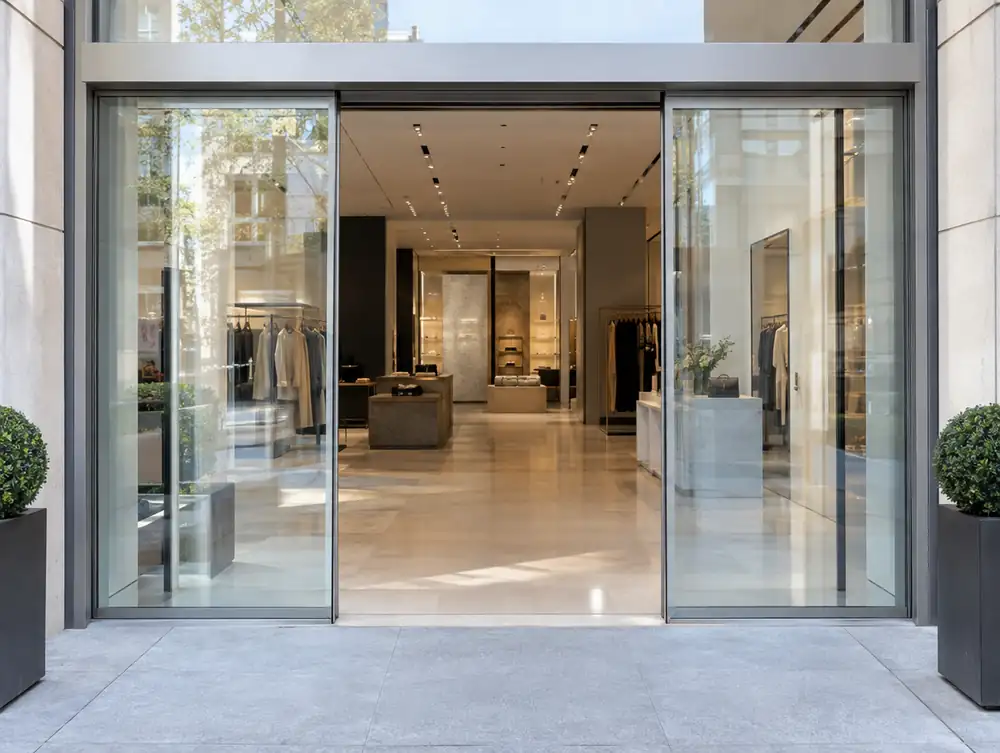
What goes into getting automatic sliding doors right in Crofton Park?
For a pharmacy or retail chain with a branch in Crofton Park, we'd keep the door type, finish and settings the same as the estate standard. Opening width and head detail then adapt to this particular front.
If your Crofton Park entrance catches low sun, infrared sensors can misread the light on the floor. We'd favour radar with a presence sensor set for those conditions, and consider solar control glass in the leaves.
If your premises were once two shops, decide early whether the front should read as one or as two. One continuous fascia with a repeated bay width usually settles the elevation better than two mismatched halves, which is worth testing on any Crofton Park unit of that kind.
How much could automatic sliding doors in Crofton Park cost you?
Our guide band is £3,895 to £11,995 plus VAT per entrance. Scope is the biggest lever, so a tighter brief for automatic sliding doors brings the figure down faster than any change of detail.
Which applications might automatic sliding doors in Crofton Park involve?
For automatic sliding doors at premises in the Crofton Park area, the deciding question in England is whether the building work materially affects the external appearance. If it does, planning permission is needed, while a true like-for-like replacement usually needs none. The council confirms the position for each site.
We confirm the position at survey, because a boundary or a special designation can change who handles the file, but applications from Crofton Park premises normally go to London Borough of Lewisham.
| Town | Crofton Park |
|---|---|
| Area | Greater London |
| Postcode districts | SE13, SE23, SE4, SE6 |
| Planning authority | London Borough of Lewisham |
| Building approval | Building Regulations (Approved Documents) |
| Distance from Great Barr | About 110 miles |
| Survey | Free for new work |
Does Lewisham Council publish shopfront guidance?
Yes, Shopfront design guide, a supplementary planning document (2006). It tells applicants what the council expects from new and altered shopfronts. A few of the things it asks for:
- Fascias should generally be about 600mm high, never more than 900mm, and should not run unbroken across separate buildings.
- Solid external roller shutters are not acceptable, and open mesh or grille shutters should be powder coated with the box hidden behind the fascia.
- Internally lit fascia boxes are not allowed in conservation areas, with external lighting preferred.
Questions about automatic sliding doors in Crofton Park
Can an automatic door work with my Crofton Park shop's alarm and locks?
Yes. The door can lock at closing, and it can link to your alarm or access control where the systems allow, with a manual key position as a fallback.
Will an automatic door fit my Crofton Park shop?
It depends on the width of the front and the depth at the head. A survey shows whether the parked leaves fit and where the operator can hide, and if a slider won't work we'd look at a powered swing door.
What will people on the street see at my Crofton Park entrance?
Ideally, very little. The drive sits behind the fascia, the leaves line up with the screens beside them, and the frame colour matches the rest of your front.
Do roller shutters need planning permission in the Crofton Park area?
Usually yes. Installing or replacing a security grill or shutter on a shopfront is expressly outside England's shop permitted development rights, so the only way to avoid an application is work that doesn't materially affect the appearance. Ask the council before ordering.
Do I need listed building consent for a shopfront in the Crofton Park area?
Usually yes, if the building is listed. In England the local planning authority decides, and Historic England is notified of Grade I and II* works and specified Grade II works. Like-for-like repair may not need consent, so ask the council before work starts.