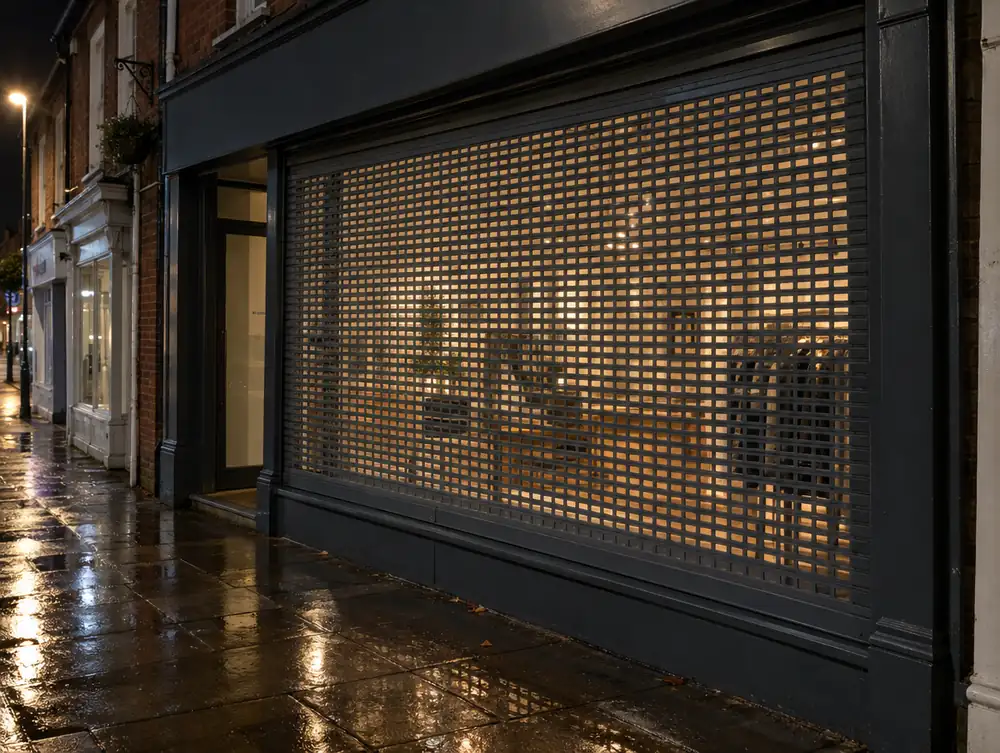
A closed shop should still look alive. For Crofton Park frontages, a perforated curtain and a lit display keep the window working long after you lock up.
Surveys for Crofton Park are booked with you directly. Tell us your quieter days and we'll work around them.
What makes perforated roller shutters work well on Crofton Park premises?
If your Crofton Park unit has an old external shutter, we check whether the box can come off and leave a clean fascia. That single change can lift a frontage more than a new sign.
Where stock is high in value, a perforated shutter alone may not be enough. We would look at laminated glass in front, a rated curtain, and what your insurer expects, then specify the three together.
Where a fascia has crept down over the years, lifting it back to its original line can add real height to the glass. Check what sits behind it first at Crofton Park premises, since a shutter box or old beam may set the limit.
How much should you set aside for perforated roller shutters in Crofton Park?
Until the survey is done, plan on £1,695 to £4,495 plus VAT per shutter. Unusual sizes, fine detail and phased working push the figure up, while a simple brief and clear access keep it toward the lower end.
Could perforated roller shutters in Crofton Park need planning permission?
England has no permitted development route for changing a shopfront. Part 7 Class A of the General Permitted Development Order 2015 excludes creating, altering or replacing one, and it allows no alterations at all on article 2(3) land. That leaves two outcomes for perforated roller shutters at premises in the Crofton Park area: a planning application, or work that doesn't materially affect the external appearance.
We confirm the position at survey, because a boundary or a special designation can change who handles the file, but applications from Crofton Park premises normally go to London Borough of Lewisham.
| Town | Crofton Park |
|---|---|
| Area | Greater London |
| Postcode districts | SE13, SE23, SE4, SE6 |
| Planning authority | London Borough of Lewisham |
| Building approval | Building Regulations (Approved Documents) |
| Distance from Great Barr | About 110 miles |
| Survey | Free for new work |
Does Lewisham Council publish shopfront guidance?
Yes, Shopfront design guide, a supplementary planning document (2006). It tells applicants what the council expects from new and altered shopfronts. A few of the things it asks for:
- Fascias should generally be about 600mm high, never more than 900mm, and should not run unbroken across separate buildings.
- Solid external roller shutters are not acceptable, and open mesh or grille shutters should be powder coated with the box hidden behind the fascia.
- Internally lit fascia boxes are not allowed in conservation areas, with external lighting preferred.
Questions about perforated roller shutters in Crofton Park
What happens if the shutter jams at closing time in Crofton Park?
Do not force it, because that can damage the curtain and motor. Use the manual override if it is safe, then call us. Repairs are charged call-outs, and the fixed price is shown on our site.
Can one person open the shutter at my Crofton Park shop?
Yes. Powered shutters run at the turn of a key or a button press, and a manual override is available if the power fails. We show your staff both at handover.
Can you fit an internal shutter on my Crofton Park premises?
Usually, yes. We check for ceiling space, a clear path behind the window and a solid fixing for the guides. Where space is tight, a slim box or a smaller display can make it work.
Does a shop sign in the Crofton Park area need advertisement consent?
Not always. In England, an unlit sign within Class 5 of the 2007 Advertisement Regulations generally needs no application, and neither does a lit sign within Class 4B. Anything outside those classes needs consent, and Class 4B isn't available in conservation areas, so check before ordering.
Does the Equality Act apply to a shop entrance in the Crofton Park area?
Yes. The Equality Act 2010 applies in England, as across Great Britain, and it requires reasonable steps to remove, alter or avoid physical features that disadvantage disabled people. The duty is anticipatory, so it looks at disabled people generally, and a new Services Code replaced the 2011 Code on 5 August 2026.