A bi-folding front lets a restaurant, bar or showroom in Ammanford open fully to the street when the weather allows. We draw the panels, stack and threshold to your opening, so it closes up tight when the weather doesn't.
It helps if you can be there when we visit Ammanford, since five minutes walking the frontage together answers more than a long email.
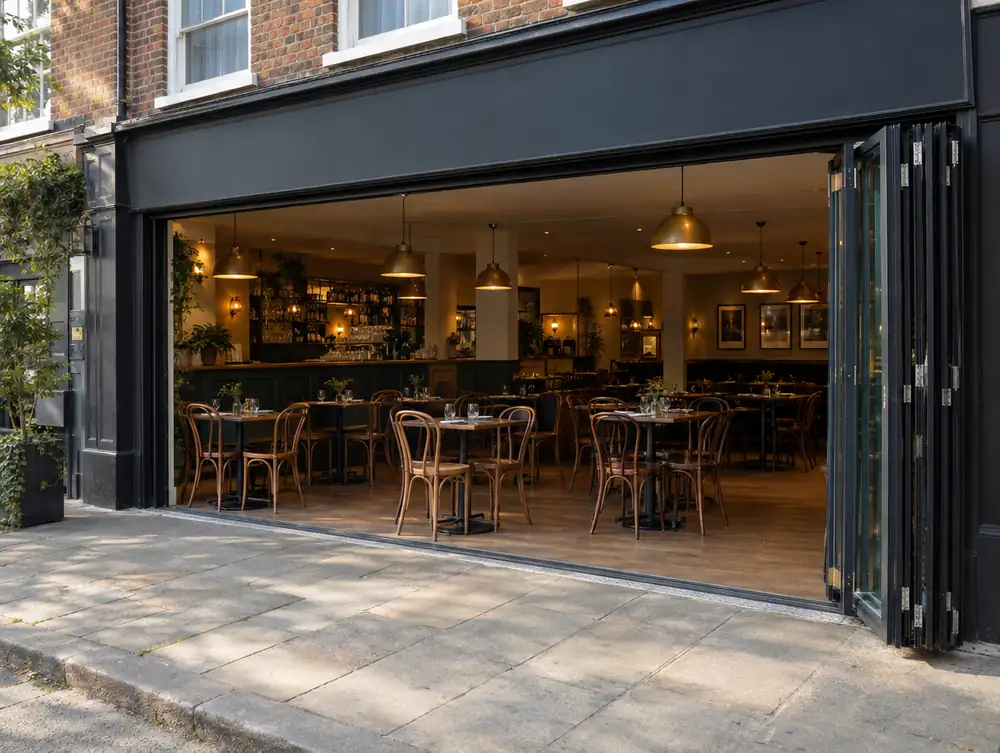
What should you think about before commissioning bi-folding shopfronts in Ammanford?
If your Ammanford frontage faces the sun, a bi-fold doubles as ventilation. We'd pair it with an awning so the room stays usable at midday, and look at solar control glass for the days the set stays closed.
A corner plot offers something rare: a front that can open on two sides. For Ammanford corner premises, we'd look at two sets meeting with no fixed post, provided the structure above can span it.
If there are storeys above the shop, the frontage should feel like the base of the building and not a sign stuck on it. Lining up mullions with the windows overhead is a small move that settles the whole elevation at Ammanford premises.
What is a realistic budget for bi-folding shopfronts in Ammanford?
Allow £5,195 to £13,995 plus VAT for a typical opening. Size and specification set most of that figure for bi-folding shopfronts, and the rest depends on what the survey finds on site.
Who approves bi-folding shopfronts in Ammanford?
The existing rules still apply in Wales, because most of the Planning (Wales) Act 2026 is waiting for a commencement order. For bi-folding shopfronts at premises in the Ammanford area, building work that materially affects the external appearance needs planning permission, while a true like-for-like replacement usually doesn't. The council confirms the current position.
Planning and advert applications for Ammanford premises normally go to Carmarthenshire County Council. We check the position for your address at survey.
| Town | Ammanford |
|---|---|
| Area | Dyfed |
| Postcode districts | SA18 |
| Planning authority | Carmarthenshire County Council |
| Building approval | Building Regulations (Approved Documents for Wales) |
| Distance from Great Barr | About 102 miles |
| Survey | Free for new work |
Does Carmarthenshire County Council publish shopfront guidance?
Yes, Carmarthenshire Shopfront Design Guide 2022 (2022). It tells applicants what the council expects from new and altered shopfronts. A few of the things it asks for:
- The fascia should be no deeper than the console and sit just below the cornice, and box fascias are not permitted.
- External roller shutters, external grilles and solid metal shutters are not permitted, with internal lattice or brick-bond grilles preferred.
- Internally lit signs are not permitted, and fascias should be lit externally with discreet downward-facing fittings.
Questions about bi-folding shopfronts in Ammanford
Who do I speak to about a bi-fold in Ammanford?
Your named contact stays the same from the first visit to the final adjustment. Fitting is carried out by vetted teams working under S&K Glazing, travelling from Great Barr.
Will I lose a table to the stack in my Ammanford restaurant?
Possibly one, but careful layout usually avoids it. We draw the folded panels on your floor plan, then look at moving the stack to a quieter corner or splitting the set in two.
Can the threshold be level at my Ammanford premises?
It can be close to level, depending on the floor and drainage. We'd check the levels at survey, because a track sitting flush with the pavement still needs somewhere for water to go.
Does a replacement shopfront in the Ammanford area need Building Regulations approval?
Assume yes until building control says otherwise, because Wales has no like-for-like exemption. Glazing is judged against Approved Document N, as Wales keeps Part N. A registered installer can self-certify replacement windows and doors in non-dwellings, but not structural glass, curtain walling or revolving doors.
When does a shop sign in the Ammanford area need advertisement consent?
A sign needs advertisement consent when it falls outside Class 5 or Class 4B of the 1992 Advertisement Regulations, which still apply in Wales. Within Class 5, an unlit sign sits on a wall containing a shop window and tops out at 4.6m or the first-floor sill if lower. A lit sign in a conservation area needs consent, because Class 4B isn't available there.