Internal shutters have become the sensible first option for many premises. They keep the frontage clean by day and protect stock at night.
Please have keys to any meter cupboards and shutter housings to hand when we survey in Ammanford, because what sits behind them can change the drawing.
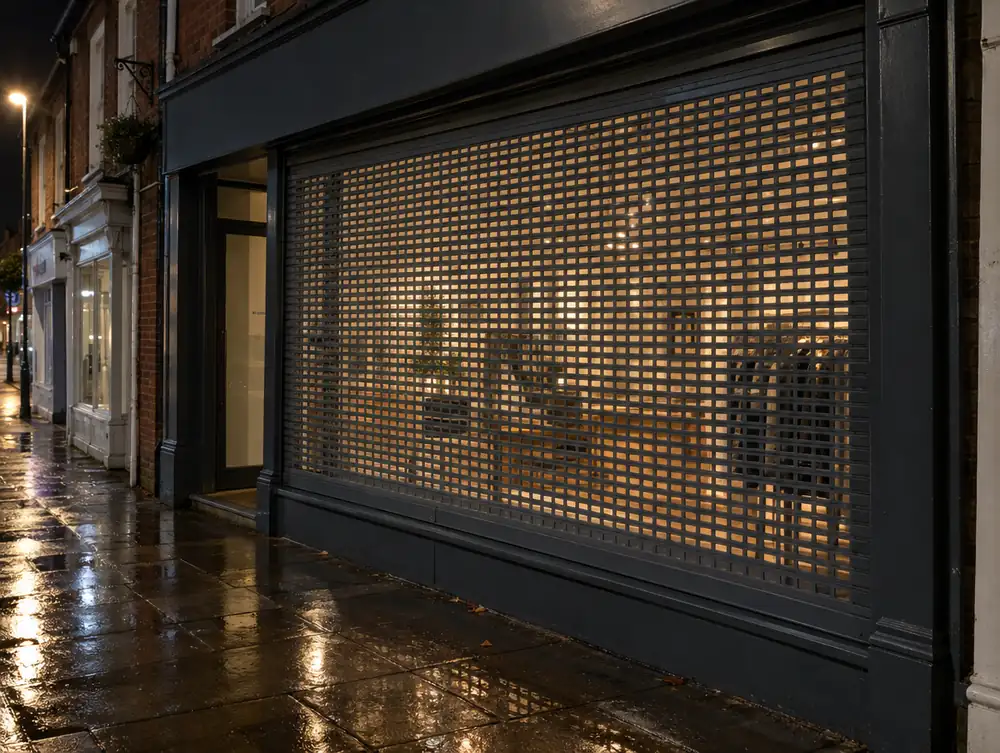
How do you design around the building when planning perforated roller shutters in Ammanford?
If your Ammanford shopfront has a suspended ceiling behind it, an internal box can often hide above the tiles. Where the ceiling is solid or very low, we would look at a slim box in a painted bulkhead.
Where stock is high in value, a perforated shutter alone may not be enough. We would look at laminated glass in front, a rated curtain, and what your insurer expects, then specify the three together.
Where a fascia has crept down over the years, lifting it back to its original line can add real height to the glass. Check what sits behind it first at Ammanford premises, since a shutter box or old beam may set the limit.
What might perforated roller shutters cost in Ammanford?
We would budget £1,695 to £4,495 plus VAT per shutter. Scope sets most of the figure, so a clear brief at the start does more for the budget than any later change of detail.
What permissions should you check for perforated roller shutters in Ammanford?
Like-for-like replacement usually needs no planning permission in Wales, because the external appearance isn't materially affected. Matching the existing materials, proportions and glass line is what keeps a job in that position. For perforated roller shutters at premises in the Ammanford area, changing any of those usually means an application, which the council can confirm.
For Ammanford, the usual route for planning and advert applications is through Carmarthenshire County Council, and we confirm that when we visit.
| Town | Ammanford |
|---|---|
| Area | Dyfed |
| Postcode districts | SA18 |
| Planning authority | Carmarthenshire County Council |
| Building approval | Building Regulations (Approved Documents for Wales) |
| Distance from Great Barr | About 102 miles |
| Survey | Free for new work |
Does Carmarthenshire County Council publish shopfront guidance?
Yes, Carmarthenshire Shopfront Design Guide 2022 (2022). It tells applicants what the council expects from new and altered shopfronts. A few of the things it asks for:
- The fascia should be no deeper than the console and sit just below the cornice, and box fascias are not permitted.
- External roller shutters, external grilles and solid metal shutters are not permitted, with internal lattice or brick-bond grilles preferred.
- Internally lit signs are not permitted, and fascias should be lit externally with discreet downward-facing fittings.
Questions about perforated roller shutters in Ammanford
What happens if the shutter jams at closing time in Ammanford?
Do not force it, because that can damage the curtain and motor. Use the manual override if it is safe, then call us. Repairs are charged call-outs, and the fixed price is shown on our site.
Can a perforated shutter match my other sites in Dyfed?
Yes. Send us the colour reference and curtain type from an existing site, and we match them on the new one. The box and guides may differ, because each frontage has its own structure.
What controls can a shutter have?
A key switch, a wall button or a remote are the usual choices, each with a manual override. Many shops use a key switch at the door, so closing up needs someone present.
When does a shop sign in the Ammanford area need advertisement consent?
A sign needs advertisement consent when it falls outside Class 5 or Class 4B of the 1992 Advertisement Regulations, which still apply in Wales. Within Class 5, an unlit sign sits on a wall containing a shop window and tops out at 4.6m or the first-floor sill if lower. A lit sign in a conservation area needs consent, because Class 4B isn't available there.
What access duty applies to a shop in the Ammanford area?
The Equality Act 2010 applies, in Wales as across Great Britain, and it requires reasonable steps to remove, alter or avoid physical features that disadvantage disabled people. The duty is anticipatory, so it covers disabled people generally. A feature that meets a design standard is generally protected for 10 years.