Panels that fold away should still look right when closed, since that is how a front in Crumpsall spends most of the year. We keep the widths even, the rails aligned and the frames slim, so the set reads as a shopfront.
It helps if you can be there when we visit Crumpsall, since five minutes walking the frontage together answers more than a long email.
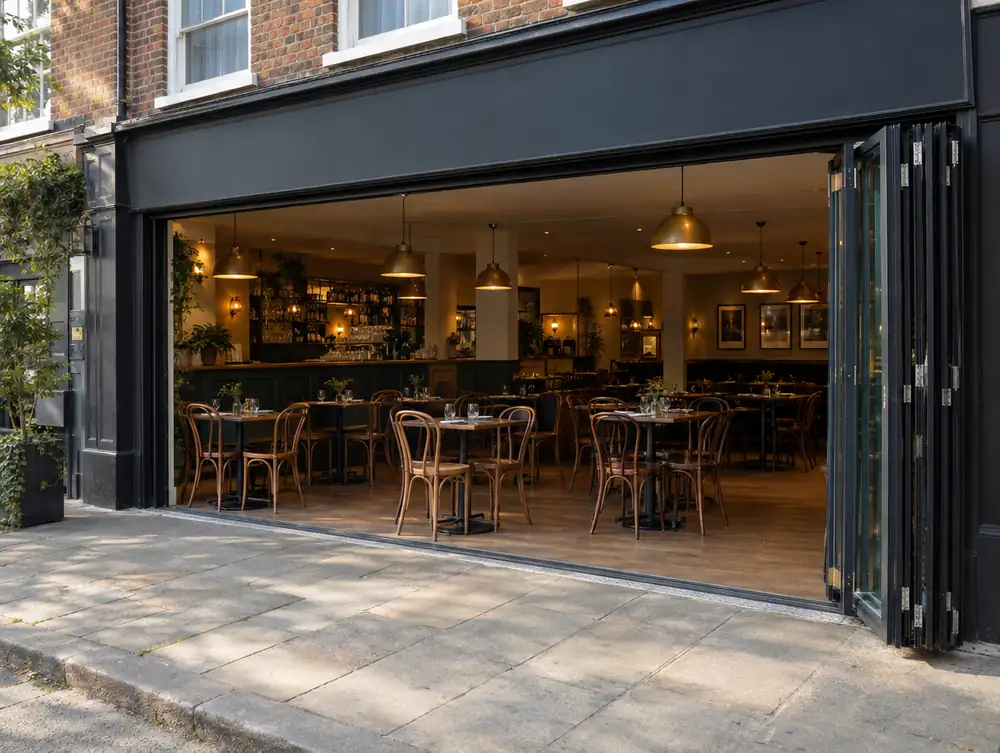
How would we approach bi-folding shopfronts for your Crumpsall premises?
A corner plot offers something rare: a front that can open on two sides. For Crumpsall corner premises, we'd look at two sets meeting with no fixed post, provided the structure above can span it.
For a restaurant group opening in Crumpsall, a bi-fold can carry the brand's look from site to site. We'd standardise the panel section, colour and hardware, then vary the panel count and stack side to suit each opening.
If there are storeys above the shop, the frontage should feel like the base of the building and not a sign stuck on it. Lining up mullions with the windows overhead is a small move that settles the whole elevation at Crumpsall premises.
What should you budget for bi-folding shopfronts in Crumpsall?
As a working budget, use £5,195 to £13,995 plus VAT for a typical opening. Your place inside that range for bi-folding shopfronts depends mostly on how much of the existing frontage can stay and how much has to be put right first.
What consents could affect bi-folding shopfronts in Crumpsall?
A true like-for-like replacement usually needs no planning permission in England, because the external appearance isn't materially affected. New materials, a different glass line or altered proportions usually do count as material, so for bi-folding shopfronts at premises in the Crumpsall area, an application is then likely. The council confirms which side of that line a job falls on.
For Crumpsall, the usual route for planning and advert applications is through Manchester City Council, and we confirm that when we visit.
| Town | Crumpsall |
|---|---|
| Area | Greater Manchester |
| Postcode districts | M25, M7, M8, M9 |
| Planning authority | Manchester City Council |
| Building approval | Building Regulations (Approved Documents) |
| Distance from Great Barr | About 68 miles |
| Survey | Free for new work |
Does Manchester City Council publish shopfront guidance?
Yes, Shopfront and Signage Design Guide. It tells applicants what the council expects from new and altered shopfronts. A few of the things it asks for:
- External shutters are generally not permitted, and any exceptional case must be at least 50% transparent, sit within the shopfront frame and hide its box behind the fascia.
- Internally lit lightbox signage is not permitted for new signs, and external lighting such as discreet spotlights is preferred.
- New signage is limited to one fascia or internal hanging sign per elevation, with a maximum depth of 30mm.
Questions about bi-folding shopfronts in Crumpsall
Will I lose a table to the stack in my Crumpsall restaurant?
Possibly one, but careful layout usually avoids it. We draw the folded panels on your floor plan, then look at moving the stack to a quieter corner or splitting the set in two.
How secure is a folding front in Crumpsall overnight?
Very, if it is specified for the job. Each leaf locks top and bottom with concealed bolts, and laminated glass adds a second line of defence.
Who do I speak to about a bi-fold in Crumpsall?
Your named contact stays the same from the first visit to the final adjustment. Fitting is carried out by vetted teams working under S&K Glazing, travelling from Great Barr.
Does the Equality Act apply to a shop entrance in the Crumpsall area?
Yes. The Equality Act 2010 applies in England, as across Great Britain, and it requires reasonable steps to remove, alter or avoid physical features that disadvantage disabled people. The duty is anticipatory, so it looks at disabled people generally, and a new Services Code replaced the 2011 Code on 5 August 2026.
Do I need planning permission to change a shopfront in the Crumpsall area?
Usually yes, if the work materially affects the building's external appearance. England's shop permitted development rights exclude creating, altering or replacing a shopfront, so there is no shortcut. A true like-for-like replacement usually needs no application, and the council confirms the position.