A heritage shopfront in Crumpsall starts with what survives on the building, however little that seems. We record it, draw it and design any new work from that evidence.
Please have keys to any meter cupboards and shutter housings to hand when we survey in Crumpsall, because what sits behind them can change the drawing.
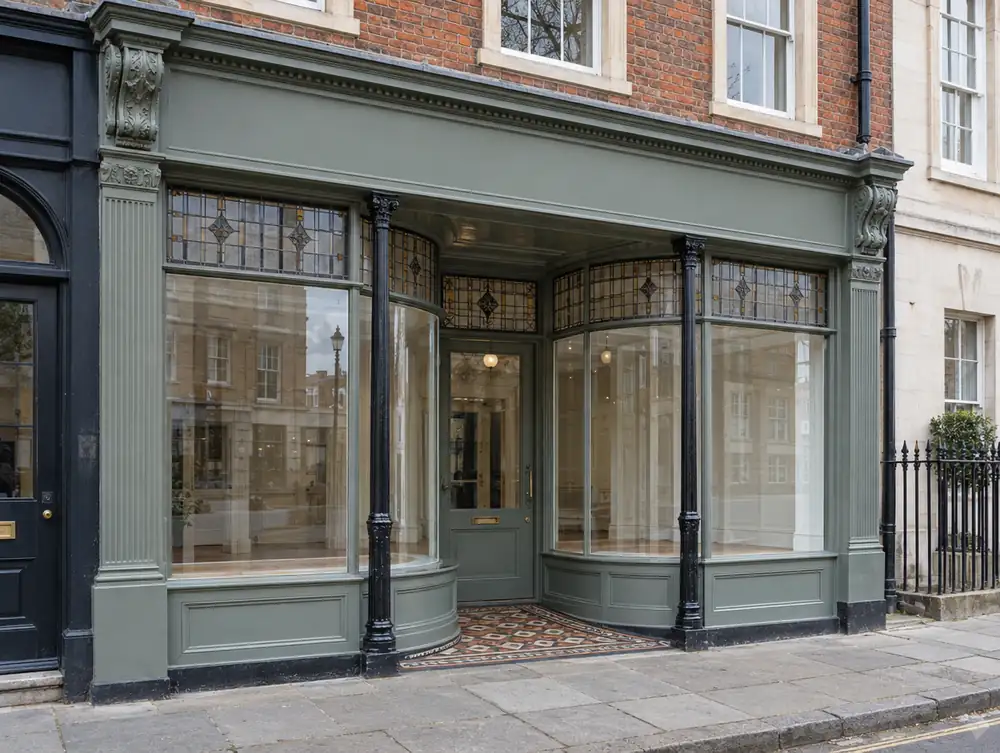
What goes into getting heritage shopfronts right in Crumpsall?
Old joinery doesn't suit rushed night work, though parts of the job do. At Crumpsall premises that can't close, we'd carry out noisy removal and glazing out of hours, and leave careful repairs and painting for the day behind a dust screen.
Period corner shops often had a canted entrance or a curved pane. If yours did, the floor and ceiling at your Crumpsall premises may still show its line, and we'd look for those marks before redesigning the corner.
If your premises were once two shops, decide early whether the front should read as one or as two. One continuous fascia with a repeated bay width usually settles the elevation better than two mismatched halves, which is worth testing on any Crumpsall unit of that kind.
Which applications might heritage shopfronts in Crumpsall involve?
For heritage shopfronts at premises in the Crumpsall area, the deciding question in England is whether the building work materially affects the external appearance. If it does, planning permission is needed, while a true like-for-like replacement usually needs none. The council confirms the position for each site.
Expect planning and advert applications here to go to Manchester City Council in the normal way. We check what that means for your building when we survey it in Crumpsall.
How much could heritage shopfronts in Crumpsall cost you?
We would budget £8,495 to £24,995 plus VAT for a typical frontage. Scope sets most of the figure, so a clear brief at the start does more for the budget than any later change of detail.
| Town | Crumpsall |
|---|---|
| Area | Greater Manchester |
| Postcode districts | M25, M7, M8, M9 |
| Planning authority | Manchester City Council |
| Building approval | Building Regulations (Approved Documents) |
| Distance from Great Barr | About 68 miles |
| Survey | Free for new work |
Does Manchester City Council publish shopfront guidance?
Yes, Shopfront and Signage Design Guide. It tells applicants what the council expects from new and altered shopfronts. A few of the things it asks for:
- External shutters are generally not permitted, and any exceptional case must be at least 50% transparent, sit within the shopfront frame and hide its box behind the fascia.
- Internally lit lightbox signage is not permitted for new signs, and external lighting such as discreet spotlights is preferred.
- New signage is limited to one fascia or internal hanging sign per elevation, with a maximum depth of 30mm.
Questions about heritage shopfronts in Crumpsall
Which old features would you always try to save in Greater Manchester?
Tiled stallrisers, mosaic thresholds, console brackets, ironwork and leaded top lights, wherever they survive. These are the details that are hardest to recreate convincingly.
Can I still have good security on a period front in Crumpsall?
Yes. An internal shutter, laminated glass where the frame can carry it and discreet alarm contacts protect the shop without changing how it looks from the street.
Can you find the colour my Crumpsall shopfront used to be?
Often. Scraping back through the paint layers shows earlier colours, and a specialist can analyse them if the detail matters.
Do I need planning permission to change a shopfront in the Crumpsall area?
Usually yes, if the work materially affects the building's external appearance. England's shop permitted development rights exclude creating, altering or replacing a shopfront, so there is no shortcut. A true like-for-like replacement usually needs no application, and the council confirms the position.
Do roller shutters need planning permission in the Crumpsall area?
Usually yes. Installing or replacing a security grill or shutter on a shopfront is expressly outside England's shop permitted development rights, so the only way to avoid an application is work that doesn't materially affect the appearance. Ask the council before ordering.