Colour is the first thing anyone notices about an awning, and it changes the light underneath. For premises in Skegness we choose fabric with the interior and the stock in mind.
Nothing gets ordered off the back of a survey in Skegness, because its job is to give us the numbers to draw and price from.
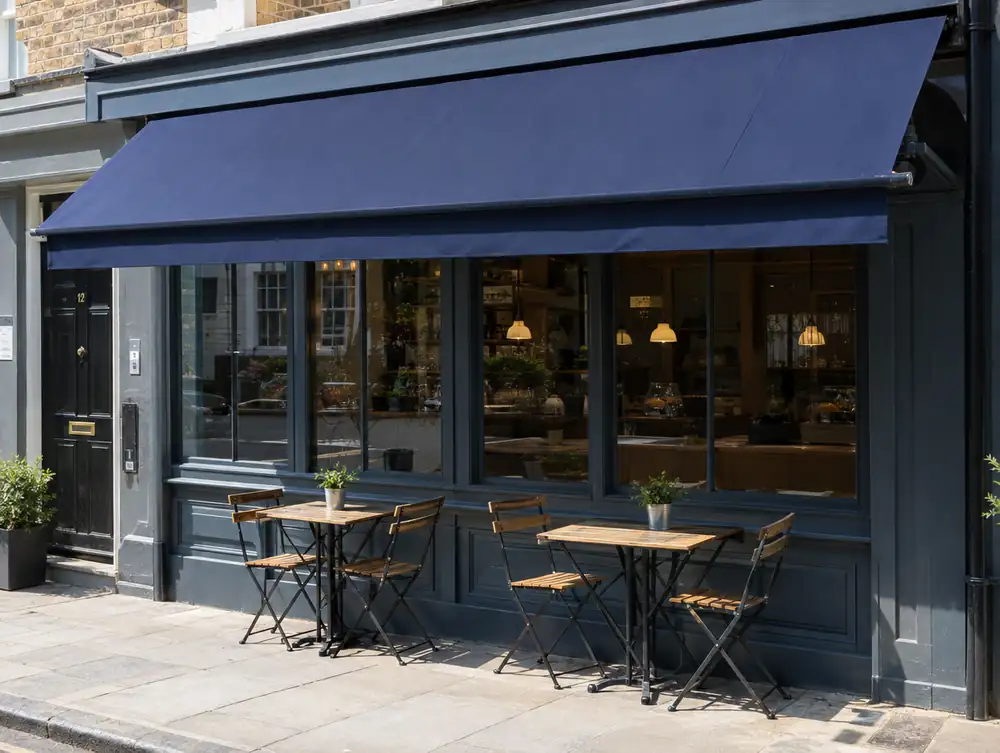
What makes canopies and awnings work well on Skegness premises?
If your Skegness frontage faces south or west, we size the projection for the afternoon sun. A north-facing unit rarely needs shade, so a fixed canopy for shelter may be a wiser use of the budget.
If your Skegness premises sell food from the front, we would avoid a strong fabric colour that tints the display. Neutral or striped canvas keeps produce looking natural.
On a north-facing frontage the glass stays free of glare, but the interior can look dim from the street, so lighting needs to sit closer to the window. If your Skegness premises face south, the problem flips to reflections by day and fading stock.
How much should you set aside for canopies and awnings in Skegness?
Until the survey is done, plan on £1,495 to £9,995 plus VAT per canopy or awning. Unusual sizes, fine detail and phased working push the figure up, while a simple brief and clear access keep it toward the lower end.
Could canopies and awnings in Skegness need planning permission?
England has no permitted development route for changing a shopfront. Part 7 Class A of the General Permitted Development Order 2015 excludes creating, altering or replacing one, and it allows no alterations at all on article 2(3) land. That leaves two outcomes for canopies and awnings at premises in the Skegness area: a planning application, or work that doesn't materially affect the external appearance.
Class 4B, England's class for lit signs, isn't available in conservation areas, Areas of Outstanding Natural Beauty, National Parks or the Broads, so a lit sign there normally needs advertisement consent. In an area of special control it is unavailable too, and Class 5 drops to a 3.6m top height, 0.3m letters and one-tenth of the building face up to 3.6m. Ask the council which designations cover premises in the Skegness area.
We confirm the position at survey, because a boundary or a special designation can change who handles the file, but applications from Skegness premises normally go to East Lindsey District Council.
| Town | Skegness |
|---|---|
| Area | Lincolnshire |
| Postcode districts | PE25 |
| Planning authority | East Lindsey District Council |
| Building approval | Building Regulations (Approved Documents) |
| Distance from Great Barr | About 102 miles |
| Survey | Free for new work |
Questions about canopies and awnings in Skegness
Can you fit a canopy over a single door in Skegness?
Yes. A small fixed canopy or Dutch canopy works well over one entrance. We design the fixings around the wall, and the size around the door and any sign above it.
Which awning suits a cafe in Skegness?
A folding arm awning with a motor usually suits a cafe, because it covers a wide area with no posts. If tables sit close to the kerb or the site is windy, a shorter projection or fixed canopy may suit better.
Will an awning or canopy be measured before I get a price in Skegness?
Yes. Every price comes from a measure-up, because wall construction and pavement width affect the design. You then receive an itemised quotation, valid for 90 days.
Do I need listed building consent for a shopfront in the Skegness area?
Usually yes, if the building is listed. In England the local planning authority decides, and Historic England is notified of Grade I and II* works and specified Grade II works. Like-for-like repair may not need consent, so ask the council before work starts.
What rules apply to a fire exit door through a shopfront in the Skegness area?
It must open in the direction of escape and can't be locked against immediate use, and a dedicated fire exit can't be a sliding or revolving door. In England that comes from article 14(2) of the Regulatory Reform (Fire Safety) Order 2005, and the duty sits with the responsible person, normally the employer or whoever controls the premises for a business, otherwise the owner. An outward door can clash with section 153 of the Highways Act 1980 where it opens onto the footway, so raise it early.