Colour is the first thing anyone notices about an awning, and it changes the light underneath. For premises in Street we choose fabric with the interior and the stock in mind.
It helps if you can be there when we visit Street, since five minutes walking the frontage together answers more than a long email.
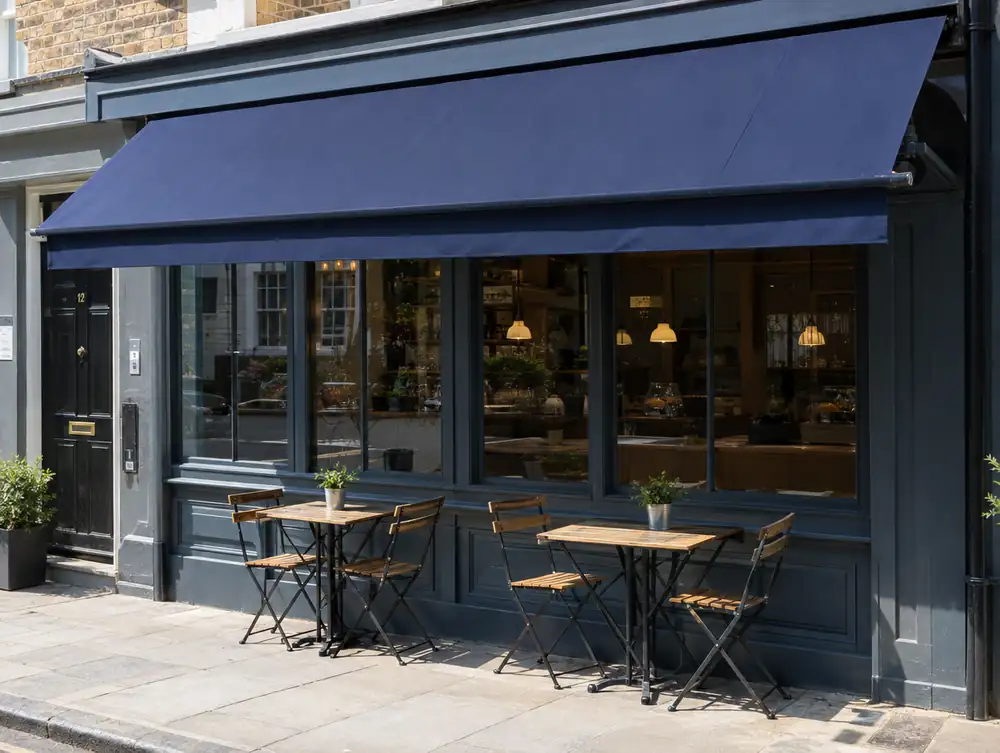
How do you design around the building when planning canopies and awnings in Street?
If you only need cover at the door, a small fixed canopy or Dutch canopy over the entrance may do the job at a fraction of the cost of a full-width awning. We would draw both, so you can compare them on your elevation.
If the wall is rendered or cavity-built, we check what lies behind it before designing brackets. Long anchors or a spreader plate can take the load where a standard fixing would pull out.
If your Street unit is narrow, a central door can split a small window into two weak ones. Moving the door to one side gives you a single confident pane, provided the layout inside still works.
What might canopies and awnings cost in Street?
As a working budget, use £1,495 to £9,995 plus VAT per canopy or awning. Your place inside that range for canopies and awnings depends mostly on how much of the existing frontage can stay and how much has to be put right first.
What permissions should you check for canopies and awnings in Street?
England has no permitted development route for changing a shopfront. Part 7 Class A of the General Permitted Development Order 2015 excludes creating, altering or replacing one, and it allows no alterations at all on article 2(3) land. That leaves two outcomes for canopies and awnings at premises in the Street area: a planning application, or work that doesn't materially affect the external appearance.
A lit projecting sign at premises in the Street area has firm limits under Class 4B in England: 0.75m² per surface and 1m high. It can project 1m, or two-thirds of the footway if that is less, and it can't sit over the carriageway. A larger sign needs advertisement consent, and so does a lit one in a conservation area.
Expect planning and advert applications here to go to Somerset Council in the normal way. We check what that means for your building when we survey it in Street.
| Town | Street |
|---|---|
| Area | Somerset |
| Postcode districts | BA16 |
| Planning authority | Somerset Council |
| Building approval | Building Regulations (Approved Documents) |
| Distance from Great Barr | About 105 miles |
| Survey | Free for new work |
Questions about canopies and awnings in Street
Which awning suits a cafe in Street?
A folding arm awning with a motor usually suits a cafe, because it covers a wide area with no posts. If tables sit close to the kerb or the site is windy, a shorter projection or fixed canopy may suit better.
Will an awning hide the sign on my Street premises?
It should not, if it is designed properly. We place the box and valance so the name reads with the cover out, or we add lettering to the valance.
Can an awning in Street be motorised?
Yes, most can. A tubular motor sits inside the roller, with a remote or wall switch, and a wind sensor can be added. You will need a power supply near the box, which we check at survey.
Does a new shopfront in the Street area need Building Regulations approval?
Assume yes until building control says otherwise. England has no like-for-like exemption, though registered installers can self-certify replacement windows and doors in non-dwellings. That route doesn't cover structural glass, curtain walling or revolving doors.
Does a shop sign in the Street area need advertisement consent?
Not always. In England, an unlit sign within Class 5 of the 2007 Advertisement Regulations generally needs no application, and neither does a lit sign within Class 4B. Anything outside those classes needs consent, and Class 4B isn't available in conservation areas, so check before ordering.