Good fascia signs are mostly a matter of spacing. For Street premises we set letter height, margins and alignment from the door and window lines below.
A survey in Street usually starts outside, looking at the whole elevation before any tape comes out, because the frontage has to answer the building above it.
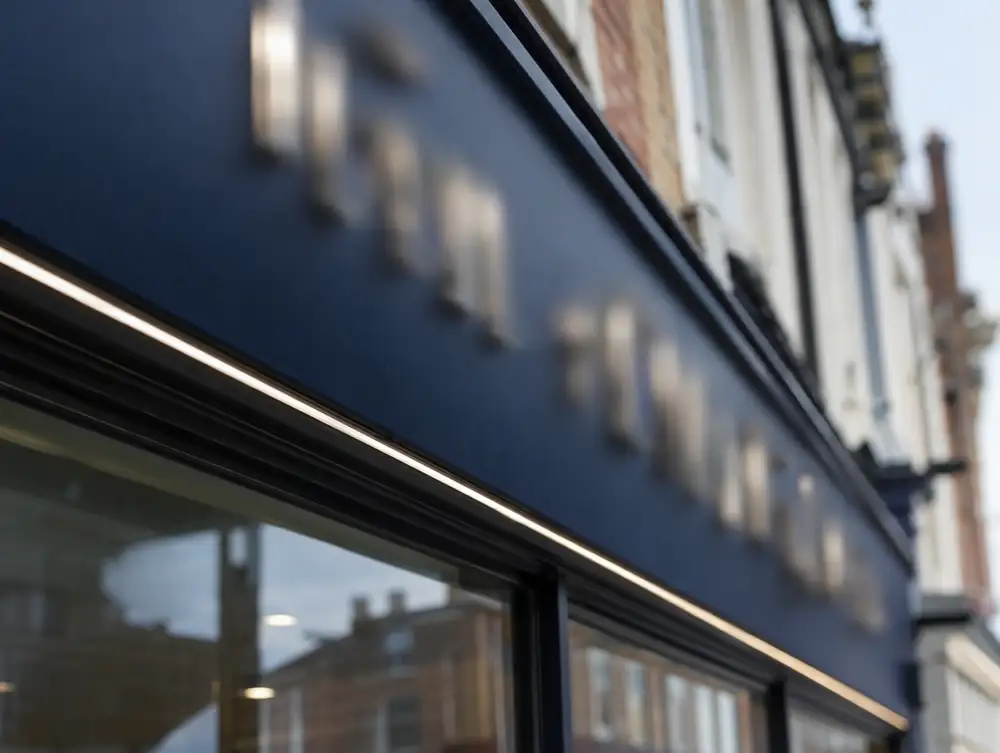
How do you design around the building when planning fascia signage in Street?
If the wall above your Street shop is brick or stone, letters fixed straight to it may look better than a panel. We check the surface first, since soft brick needs a different fixing from hard stone.
If your Street unit sits in a parade of similar shops, we would look at the fascia line on either side before setting your sign height. Holding that line usually looks more confident than trying to outgrow it.
Where the building has good brick or stone around the opening, set the frame back in the reveal so the masonry can be seen. On Street premises with a flat elevation, that deep reveal throws a shadow line that adds real depth in low sun.
What permissions should you check for fascia signage in Street?
England has no permitted development route for changing a shopfront. Part 7 Class A of the General Permitted Development Order 2015 excludes creating, altering or replacing one, and it allows no alterations at all on article 2(3) land. That leaves two outcomes for fascia signage at premises in the Street area: a planning application, or work that doesn't materially affect the external appearance.
A lit projecting sign at premises in the Street area has firm limits under Class 4B in England: 0.75m² per surface and 1m high. It can project 1m, or two-thirds of the footway if that is less, and it can't sit over the carriageway. A larger sign needs advertisement consent, and so does a lit one in a conservation area.
Expect planning and advert applications here to go to Somerset Council in the normal way. We check what that means for your building when we survey it in Street.
What might fascia signage cost in Street?
A sensible starting budget is £395 to £1,995 plus VAT per sign. What shifts the figure is whatever can't be seen yet, such as the condition behind the old frontage or the services running through it.
| Town | Street |
|---|---|
| Area | Somerset |
| Postcode districts | BA16 |
| Planning authority | Somerset Council |
| Building approval | Building Regulations (Approved Documents) |
| Distance from Great Barr | About 105 miles |
| Survey | Free for new work |
Questions about fascia signage in Street
Can a new fascia sign in Street be fitted on a closed day?
Yes, we can arrange that, or fit out of hours if that suits you better. Most fascia signs take about a day, so the work can often go into your quietest trading hours.
Will a new sign suit the rest of my Street frontage?
That is what the scale drawing is for. We draw the sign on your actual elevation with door, windows and stallriser in place, so you can judge colour and proportion together.
Can a sign match my other sites in Somerset?
Yes. Send a photograph and the drawings or brand file from an existing site, and we match the letter style, finish and colour reference. Fascia depth may differ, so the size is adjusted to keep the proportions right.
Does a new shopfront in the Street area need Building Regulations approval?
Assume yes until building control says otherwise. England has no like-for-like exemption, though registered installers can self-certify replacement windows and doors in non-dwellings. That route doesn't cover structural glass, curtain walling or revolving doors.
Do I need listed building consent for a shopfront in the Street area?
Usually yes, if the building is listed. In England the local planning authority decides, and Historic England is notified of Grade I and II* works and specified Grade II works. Like-for-like repair may not need consent, so ask the council before work starts.