Curtain walling gives Brockley premises a glazed elevation that runs past the floor edges, where a standard shopfront frame would run out of span. We measure the structure first, then set the grid out to suit the building.
It helps if you can be there when we visit Brockley, since five minutes walking the frontage together answers more than a long email.
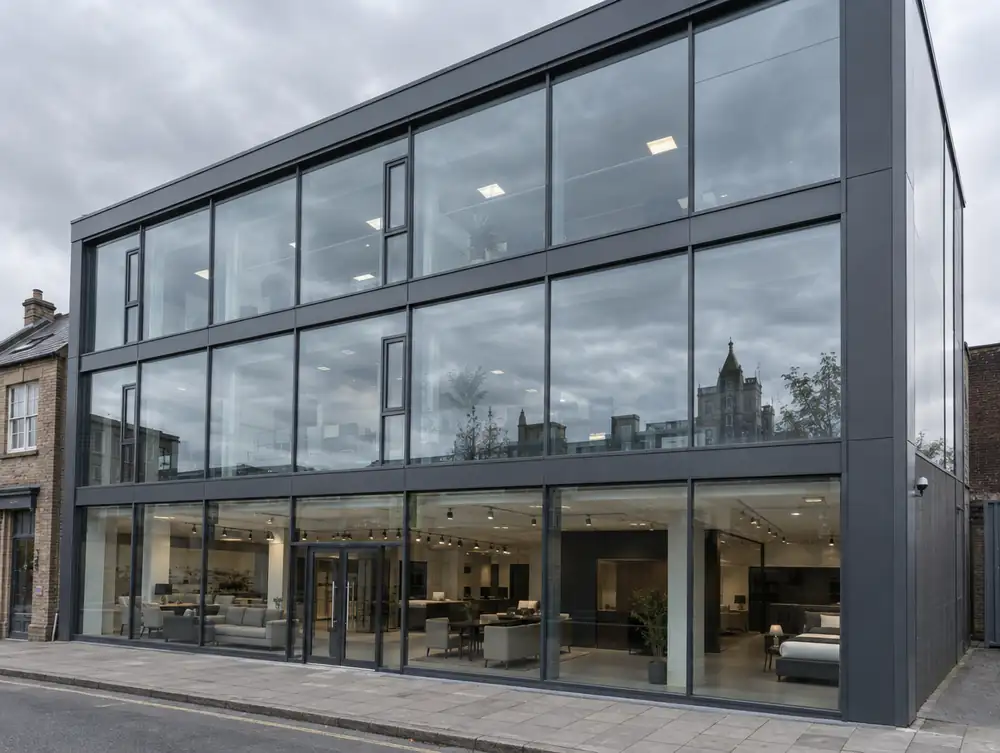
How would we approach curtain walling for your Brockley premises?
Where the elevation faces south or west, solar control glass can do more for comfort than any blind. If it looks north, we would usually keep the glass clear and neutral, so the building does not turn dull on a grey day.
Where the building already has curtain walling, we test whether the brackets and framing can be reused. Keeping a sound frame and changing the glass and caps can give most of the result with far less disruption.
If your Brockley unit is narrow, a central door can split a small window into two weak ones. Moving the door to one side gives you a single confident pane, provided the layout inside still works.
What consents could affect curtain walling in Brockley?
For curtain walling at premises in the Brockley area, the deciding question in England is whether the building work materially affects the external appearance. If it does, planning permission is needed, while a true like-for-like replacement usually needs none. The council confirms the position for each site.
Expect planning and advert applications here to go to London Borough of Lewisham in the normal way. We check what that means for your building when we survey it in Brockley.
What should you budget for curtain walling in Brockley?
We would budget £550 to £1,250 plus VAT per m². Scope sets most of the figure, so a clear brief at the start does more for the budget than any later change of detail.
| Town | Brockley |
|---|---|
| Area | Greater London |
| Postcode districts | SE13, SE14, SE4, SE8 |
| Planning authority | London Borough of Lewisham |
| Building approval | Building Regulations (Approved Documents) |
| Distance from Great Barr | About 109 miles |
| Survey | Free for new work |
Does Lewisham Council publish shopfront guidance?
Yes, Shopfront design guide, a supplementary planning document (2006). It tells applicants what the council expects from new and altered shopfronts. A few of the things it asks for:
- Fascias should generally be about 600mm high, never more than 900mm, and should not run unbroken across separate buildings.
- Solid external roller shutters are not acceptable, and open mesh or grille shutters should be powder coated with the box hidden behind the fascia.
- Internally lit fascia boxes are not allowed in conservation areas, with external lighting preferred.
Questions about curtain walling in Brockley
Who do I deal with during a curtain walling job in Brockley?
You have one named contact from survey to handover. The contract is with S&K Glazing Limited, and vetted teams working under S&K Glazing carry out the work.
Can you match the frames already on my Brockley building?
Usually, yes. Colour can be matched to a RAL reference or a sample, and cap profiles can be chosen to sit close to what is there. An exact match on an old system may not be possible, in which case we would suggest a deliberate change at a natural break.
Is curtain walling right for a single-storey unit in Brockley?
Usually not. A well-designed aluminium shopfront will span most single-storey openings with slimmer sections and lower cost. Curtain walling starts to make sense once the glass runs past a floor edge or the opening is unusually tall.
Does a shop sign in the Brockley area need advertisement consent?
Not always. In England, an unlit sign within Class 5 of the 2007 Advertisement Regulations generally needs no application, and neither does a lit sign within Class 4B. Anything outside those classes needs consent, and Class 4B isn't available in conservation areas, so check before ordering.
Do I need planning permission to change a shopfront in the Brockley area?
Usually yes, if the work materially affects the building's external appearance. England's shop permitted development rights exclude creating, altering or replacing a shopfront, so there is no shortcut. A true like-for-like replacement usually needs no application, and the council confirms the position.