Curtain walling gives Ladywell premises a glazed elevation that runs past the floor edges, where a standard shopfront frame would run out of span. We measure the structure first, then set the grid out to suit the building.
We measure your Ladywell opening in person, at a time agreed with you first, so the visit fits around your trading.
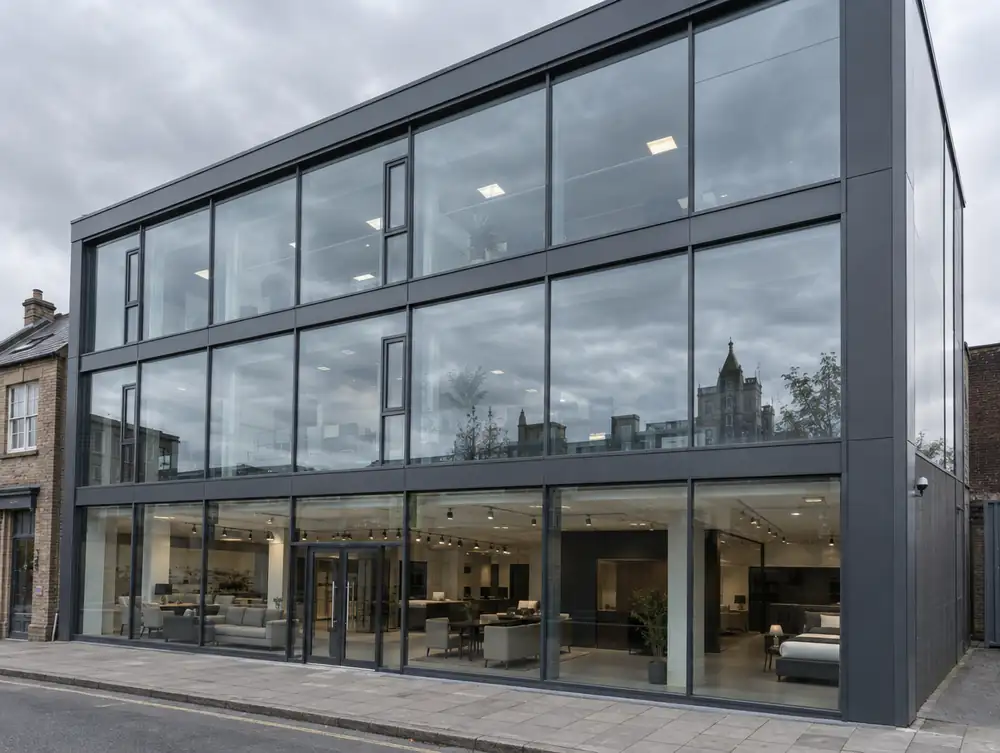
What goes into getting curtain walling right in Ladywell?
Where your frontage in Ladywell faces open ground, wind load can push mullions a size deeper than a sheltered terrace would need. We check exposure for your elevation, so the sections are no heavier than they have to be.
Should the floors above stay occupied, the work can be phased bay by bay, with temporary weathering at the end of each shift. Tenants keep their rooms dry and the old elevation comes out in an order that suits the building.
Where the footway outside your Ladywell premises is narrow, a recessed entrance earns its keep. It gives people a dry place to pause out of the walkway, and it adds a longer run of display glass either side of the door.
Which applications might curtain walling in Ladywell involve?
For curtain walling at premises in the Ladywell area, the deciding question in England is whether the building work materially affects the external appearance. If it does, planning permission is needed, while a true like-for-like replacement usually needs none. The council confirms the position for each site.
For Ladywell, the usual route for planning and advert applications is through London Borough of Lewisham, and we confirm that when we visit.
How much could curtain walling in Ladywell cost you?
Allow £550 to £1,250 plus VAT per m². Size and specification set most of that figure for curtain walling, and the rest depends on what the survey finds on site.
| Town | Ladywell |
|---|---|
| Area | Greater London |
| Postcode districts | SE13, SE23, SE4, SE6 |
| Planning authority | London Borough of Lewisham |
| Building approval | Building Regulations (Approved Documents) |
| Distance from Great Barr | About 110 miles |
| Survey | Free for new work |
Does Lewisham Council publish shopfront guidance?
Yes, Shopfront design guide, a supplementary planning document (2006). It tells applicants what the council expects from new and altered shopfronts. A few of the things it asks for:
- Fascias should generally be about 600mm high, never more than 900mm, and should not run unbroken across separate buildings.
- Solid external roller shutters are not acceptable, and open mesh or grille shutters should be powder coated with the box hidden behind the fascia.
- Internally lit fascia boxes are not allowed in conservation areas, with external lighting preferred.
Questions about curtain walling in Ladywell
Can part of an elevation in Ladywell be done first?
Yes, provided the break falls at a sensible mullion. Phasing can spread cost and disruption, although two visits usually cost more than one. We would draw the whole elevation first so the second phase matches.
How disruptive is curtain walling for neighbours in Ladywell?
Most disruption comes from access equipment and deliveries, not from noisy work. We plan unloading and any scaffold around nearby premises, and we keep the working area screened and tidy at the end of each shift.
Is curtain walling right for a single-storey unit in Ladywell?
Usually not. A well-designed aluminium shopfront will span most single-storey openings with slimmer sections and lower cost. Curtain walling starts to make sense once the glass runs past a floor edge or the opening is unusually tall.
Do I need planning permission to change a shopfront in the Ladywell area?
Usually yes, if the work materially affects the building's external appearance. England's shop permitted development rights exclude creating, altering or replacing a shopfront, so there is no shortcut. A true like-for-like replacement usually needs no application, and the council confirms the position.
What rules apply to a fire exit door through a shopfront in the Ladywell area?
It must open in the direction of escape and can't be locked against immediate use, and a dedicated fire exit can't be a sliding or revolving door. In England that comes from article 14(2) of the Regulatory Reform (Fire Safety) Order 2005, and the duty sits with the responsible person, normally the employer or whoever controls the premises for a business, otherwise the owner. An outward door can clash with section 153 of the Highways Act 1980 where it opens onto the footway, so raise it early.