Replacing tired glazing on Hawick premises is often a chance to rethink the whole elevation. We survey the existing frame and fixings, then advise whether a new curtain wall or a more modest reglaze makes sense.
We measure your Hawick opening in person, at a time agreed with you first, so the visit fits around your trading.
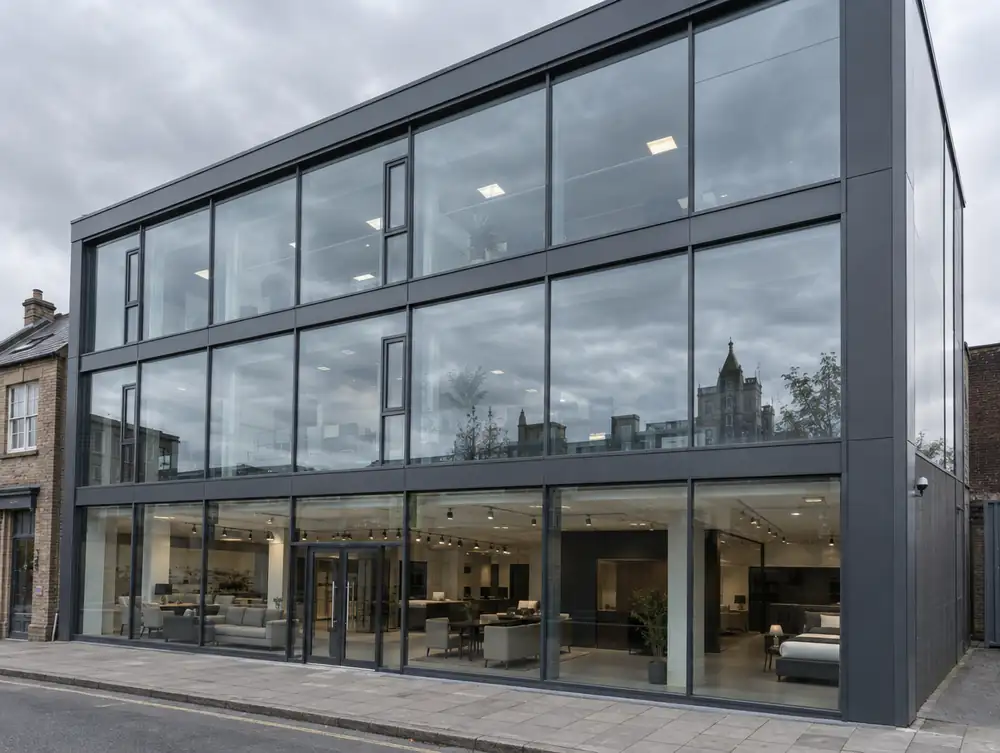
What should you think about before commissioning curtain walling in Hawick?
Where the elevation faces south or west, solar control glass can do more for comfort than any blind. If it looks north, we would usually keep the glass clear and neutral, so the building does not turn dull on a grey day.
Should the floors above stay occupied, the work can be phased bay by bay, with temporary weathering at the end of each shift. Tenants keep their rooms dry and the old elevation comes out in an order that suits the building.
If your premises were once two shops, decide early whether the front should read as one or as two. One continuous fascia with a repeated bay width usually settles the elevation better than two mismatched halves, which is worth testing on any Hawick unit of that kind.
What is a realistic budget for curtain walling in Hawick?
We would budget £550 to £1,250 plus VAT per m². Scope sets most of the figure, so a clear brief at the start does more for the budget than any later change of detail.
Who approves curtain walling in Hawick?
Section 26 of the Town and Country Planning (Scotland) Act 1997 sets the test: work that doesn't materially affect the external appearance isn't development. For curtain walling at premises in the Hawick area, anything that does needs planning permission, and a true like-for-like replacement usually doesn't. The council confirms how that applies to each site.
For Hawick, the usual route for planning and advert applications is through the Scottish Borders Council, and we confirm that when we visit.
| Town | Hawick |
|---|---|
| Area | Scottish Borders |
| Postcode districts | TD9 |
| Planning authority | Scottish Borders Council |
| Building approval | Building warrant (Technical Handbook) |
| Distance from Great Barr | About 202 miles |
| Survey | Free for new work |
Does Scottish Borders Council publish shopfront guidance?
Yes, Supplementary Planning Guidance on Shop Fronts and Shop Signs (2011). It tells applicants what the council expects from new and altered shopfronts. A few of the things it asks for:
- Roller shutters are opposed on listed buildings and sensitive conservation area frontages, and elsewhere should be recessed and preferably open grille.
- Signs in conservation areas should not be internally illuminated, and reasonable external lighting is often acceptable.
- Each enterprise may have one projecting sign, with its bottom edge at least 2.25m above ground and 0.5m in from the kerb.
Questions about curtain walling in Hawick
Will you coordinate with my architect or main contractor in Hawick?
Yes. We can work to their drawings and programme, and we supply shop drawings for their review before anything is made. Your named contact stays the single route for questions on our package.
What should I send before a survey of my Hawick premises?
The address, a few photographs and any existing drawings are enough to start. Tell us how the building is used and which floors stay occupied, because that shapes the access plan.
Can you replace failing curtain walling on premises in Hawick?
Yes. We survey the frame, brackets and seals first, because some elevations only need new glass and gaskets. If the frame itself has failed, we draw a replacement that can be phased around the building's use.
Do roller shutters need planning permission in the Hawick area?
Usually yes, if they materially affect the external appearance. Class 9A doesn't name shutters, so in Scotland treat them as falling to the appearance test rather than assuming a permitted development route. Ask the council before ordering, as this is a reading of the rules and not an official statement.
Which way must a fire exit door open on a shop in the Hawick area?
In the direction of escape. Regulation 13(2) of the Fire Safety (Scotland) Regulations 2006 also rules out sliding and revolving doors on a dedicated fire exit and says fire exit doors can't be locked against immediate use. Duties sit with dutyholders under Part 3 of the Fire (Scotland) Act 2005, meaning the employer and any person with control of the premises.