Frameless glass doors give Hawick premises a clean, open entrance with very little on show. We check the floor, the opening and the wind at your door before the glass is ordered.
Surveys for Hawick are booked with you directly. Tell us your quieter days and we'll work around them.
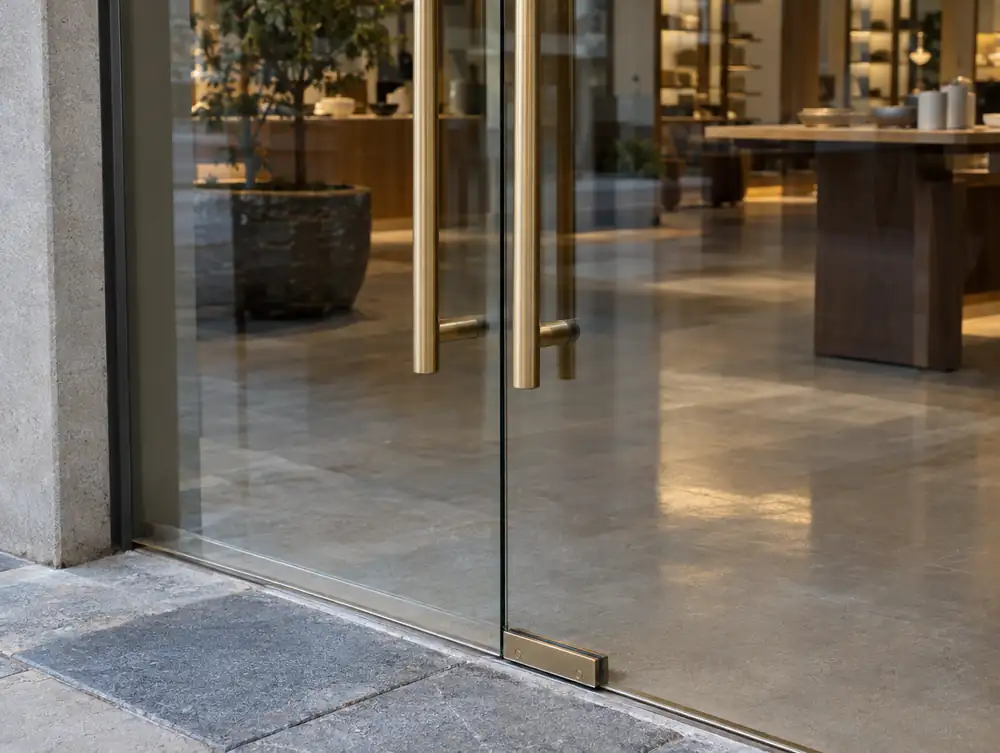
What goes into getting frameless glass doors right in Hawick?
For a brand with branches beyond Hawick, we'd fix the handle, fitting finish and manifestation as a standard. The glass is then made to each opening, so all the doors match despite different sizes.
If a landlord in Hawick controls the frontage, a glass door is often an easy approval because so little changes visually. We'd supply a drawing showing the door, the fittings and any markings on the glass.
Where the building has good brick or stone around the opening, set the frame back in the reveal so the masonry can be seen. On Hawick premises with a flat elevation, that deep reveal throws a shadow line that adds real depth in low sun.
Which applications might frameless glass doors in Hawick involve?
Section 26 of the Town and Country Planning (Scotland) Act 1997 sets the test: work that doesn't materially affect the external appearance isn't development. For frameless glass doors at premises in the Hawick area, anything that does needs planning permission, and a true like-for-like replacement usually doesn't. The council confirms how that applies to each site.
At survey we check how things stand for your building, although applications for planning permission or advertisement consent here normally go to the Scottish Borders Council.
How much could frameless glass doors in Hawick cost you?
Until the survey is done, plan on £1,495 to £4,495 plus VAT per door set. Unusual sizes, fine detail and phased working push the figure up, while a simple brief and clear access keep it toward the lower end.
| Town | Hawick |
|---|---|
| Area | Scottish Borders |
| Postcode districts | TD9 |
| Planning authority | Scottish Borders Council |
| Building approval | Building warrant (Technical Handbook) |
| Distance from Great Barr | About 202 miles |
| Survey | Free for new work |
Does Scottish Borders Council publish shopfront guidance?
Yes, Supplementary Planning Guidance on Shop Fronts and Shop Signs (2011). It tells applicants what the council expects from new and altered shopfronts. A few of the things it asks for:
- Roller shutters are opposed on listed buildings and sensitive conservation area frontages, and elsewhere should be recessed and preferably open grille.
- Signs in conservation areas should not be internally illuminated, and reasonable external lighting is often acceptable.
- Each enterprise may have one projecting sign, with its bottom edge at least 2.25m above ground and 0.5m in from the kerb.
Questions about frameless glass doors in Hawick
Can I have my logo on a glass door in Hawick?
Yes. Etched, frosted or printed logos work well, and they can double as the marking that stops people walking into the glass.
Can you reuse my existing floor spring in Hawick?
Sometimes, if it is sound and suits the new leaf. We'd test it at survey, because an old spring under a heavier door tends to fail early.
What handle should I choose for a door in the Scottish Borders?
Full-height pulls suit tall leaves, while shorter offset handles suit small doors. We'd bring examples to your Hawick premises so you can feel the difference.
Which way must a fire exit door open on a shop in the Hawick area?
In the direction of escape. Regulation 13(2) of the Fire Safety (Scotland) Regulations 2006 also rules out sliding and revolving doors on a dedicated fire exit and says fire exit doors can't be locked against immediate use. Duties sit with dutyholders under Part 3 of the Fire (Scotland) Act 2005, meaning the employer and any person with control of the premises.
Do I need listed building consent for a shopfront in the Hawick area?
Almost certainly, if the building is listed and windows or doors are changing, according to Historic Environment Scotland. The planning authority decides, and Historic Environment Scotland is consulted on some applications. Scottish Ministers are notified if it objects.