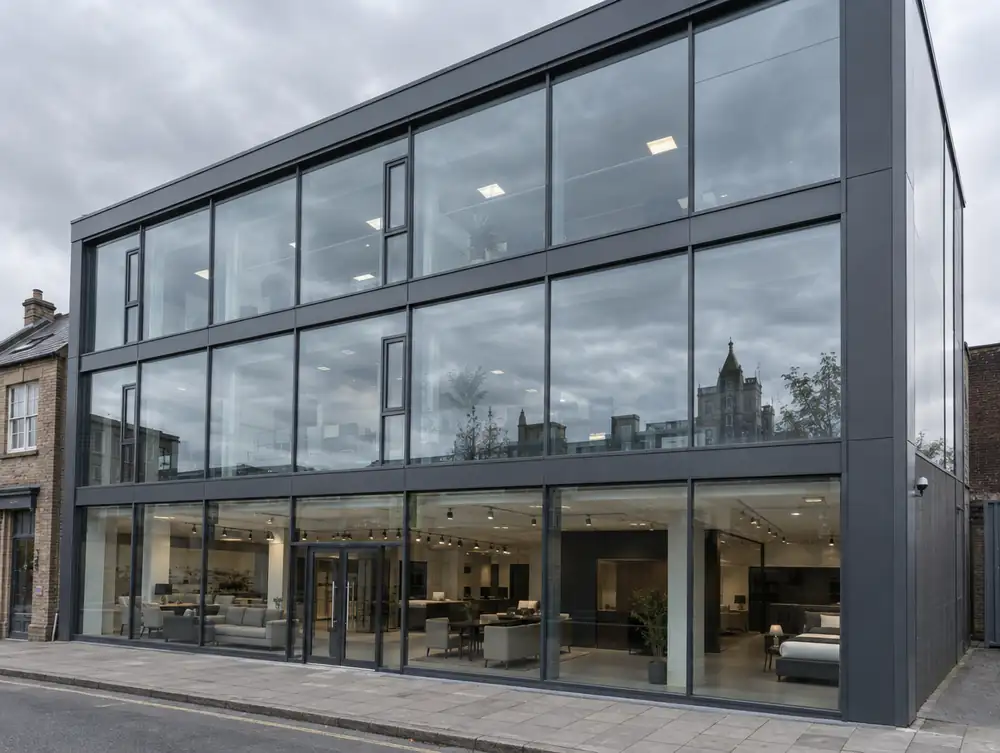
Showrooms, hotels and offices in Tooting can reach the point where glass has to pass a floor edge, and that is where curtain walling takes over from a shopfront. You see every mullion and transom on scale drawings before anything is ordered.
Measuring the opening is the easy part of a survey in Tooting. We also look at the beam above, the pavement fall and any meters or drains nearby.
What should you think about before commissioning curtain walling in Tooting?
Should the floors above stay occupied, the work can be phased bay by bay, with temporary weathering at the end of each shift. Tenants keep their rooms dry and the old elevation comes out in an order that suits the building.
Unloading is worth thinking through early on any Tooting site with restricted access. Mullions can run to 6m or more, so we look at lifting routes, storage and where a delivery can stop.
Where the footway outside your Tooting premises is narrow, a recessed entrance earns its keep. It gives people a dry place to pause out of the walkway, and it adds a longer run of display glass either side of the door.
What is a realistic budget for curtain walling in Tooting?
Until the survey is done, plan on £550 to £1,250 plus VAT per m². Unusual sizes, fine detail and phased working push the figure up, while a simple brief and clear access keep it toward the lower end.
Who approves curtain walling in Tooting?
A true like-for-like replacement usually needs no planning permission in England, because the external appearance isn't materially affected. New materials, a different glass line or altered proportions usually do count as material, so for curtain walling at premises in the Tooting area, an application is then likely. The council confirms which side of that line a job falls on.
At survey we check how things stand for your building, although applications for planning permission or advertisement consent here normally go to London Borough of Wandsworth.
| Town | Tooting |
|---|---|
| Area | Greater London |
| Postcode districts | CR4, SW12, SW16, SW17 |
| Planning authority | London Borough of Wandsworth |
| Building approval | Building Regulations (Approved Documents) |
| Distance from Great Barr | About 108 miles |
| Survey | Free for new work |
Does Wandsworth Borough Council publish shopfront guidance?
Yes, Shopfronts SPG (1988). It tells applicants what the council expects from new and altered shopfronts. A few of the things it asks for:
- Stallrisers should be retained where possible and be at least 500mm high, or reach the top of the pilaster base.
- Solid external metal shutters are discouraged, with boxes set behind the fascia or recessed flush and guides colour-coated to match.
- Internally lit box fascias and projecting box signs are generally unsuitable in conservation areas and on traditional shopfronts.
Questions about curtain walling in Tooting
Is curtain walling right for a single-storey unit in Tooting?
Usually not. A well-designed aluminium shopfront will span most single-storey openings with slimmer sections and lower cost. Curtain walling starts to make sense once the glass runs past a floor edge or the opening is unusually tall.
What should I send before a survey of my Tooting premises?
The address, a few photographs and any existing drawings are enough to start. Tell us how the building is used and which floors stay occupied, because that shapes the access plan.
Who do I deal with during a curtain walling job in Tooting?
You have one named contact from survey to handover. The contract is with S&K Glazing Limited, and vetted teams working under S&K Glazing carry out the work.
Does the Equality Act apply to a shop entrance in the Tooting area?
Yes. The Equality Act 2010 applies in England, as across Great Britain, and it requires reasonable steps to remove, alter or avoid physical features that disadvantage disabled people. The duty is anticipatory, so it looks at disabled people generally, and a new Services Code replaced the 2011 Code on 5 August 2026.
What rules apply to a fire exit door through a shopfront in the Tooting area?
It must open in the direction of escape and can't be locked against immediate use, and a dedicated fire exit can't be a sliding or revolving door. In England that comes from article 14(2) of the Regulatory Reform (Fire Safety) Order 2005, and the duty sits with the responsible person, normally the employer or whoever controls the premises for a business, otherwise the owner. An outward door can clash with section 153 of the Highways Act 1980 where it opens onto the footway, so raise it early.