What should your premises say from across the road? We open every conversation about curtain walling in West Yorkshire with that question, then treat sightlines and proportion as seriously as the budget.
Daylight is only half the brief for curtain walling, because a frontage keeps working after dark. Think about how the glass, the sign and the view inside will read to someone walking past at six o'clock on a winter evening.
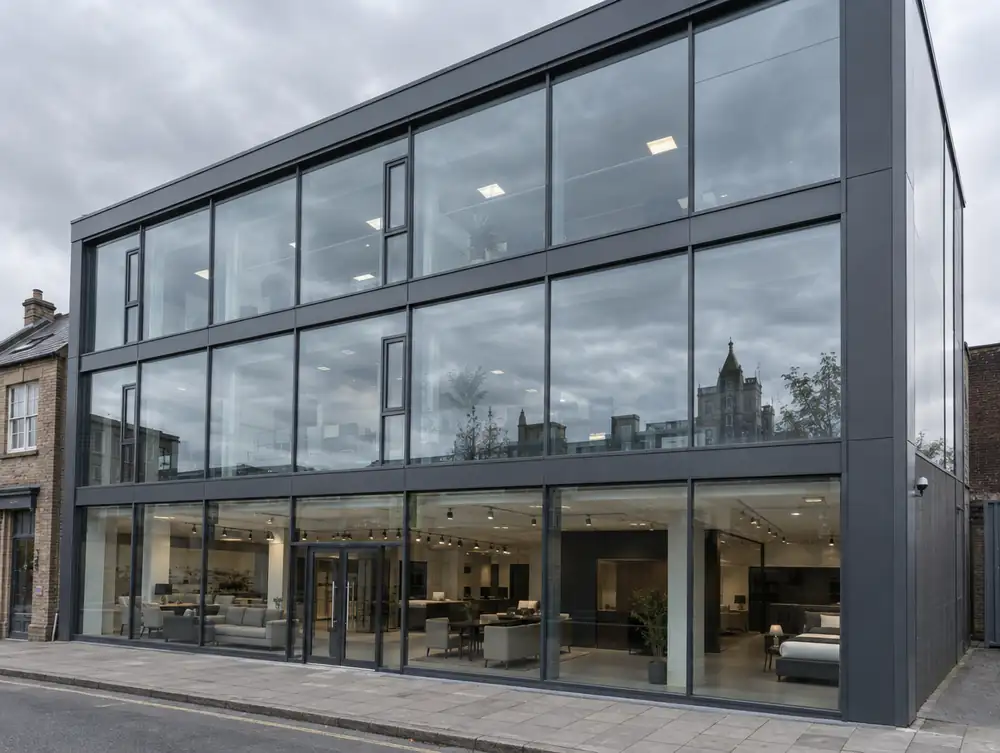
What should you look for from curtain walling in West Yorkshire?
Occupied upper floors change the sequence. Many elevations in West Yorkshire can come out one bay at a time, with temporary weathering each evening so the rooms behind stay dry.
Exposure changes from plot to plot across West Yorkshire. A corner unit or a frontage facing open ground takes more wind than one sheltered in a terrace, so we size mullions for your elevation and leave the catalogue table aside.
What consents apply to curtain walling in West Yorkshire?
A true like-for-like replacement usually needs no planning permission in England, because the external appearance isn't materially affected. New materials, a different glass line or altered proportions usually do count as material, so for curtain walling at premises in the West Yorkshire area, an application is then likely. The council confirms which side of that line a job falls on.
How much does curtain walling cost in West Yorkshire?
As a working budget, use £550 to £1,250 plus VAT per m². Your place inside that range for curtain walling depends mostly on how much of the existing frontage can stay and how much has to be put right first.
| Area | West Yorkshire |
|---|---|
| Nation | England |
| Towns covered | 43 |
| Main town | Leeds |
| Planning regime | England: TCPA 1990 and the 2007 Advertisement Regulations |
| Building approval | Building Regulations (Approved Documents) |
| Survey | Free for new work, from our Great Barr base |
Does City of Bradford Metropolitan District Council publish shopfront guidance?
Yes, Bradford Shopfront Design Guide Supplementary Planning Document (2026). It tells applicants what the council expects from new and altered shopfronts. A few of the things it asks for:
- Stallrisers should ideally be no more than 20% of total shopfront height, and plastic is never acceptable for them.
- Cornice, fascia and architrave together should be no more than 20% of total height, with lettering no more than two-thirds of the fascia height.
- Solid and perforated roller shutters are strongly discouraged, and internal grilles, ideally set back at least 1m from the window, are the council's preferred approach.
Questions about curtain walling in West Yorkshire
Can one contract cover the curtain wall and shopfront on premises in West Yorkshire?
Yes. Frame, glass, doors and signs can all sit in one contract with S&K Glazing, so the junction between upper and lower elevations has a single owner. That junction is where separate trades most often leave a gap.
Can a building around Leeds stay open during the work?
Usually, with some care over the sequence. Bays can be phased so one entrance stays in use, and closed-day or out-of-hours installation can be arranged for the parts that affect it. Your named contact agrees the sequence with you before work starts.
Can you work from my architect's drawings for a building in West Yorkshire?
Yes, and we check them against a measured survey before anything is ordered. Site dimensions overrule drawn ones, so any gap is raised with your architect and settled on revised scale drawings.
Do roller shutters need planning permission in the West Yorkshire area?
Usually yes. Installing or replacing a security grill or shutter on a shopfront is expressly outside England's shop permitted development rights, so the only way to avoid an application is work that doesn't materially affect the appearance. Ask the council before ordering.
Do I need listed building consent for a shopfront in the West Yorkshire area?
Usually yes, if the building is listed. In England the local planning authority decides, and Historic England is notified of Grade I and II* works and specified Grade II works. Like-for-like repair may not need consent, so ask the council before work starts.