Seen a frontage you admire? Bring the picture to our first talk about illuminated signage in West Yorkshire, and we will work out what makes it succeed, from fascia depth to glass line, and what that means for your building.
Daylight is only half the brief for illuminated signage, because a frontage keeps working after dark. Think about how the glass, the sign and the view inside will read to someone walking past at six o'clock on a winter evening.
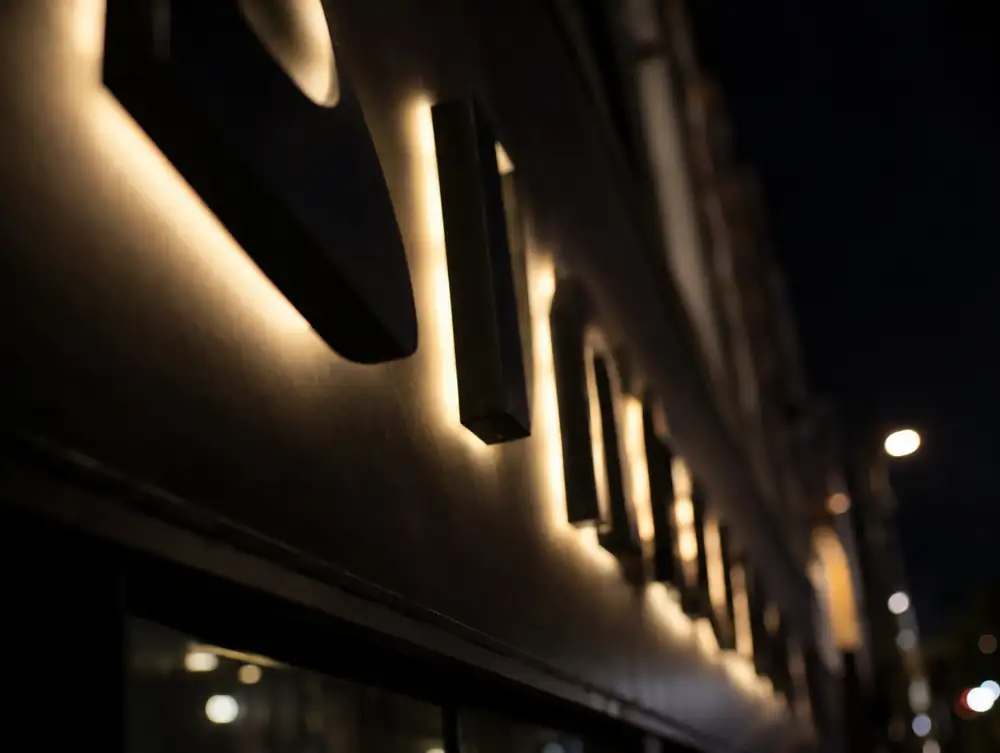
Where do you start with illuminated signage in West Yorkshire?
Think first about when your customers arrive. For premises across West Yorkshire that trade into the evening, we design from the dusk view, since that is when the letters do their real work.
Colour temperature should match across a group. If you run premises at several addresses in West Yorkshire, we specify one white and one output, so sites opened years apart still look like one brand.
What consents apply to illuminated signage in West Yorkshire?
Security grilles and shutters are named in England's rules: installing or replacing one on a shopfront sits outside the shop permitted development rights. The frontage itself is treated the same way, so for illuminated signage at premises in the West Yorkshire area, building work that materially affects the appearance needs planning permission. Confirm the position with the council before anything is ordered.
Class 4B, England's class for lit signs, isn't available in conservation areas, Areas of Outstanding Natural Beauty, National Parks or the Broads, so a lit sign there normally needs advertisement consent. In an area of special control it is unavailable too, and Class 5 drops to a 3.6m top height, 0.3m letters and one-tenth of the building face up to 3.6m. Ask the council which designations cover premises in the West Yorkshire area.
How much does illuminated signage cost in West Yorkshire?
Until the survey is done, plan on £895 to £3,995 plus VAT per sign. Unusual sizes, fine detail and phased working push the figure up, while a simple brief and clear access keep it toward the lower end.
| Area | West Yorkshire |
|---|---|
| Nation | England |
| Towns covered | 43 |
| Main town | Leeds |
| Planning regime | England: TCPA 1990 and the 2007 Advertisement Regulations |
| Building approval | Building Regulations (Approved Documents) |
| Survey | Free for new work, from our Great Barr base |
Does City of Bradford Metropolitan District Council publish shopfront guidance?
Yes, Bradford Shopfront Design Guide Supplementary Planning Document (2026). It tells applicants what the council expects from new and altered shopfronts. A few of the things it asks for:
- Stallrisers should ideally be no more than 20% of total shopfront height, and plastic is never acceptable for them.
- Cornice, fascia and architrave together should be no more than 20% of total height, with lettering no more than two-thirds of the fascia height.
- Solid and perforated roller shutters are strongly discouraged, and internal grilles, ideally set back at least 1m from the window, are the council's preferred approach.
Questions about illuminated signage in West Yorkshire
Can a lit sign in West Yorkshire be set on a timer?
Yes, and we would recommend it. A timer or photocell switches the sign to suit your trading hours, and it can dim or switch off late in the evening.
Do you arrange the electrics for signs around Leeds?
Yes. Low-voltage wiring and testing are part of the installation, with the final connection made by a qualified electrician. Any supply work needed is shown on the itemised quotation.
Can you test a lit letter on my premises in West Yorkshire before ordering?
Yes, where the job warrants it. A sample letter held against your fascia at dusk tells you more than a visual, particularly for halo lighting on a dark finish.
Does a shop sign in the West Yorkshire area need advertisement consent?
Not always. In England, an unlit sign within Class 5 of the 2007 Advertisement Regulations generally needs no application, and neither does a lit sign within Class 4B. Anything outside those classes needs consent, and Class 4B isn't available in conservation areas, so check before ordering.
Does the Equality Act apply to a shop entrance in the West Yorkshire area?
Yes. The Equality Act 2010 applies in England, as across Great Britain, and it requires reasonable steps to remove, alter or avoid physical features that disadvantage disabled people. The duty is anticipatory, so it looks at disabled people generally, and a new Services Code replaced the 2011 Code on 5 August 2026.