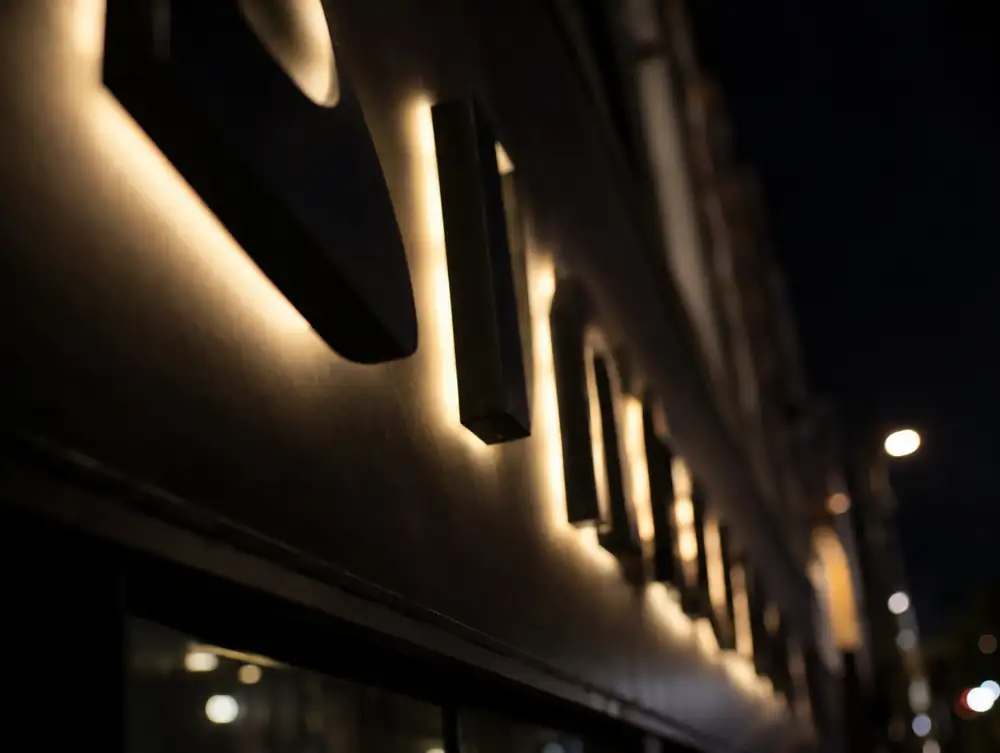
Halo-lit letters give Knottingley premises a soft glow on the panel behind, with the name itself in crisp silhouette. Face-lit and trough options suit other brands and buildings, and we show you the difference on a scale drawing.
Please have keys to any meter cupboards and shutter housings to hand when we survey in Knottingley, because what sits behind them can change the drawing.
What should you think about before commissioning illuminated signage in Knottingley?
If there are flats above your Knottingley premises, we would keep the output modest and put the sign on a timer. A warm white at lower brightness is kinder to neighbours and still does its job.
Where the frontage faces a wide road, face-lit letters can carry further than halo lighting. On a narrower street the softer option usually reads well enough and looks more refined.
On a north-facing frontage the glass stays free of glare, but the interior can look dim from the street, so lighting needs to sit closer to the window. If your Knottingley premises face south, the problem flips to reflections by day and fading stock.
Who approves illuminated signage in Knottingley?
A true like-for-like replacement usually needs no planning permission in England, because the external appearance isn't materially affected. New materials, a different glass line or altered proportions usually do count as material, so for illuminated signage at premises in the Knottingley area, an application is then likely. The council confirms which side of that line a job falls on.
In England, signs at premises in the Knottingley area come under the 2007 Advertisement Regulations. An unlit fascia sign generally needs no application under Class 5 of Schedule 3 if it sits on a wall containing a shop window, tops out at 4.6m or the first-floor sill if that is lower, and keeps letters to 0.75m high. Displaying a sign without the consent it needs is a criminal offence, so check before it goes up.
For Knottingley, the usual route for planning and advert applications is through Wakefield Metropolitan District Council, and we confirm that when we visit.
What is a realistic budget for illuminated signage in Knottingley?
Allow £895 to £3,995 plus VAT per sign. Size and specification set most of that figure for illuminated signage, and the rest depends on what the survey finds on site.
| Town | Knottingley |
|---|---|
| Area | West Yorkshire |
| Postcode districts | WF10, WF11, WF8 |
| Planning authority | Wakefield Metropolitan District Council |
| Building approval | Building Regulations (Approved Documents) |
| Distance from Great Barr | About 85 miles |
| Survey | Free for new work |
Questions about illuminated signage in Knottingley
What happens if a lit letter fails on my Knottingley sign?
Usually a single LED driver or a damaged connection is to blame, and it can be traced from the access point. That is why drivers are placed where they can be reached without taking the sign down.
How will I know what my Knottingley sign looks like at night?
We draw it on your elevation and describe the lighting effect in the specification, and a sample letter can be tested on your fascia where that helps. Colour temperature and output are agreed before manufacture.
Can an illuminated sign be fitted around trading in Knottingley?
Yes. External fitting is usually done from a tower or platform with little effect on the shop, and internal cable work can be arranged out of hours.
Do I need planning permission to change a shopfront in the Knottingley area?
Usually yes, if the work materially affects the building's external appearance. England's shop permitted development rights exclude creating, altering or replacing a shopfront, so there is no shortcut. A true like-for-like replacement usually needs no application, and the council confirms the position.
Does a new shopfront in the Knottingley area need Building Regulations approval?
Assume yes until building control says otherwise. England has no like-for-like exemption, though registered installers can self-certify replacement windows and doors in non-dwellings. That route doesn't cover structural glass, curtain walling or revolving doors.