Opening premises in Faversham usually means a new fascia with a date attached. Manufacture typically takes 2 to 4 weeks from approved artwork, and fitting can be arranged around your opening plans.
Measuring the opening is the easy part of a survey in Faversham. We also look at the beam above, the pavement fall and any meters or drains nearby.
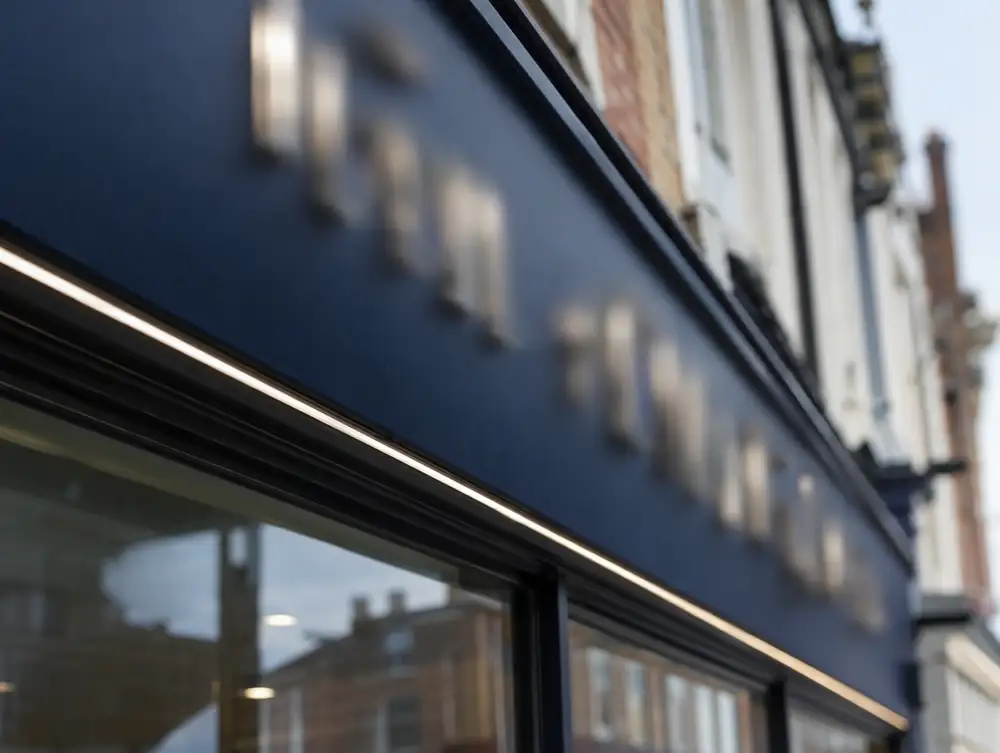
What goes into getting fascia signage right in Faversham?
If the wall above your Faversham shop is brick or stone, letters fixed straight to it may look better than a panel. We check the surface first, since soft brick needs a different fixing from hard stone.
Where the fascia on your Faversham premises has been overclad, we lift a sample at survey to see what is underneath. Original timber, cornice mouldings or tile may be worth keeping, and they change what the new sign should be.
If there are storeys above the shop, the frontage should feel like the base of the building and not a sign stuck on it. Lining up mullions with the windows overhead is a small move that settles the whole elevation at Faversham premises.
How much could fascia signage in Faversham cost you?
Our guide band is £395 to £1,995 plus VAT per sign. Scope is the biggest lever, so a tighter brief for fascia signage brings the figure down faster than any change of detail.
Which applications might fascia signage in Faversham involve?
A true like-for-like replacement usually needs no planning permission in England, because the external appearance isn't materially affected. New materials, a different glass line or altered proportions usually do count as material, so for fascia signage at premises in the Faversham area, an application is then likely. The council confirms which side of that line a job falls on.
Class 4B, England's class for lit signs, isn't available in conservation areas, Areas of Outstanding Natural Beauty, National Parks or the Broads, so a lit sign there normally needs advertisement consent. In an area of special control it is unavailable too, and Class 5 drops to a 3.6m top height, 0.3m letters and one-tenth of the building face up to 3.6m. Ask the council which designations cover premises in the Faversham area.
We confirm the position at survey, because a boundary or a special designation can change who handles the file, but applications from Faversham premises normally go to Swale Borough Council.
| Town | Faversham |
|---|---|
| Area | Kent |
| Postcode districts | ME13 |
| Planning authority | Swale Borough Council |
| Building approval | Building Regulations (Approved Documents) |
| Distance from Great Barr | About 147 miles |
| Survey | Free for new work |
Questions about fascia signage in Faversham
What if the fascia behind my old sign in Faversham is rotten?
We show you photographs and price the repair before going further. A short section of timber can often be spliced in, while a badly decayed fascia is better replaced with a new subframe.
Can a new fascia sign in Faversham be fitted on a closed day?
Yes, we can arrange that, or fit out of hours if that suits you better. Most fascia signs take about a day, so the work can often go into your quietest trading hours.
Will a new sign suit the rest of my Faversham frontage?
That is what the scale drawing is for. We draw the sign on your actual elevation with door, windows and stallriser in place, so you can judge colour and proportion together.
What rules apply to a fire exit door through a shopfront in the Faversham area?
It must open in the direction of escape and can't be locked against immediate use, and a dedicated fire exit can't be a sliding or revolving door. In England that comes from article 14(2) of the Regulatory Reform (Fire Safety) Order 2005, and the duty sits with the responsible person, normally the employer or whoever controls the premises for a business, otherwise the owner. An outward door can clash with section 153 of the Highways Act 1980 where it opens onto the footway, so raise it early.
Does the Equality Act apply to a shop entrance in the Faversham area?
Yes. The Equality Act 2010 applies in England, as across Great Britain, and it requires reasonable steps to remove, alter or avoid physical features that disadvantage disabled people. The duty is anticipatory, so it looks at disabled people generally, and a new Services Code replaced the 2011 Code on 5 August 2026.