Built-up letters, flat-cut metal or hand-painted timber can each work on fascias in Sittingbourne, depending on the frontage and the brand. A scale drawing of the sign on your elevation makes the choice easy to judge.
A survey in Sittingbourne usually starts outside, looking at the whole elevation before any tape comes out, because the frontage has to answer the building above it.
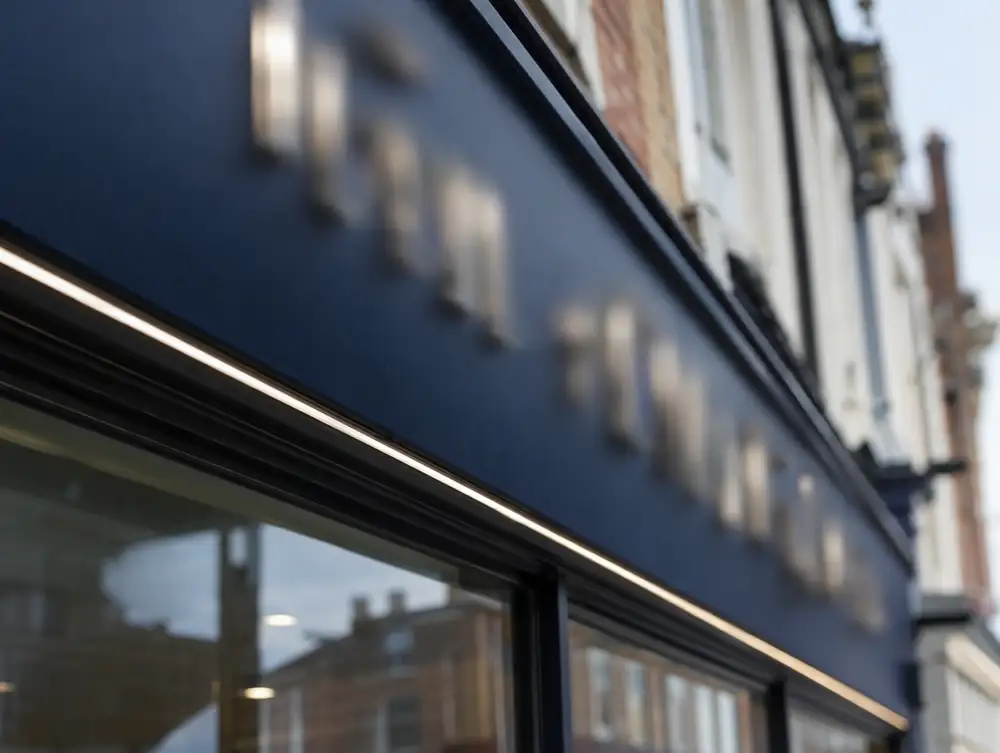
How would we approach fascia signage for your Sittingbourne premises?
Where the fascia on your Sittingbourne premises has been overclad, we lift a sample at survey to see what is underneath. Original timber, cornice mouldings or tile may be worth keeping, and they change what the new sign should be.
If your Sittingbourne unit sits in a parade of similar shops, we would look at the fascia line on either side before setting your sign height. Holding that line usually looks more confident than trying to outgrow it.
If your premises were once two shops, decide early whether the front should read as one or as two. One continuous fascia with a repeated bay width usually settles the elevation better than two mismatched halves, which is worth testing on any Sittingbourne unit of that kind.
What should you budget for fascia signage in Sittingbourne?
A sensible starting budget is £395 to £1,995 plus VAT per sign. What shifts the figure is whatever can't be seen yet, such as the condition behind the old frontage or the services running through it.
What consents could affect fascia signage in Sittingbourne?
A true like-for-like replacement usually needs no planning permission in England, because the external appearance isn't materially affected. New materials, a different glass line or altered proportions usually do count as material, so for fascia signage at premises in the Sittingbourne area, an application is then likely. The council confirms which side of that line a job falls on.
A lit projecting sign at premises in the Sittingbourne area has firm limits under Class 4B in England: 0.75m² per surface and 1m high. It can project 1m, or two-thirds of the footway if that is less, and it can't sit over the carriageway. A larger sign needs advertisement consent, and so does a lit one in a conservation area.
For Sittingbourne, the usual route for planning and advert applications is through Swale Borough Council, and we confirm that when we visit.
| Town | Sittingbourne |
|---|---|
| Area | Kent |
| Postcode districts | ME10, ME12, ME9 |
| Planning authority | Swale Borough Council |
| Building approval | Building Regulations (Approved Documents) |
| Distance from Great Barr | About 140 miles |
| Survey | Free for new work |
Questions about fascia signage in Sittingbourne
What if the fascia behind my old sign in Sittingbourne is rotten?
We show you photographs and price the repair before going further. A short section of timber can often be spliced in, while a badly decayed fascia is better replaced with a new subframe.
Can a fascia sign in Sittingbourne be lit later on?
Yes, if the sign is planned for it. Built-up letters can take halo lighting when the panel and cable route are prepared at the start, which costs far less than adapting them afterwards.
Will you remove the old sign from my Sittingbourne premises?
Yes. Taking down the old sign, clearing old fixings and making good are included in the itemised quotation. We tell you what we find behind it before going further.
What rules apply to a fire exit door through a shopfront in the Sittingbourne area?
It must open in the direction of escape and can't be locked against immediate use, and a dedicated fire exit can't be a sliding or revolving door. In England that comes from article 14(2) of the Regulatory Reform (Fire Safety) Order 2005, and the duty sits with the responsible person, normally the employer or whoever controls the premises for a business, otherwise the owner. An outward door can clash with section 153 of the Highways Act 1980 where it opens onto the footway, so raise it early.
Does a new shopfront in the Sittingbourne area need Building Regulations approval?
Assume yes until building control says otherwise. England has no like-for-like exemption, though registered installers can self-certify replacement windows and doors in non-dwellings. That route doesn't cover structural glass, curtain walling or revolving doors.