Built-up letters, flat-cut metal or hand-painted timber can each work on fascias in Gelligaer, depending on the frontage and the brand. A scale drawing of the sign on your elevation makes the choice easy to judge.
Please have keys to any meter cupboards and shutter housings to hand when we survey in Gelligaer, because what sits behind them can change the drawing.
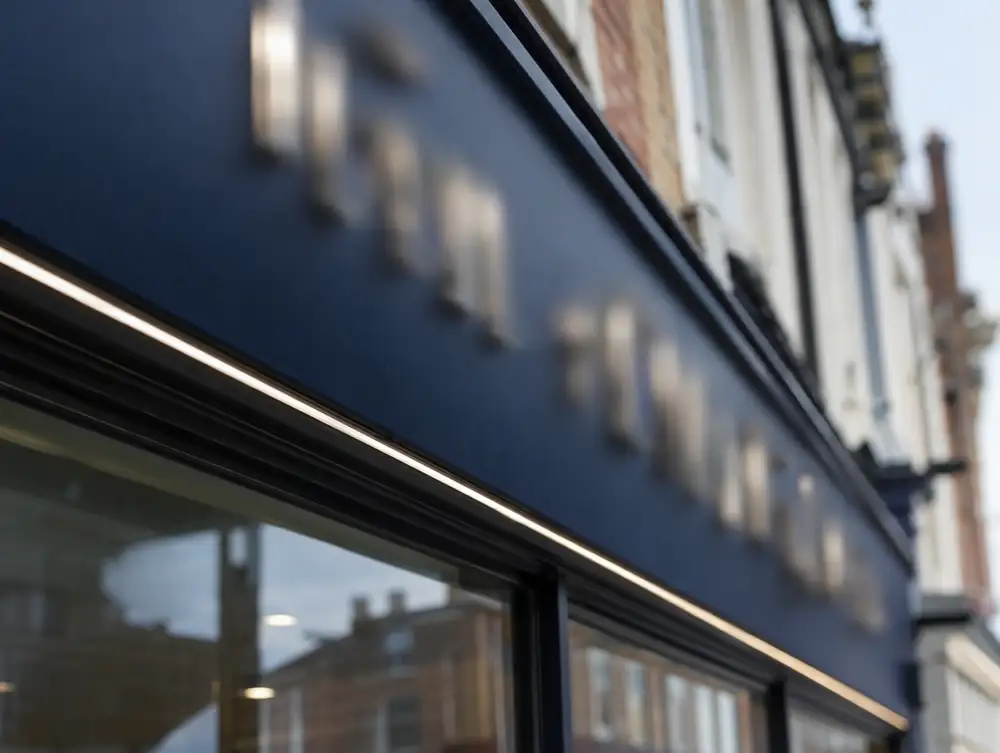
What should you think about before commissioning fascia signage in Gelligaer?
Where a shutter box sits above the window, the sign has to be designed around it. We either house the box behind the fascia or adjust the panel, so nothing sits awkwardly proud of the frontage.
For brands with strict guidelines, we turn logo artwork into cut files and check the smallest details at full size. If a thin stroke will not survive in metal, we suggest a small change before anything is made.
A corner unit has two fronts to think about, and the return elevation often does as much selling as the main one. If that is your layout in Gelligaer, carry the fascia and glass line round the corner and treat both faces as one composition.
What is a realistic budget for fascia signage in Gelligaer?
We would budget £395 to £1,995 plus VAT per sign. Scope sets most of the figure, so a clear brief at the start does more for the budget than any later change of detail.
Who approves fascia signage in Gelligaer?
Going by Part 42 of the 1995 Order as inserted in 2014, Wales has no permitted development route for changing a shopfront. The right covers A1 and A2 premises, but it excludes creating, altering or replacing a shopfront, or fitting or replacing a security grill or shutter on one, and it doesn't apply on Article 1(5) land. For fascia signage at premises in the Gelligaer area, that leaves a planning application, or work that leaves the appearance materially unchanged.
Signs in Wales still come under the 1992 Advertisement Regulations, with the classes set out in Schedule 3. At premises in the Gelligaer area, an unlit fascia sign generally needs no application under Class 5 if it sits on a wall containing a shop window and tops out at 4.6m or the first-floor sill if that is lower. Ask the council about letter sizes, and bear in mind that displaying a sign without consent is a criminal offence.
Planning and advert applications for Gelligaer premises normally go to Caerphilly County Borough Council. We check the position for your address at survey.
| Town | Gelligaer |
|---|---|
| Area | Gwent |
| Postcode districts | CF82 |
| Planning authority | Caerphilly County Borough Council |
| Building approval | Building Regulations (Approved Documents for Wales) |
| Distance from Great Barr | About 84 miles |
| Survey | Free for new work |
Questions about fascia signage in Gelligaer
Can a fascia sign in Gelligaer be lit later on?
Yes, if the sign is planned for it. Built-up letters can take halo lighting when the panel and cable route are prepared at the start, which costs far less than adapting them afterwards.
What artwork do you need for a sign in Gelligaer?
Vector files such as AI, EPS or PDF are ideal, along with any brand guidelines. If you only have a low-resolution logo, it can be redrawn, and that time is shown on the quotation.
Can a new fascia sign in Gelligaer be fitted on a closed day?
Yes, we can arrange that, or fit out of hours if that suits you better. Most fascia signs take about a day, so the work can often go into your quietest trading hours.
Is planning permission needed for a new shopfront in the Gelligaer area?
Usually yes, if the work materially affects the external appearance, because Wales has no permitted development route for changing a shopfront. Most of the Planning (Wales) Act 2026 hasn't been commenced yet, so the existing rules apply. A true like-for-like replacement usually avoids an application, and the council confirms the position.
Can a shop fire exit in the Gelligaer area use a sliding door?
No, a dedicated fire exit can't be a sliding or revolving door. In Wales, article 14(2) of the Regulatory Reform (Fire Safety) Order 2005 also says fire exit doors must open in the direction of escape and can't be locked against immediate use. The responsible person holds that duty, normally the employer or whoever controls the premises for a business, otherwise the owner.