Fascia signs for Lancing premises start with the building, because the frontage has already set the depth and position of the sign band. We measure it, draw your name to scale and show you the result before anything is cut.
Surveys for Lancing are booked with you directly. Tell us your quieter days and we'll work around them.
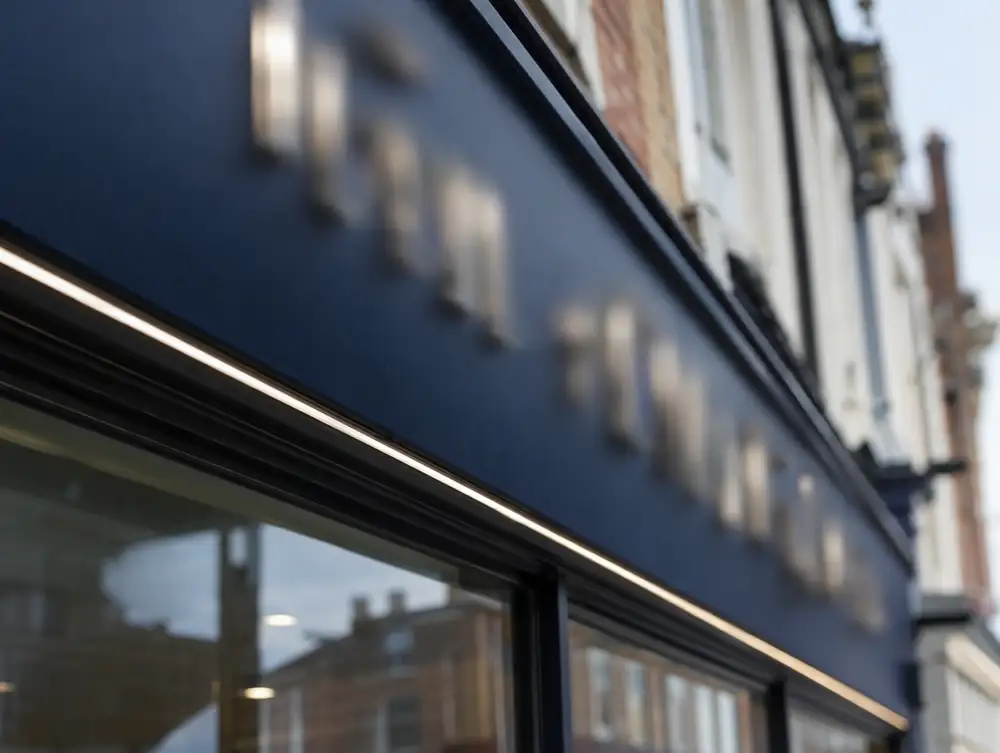
How would we approach fascia signage for your Lancing premises?
If your Lancing unit sits in a parade of similar shops, we would look at the fascia line on either side before setting your sign height. Holding that line usually looks more confident than trying to outgrow it.
For brands with strict guidelines, we turn logo artwork into cut files and check the smallest details at full size. If a thin stroke will not survive in metal, we suggest a small change before anything is made.
If your Lancing unit sits in a Victorian parade, the old pilasters usually set the rhythm, so a new front should land on them and not run past them. Keep that line and even a modern frame looks as though it belongs.
What should you budget for fascia signage in Lancing?
Until the survey is done, plan on £395 to £1,995 plus VAT per sign. Unusual sizes, fine detail and phased working push the figure up, while a simple brief and clear access keep it toward the lower end.
What consents could affect fascia signage in Lancing?
For fascia signage at premises in the Lancing area, the deciding question in England is whether the building work materially affects the external appearance. If it does, planning permission is needed, while a true like-for-like replacement usually needs none. The council confirms the position for each site.
Class 4B, England's class for lit signs, isn't available in conservation areas, Areas of Outstanding Natural Beauty, National Parks or the Broads, so a lit sign there normally needs advertisement consent. In an area of special control it is unavailable too, and Class 5 drops to a 3.6m top height, 0.3m letters and one-tenth of the building face up to 3.6m. Ask the council which designations cover premises in the Lancing area.
At survey we check how things stand for your building, although applications for planning permission or advertisement consent here normally go to Adur District Council.
| Town | Lancing |
|---|---|
| Area | West Sussex |
| Postcode districts | BN15 |
| Planning authority | Adur District Council |
| Building approval | Building Regulations (Approved Documents) |
| Distance from Great Barr | About 137 miles |
| Survey | Free for new work |
Questions about fascia signage in Lancing
Can a fascia sign in Lancing be lit later on?
Yes, if the sign is planned for it. Built-up letters can take halo lighting when the panel and cable route are prepared at the start, which costs far less than adapting them afterwards.
What if the fascia behind my old sign in Lancing is rotten?
We show you photographs and price the repair before going further. A short section of timber can often be spliced in, while a badly decayed fascia is better replaced with a new subframe.
Can a sign match my other sites in West Sussex?
Yes. Send a photograph and the drawings or brand file from an existing site, and we match the letter style, finish and colour reference. Fascia depth may differ, so the size is adjusted to keep the proportions right.
What rules apply to a fire exit door through a shopfront in the Lancing area?
It must open in the direction of escape and can't be locked against immediate use, and a dedicated fire exit can't be a sliding or revolving door. In England that comes from article 14(2) of the Regulatory Reform (Fire Safety) Order 2005, and the duty sits with the responsible person, normally the employer or whoever controls the premises for a business, otherwise the owner. An outward door can clash with section 153 of the Highways Act 1980 where it opens onto the footway, so raise it early.
Do I need listed building consent for a shopfront in the Lancing area?
Usually yes, if the building is listed. In England the local planning authority decides, and Historic England is notified of Grade I and II* works and specified Grade II works. Like-for-like repair may not need consent, so ask the council before work starts.