Fascia signs for Lowestoft premises start with the building, because the frontage has already set the depth and position of the sign band. We measure it, draw your name to scale and show you the result before anything is cut.
Nothing gets ordered off the back of a survey in Lowestoft, because its job is to give us the numbers to draw and price from.
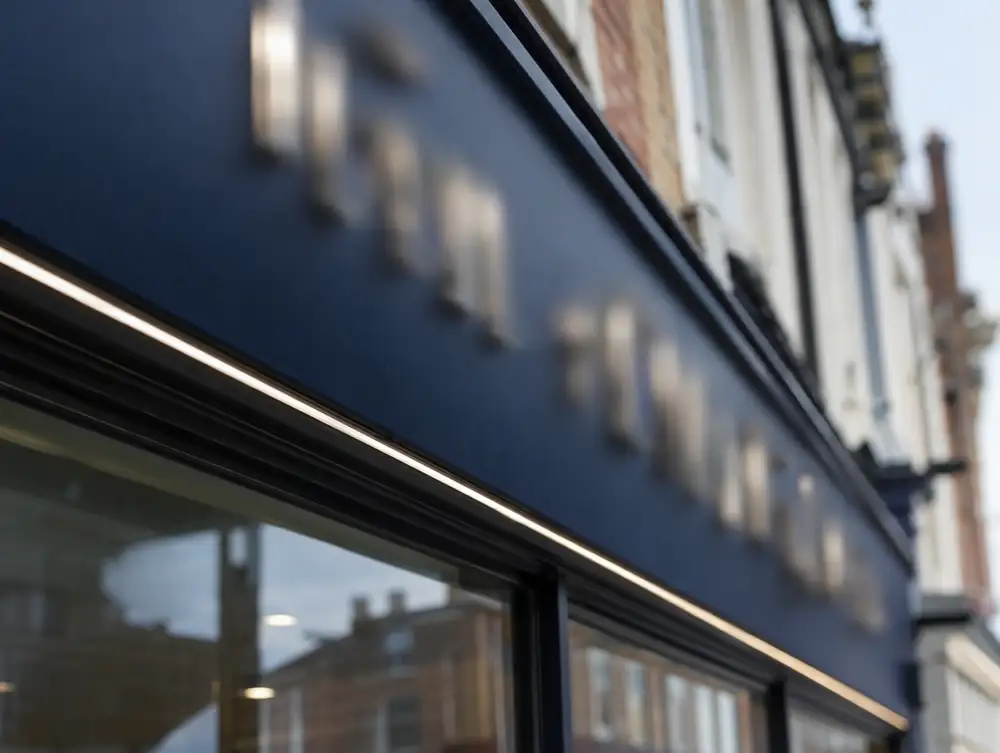
How would we approach fascia signage for your Lowestoft premises?
On a corner plot, the sign has to turn the corner cleanly. We set letter size and panel joints so the name reads from both streets, with the return falling at a natural break.
Where a shutter box sits above the window, the sign has to be designed around it. We either house the box behind the fascia or adjust the panel, so nothing sits awkwardly proud of the frontage.
If there are storeys above the shop, the frontage should feel like the base of the building and not a sign stuck on it. Lining up mullions with the windows overhead is a small move that settles the whole elevation at Lowestoft premises.
What consents could affect fascia signage in Lowestoft?
For fascia signage at premises in the Lowestoft area, the deciding question in England is whether the building work materially affects the external appearance. If it does, planning permission is needed, while a true like-for-like replacement usually needs none. The council confirms the position for each site.
Lighting moves a sign out of Class 5 in England, because that class allows illumination only for medical-type notices. Class 4B then applies at premises in the Lowestoft area: halo or character-only lighting, static, with the lowest part at least 2.5m up. Brightness is capped at 600 cd/m² on signs up to 10m² and 300 cd/m² above that, and anything outside these limits needs advertisement consent.
Lowestoft applications for planning permission or advertisement consent are normally handled by East Suffolk Council. Our survey includes a check of the position for your address.
What should you budget for fascia signage in Lowestoft?
The guide for fascia signage is £395 to £1,995 plus VAT per sign. Expect the lower end for simple work with clear access, and the upper end where detail, finish or awkward conditions add hours.
| Town | Lowestoft |
|---|---|
| Area | Suffolk |
| Postcode districts | NR32, NR33 |
| Planning authority | East Suffolk Council |
| Building approval | Building Regulations (Approved Documents) |
| Distance from Great Barr | About 154 miles |
| Survey | Free for new work |
Questions about fascia signage in Lowestoft
Can a fascia sign in Lowestoft be lit later on?
Yes, if the sign is planned for it. Built-up letters can take halo lighting when the panel and cable route are prepared at the start, which costs far less than adapting them afterwards.
What artwork do you need for a sign in Lowestoft?
Vector files such as AI, EPS or PDF are ideal, along with any brand guidelines. If you only have a low-resolution logo, it can be redrawn, and that time is shown on the quotation.
How quickly can I see a drawing for my Lowestoft sign?
Drawings typically follow within one to two weeks of the survey, depending on the artwork and how many options you want to see. Your named contact will give you a date once the survey is booked.
Does a new shopfront in the Lowestoft area need Building Regulations approval?
Assume yes until building control says otherwise. England has no like-for-like exemption, though registered installers can self-certify replacement windows and doors in non-dwellings. That route doesn't cover structural glass, curtain walling or revolving doors.
What rules apply to a fire exit door through a shopfront in the Lowestoft area?
It must open in the direction of escape and can't be locked against immediate use, and a dedicated fire exit can't be a sliding or revolving door. In England that comes from article 14(2) of the Regulatory Reform (Fire Safety) Order 2005, and the duty sits with the responsible person, normally the employer or whoever controls the premises for a business, otherwise the owner. An outward door can clash with section 153 of the Highways Act 1980 where it opens onto the footway, so raise it early.